

Rapid Refund
Jump the queue, get 50% paid upfront
Average Claim £3,000
We'll tell you straight away what you're owed

Free to enquire
It's free to find out if you have a claim
No Hidden Costs
All aftercare is included
We've collected the answers to the most common questions we get here. If your question isn't answered, or if you just prefer to talk to a real person right away, you can give us ring, use the Live Chat here on our site, join us on Facebook or send us a message for help.
No – we’ll contact you directly to confirm your prize and payment.
To help us meet AML requirements, we kindly ask you to provide the following documents:
Proof of identity:
A valid government-issued photo ID, such as:
Proof of address:
A valid document that evidences your current residential address, such as:
This must be different to the Proof of Identity provided.
If you’ve got a purchased life annuity, you’ll usually be taxed on it at the normal rate. If your income is below your tax-free Personal Allowance, you’ll be able to claim that tax back. Alternatively, you could ask for your annuity to be paid out without tax taken off.
To claim back the tax you’re owed, you’ll need a form R40 for every year you’ve overpaid. As always, there’s a hard limit of 4-years to get back what you’re owed.
If you want your annuity paid tax-free instead, you’ll send form R89 to your provider, or form R86 for joint annuities. Either way, keep in mind that you’ll have to alert the provider if your income ever goes up. If you start bringing in more than your Personal Allowance, you’ll owe some tax on it.
For pension annuities, you should get a P800 letter from HMRC if you’re owed any tax back. If you don’t get one and think you’re owed money, talk to HMRC.
Most likely, yes. The amounts you receive don’t normally cover everything you’re entitled to.
It is important to know that we deduct HDT or GYH allowances from any claim we make as both are paid non-taxed.
Use our Tax Refund Calculator to find out if you are owed anything from HMRC
If you live in married quarters, on or off base, and spend your leave periods there, it would normally be classed as your main residence. The claim in this case would be for any costs for travel between your married quarters and any temporary postings of up to 24 months.
If you already receive a Home to Duty (HDT) allowance for this already, we will review the amounts received against the allowable limits and claim for any shortfall.
Use our Tax Calculator to see if you are owed a refund from HMRC.
If you live on base part of the time but go home to another address for weekends or longer periods of leave, the leave address would be classed as your main residence.
A tax refund claim in this case would be for travel between your home address and your workplace.
If you already receive a Get You Home Travel (GYH) allowance for this, we will review the amounts received against the allowable limits and claim for any shortfall.
Use our Tax Calculator to find out if you are due a refund.
Yes this is very important as we need to have documentary evidence to support your claim.
Please ensure you keep a copy of each of your Assignment Orders for each base that you have traveled to. You can print these from JPA but please note these are deleted after 60 days.
See our checklist of the documents you will need to make a claim. We can help you get copies of anything you are missing if needed.
It will depend on the type of training.
HMRC has strict rules about what is classed as an allowable expense around training. If it was an essential part of your contractual duties of employment then we might be able to claim for the traveling expense or mileage.
You will need to have completed your phase one training to make a claim.
Even if you not due a refund this year remember that you can claim for the past 4 tax years so use our tax calculator to find out if you are owed anything.
To get a tax refund, HMRC says you need to be travelling to temporary workplaces. Reservists and Territorial Army personnel tend to spend most of their service in one place, which wouldn't qualify and is an example of when you wouldn't be able to claim an MOD tax refund.
That said, your circumstances might be different from most. Get in touch if you want us to look into it for you. It costs you nothing to find out where you stand.
Use our tax calculator to see if you are due a refund
Find out if you need to complete a Self Assessment Tax Return or if you can claim Flat Rate Expenses.
Yes. You are legally entitled to reclaim 24p per mile, which is the difference between the HMRC allowed rate of £0.45 per mile* and the MOD £0.21 per mile tax exempt allowance. To claim this, you must be on temporary duty. This is defined by the relevant HMRC legislation, not by MOD policy.
HMRC mileage refunds explained
Ask RIFT about your specific circumstances if you are still unclear.
*HMRC EIM32080 Travel expenses: travel for necessary attendance: temporary workplace: limited duration, the 24 month rule.
Despite what some people are saying, MOD personnel really can get UK tax refunds. RIFT Refunds always knew this was true and we fought hard to get the proof. You can read the MOD letter to us and feel assured that this is something that can be legitimately claimed for.
Tax refunds for travel can be claimed, as confirmed in DIN ‘2015DIN01-005’ which has been issued to all service personnel to officially confirm this.
There has been a lot of confusion around tax refunds that RIFT has worked hard to clear up with both the MOD and HMRC.
Different interpretations of what is meant by ‘a temporary posting’ have caused this confusion. Some believed that individuals who claimed a tax refund on HDT were doing so in breach of HMRC rules. RIFT can categorically confirm that none of these potential situations can arise and this is confirmed by the MOD.
Some also thought that making any claim for a tax refund may mean the individual may have to repay rebated money in the future. Others also thought claiming a refund would jeopardise the whole tax exemption of the MOD HDT allowance, disadvantaging many service personnel.
Others were worried about changes to tax codes. Your tax code should not change due to a refund claim but any problems with your tax code are covered in our aftercare service which means we will get any errors fixed for you at no extra charge. Read more about tax codes and how to check if yours is correct.
DIN ‘2015DIN01-005’ has been issued to all service personnel to officially confirm that tax refunds for travel are claimable.
It also states that you can use an agent to make a claim for you. RIFT will act as your agent, providing an end to end service if you don’t have the time or are not comfortable dealing with the technical legislation set out by HMRC.
This supports the previous formal confirmation we received from the Ministry of Defence.
Just like anyone else, you're entitled to a UK tax refund for travel expenses to and from temporary workplaces. If you're making your own way from a UK residence, you could have a pretty big refund on your hands. Watch out, though - if your family has moved abroad with you, then your main residence might be outside the UK. In that case, you can't claim for your travel costs.
Find out everything you need to know about paying UK tax if you work overseas or get in touch.
Yes, if this is classed as your main residence.
The legislation for tax refund claims is based on costs for travel expenses on to temporary postings of under 24 months, even outside the UK, using either your own vehicle or public transport counts.
If you're in the Armed Forces and making your own way to more than one base, you can claim any overpaid tax on the cost of that travel for the last 4 years, and the RIFT average 4 year rebate is £2,500.
HMRC takes a big enough bite out of your pay already. Don't let them hold onto cash that's supposed to be in your pocket. Use our tax calculator to find out if you are owed anything back.
No, laundry costs are included in your annual personal allowance (i.e. the amount you can earn tax-free each year). This will be recorded in your tax code.
You may be able to claim if you have the receipt and it is in the last four tax years as it is a work related expense.
Use our tax calculator to find out if you are due a refund.
Yes, the cost of flying varies considerably so we need evidence of your actual expenses for HMRC. We can only claim for the actual flights you made, not the cost of any flights between two destinations.
Have a look at our checklist of the documents or paperwork we'll need for your claim.
You can download all your wage slips from the JPAC website.
Under HMRC legislation a posting that is more than 24 months is deemed permanent and therefore the temporary workplace rules don’t apply. However, we would review every case in isolation as we would need to understand your expectation at the outset of your posting.
As you can claim for the previous 4 years even if you have been at your current base for over 24 months you may be able to claim for previous postings.
Use our Tax Calculator to work out if you are due a refund.
We need the following information to assess your MOD tax refund and then hopefully process your claim:
See our full document checklist and what to do if you are missing anything.
Other information – We’ll ask you a few simple questions about your financial circumstances e.g. if you have any other sources of income such as rental income, whether you have a student loan or a private pension that may affect your claim, your tax code or mean that you need to submit a self assessment tax return.
The MOD accommodation rules may also have an impact so we will need to understand your living arrangements. This helps us calculate the value of tax you’ve overpaid.
Use our Tax Calculator to find out if you are due money back.
Armed Forces uniform tax rebates are handled differently from most other professions. Generally speaking, your uniform maintenance costs are handled through your tax code. Basically, your tax-free Personal Allowance gets ratcheted up a few notches to make up for what you're shelling out.
Getting a specialist to do your tax return and refund means a load off. Any high street accountant will be expert at filling in tax returns. They may also offer you a guarantee that they’ll look after and take care of any queries, though this may be an extra cost.
As part of our Tax Refunds Service, we can complete your return AND we offer a full year’s aftercare.
Yes, no matter why you're leaving your job, you should get a P45.
Let’s start with your simple, beginner-level options for making money from home. They won’t get you rich quick, but they also don’t need any special skills.
Pick up people’s dry cleaning, mow their lawn. These kinds of odd jobs have been around for ages. But it’s now a digital marketplace - sites like TaskRabbit connect people who need odd jobs doing, with the people who are happy to do them. Some of this will require leaving the house - like picking up dry cleaning. But equally, it could be helping people with digital tasks - like helping write emails or making them a spreadsheet. So go check it out!
We’re not talking about life-changing money here but some companies will reward you for filling out surveys. It is that simple - give your opinion, get paid! You won’t even need a laptop for this one - you can easily do it on your phone.
Some people want their pets looked after in their own homes. But others will be happy to drop them at your place. There are a few well-known companies who’ll let you sign up online and then connect you digitally with pet owners - so get Googling!
If you’re just looking for some short-term funds, auction sites are a great place to start. Getting some unused items up for auction will also help you declutter your life, as well as giving you a short-term cash injection.
A lot of people like the idea of being their own boss, but don’t want to risk being self-employed as their only source of income. That’s how a lot of small businesses get their start, as second jobs for people who wok on the books elsewhere. This can be a great idea if you’re cut out for it, but you do need to keep your tax situation under control.
When you’re self-employed, even as a second job, you’ll need to get cosy with the taxman. That means registering yourself with HMRC as self-employed, getting set up for the Self Assessment system and filing yearly tax returns to report all your earnings, expenses and other key details.
Self Assessment comes with some specific dates and deadlines to hit, the most important of which is the 31st of January. Every year, this will be your deadline for filing your tax return paperwork, along with paying up what you owe.
The other thing to know before setting yourself up as self-employed is that your National Insurance Contributions (NICs) wont’ magically take care of themselves any more either. You’ll have to pay what you owe for these when you settle up with the taxman each year.
The basic paperwork for your self-employed job will be a little different from your on-the-books work, too. You won’t have a regular payslip sent to you, for one thing. That means you’ll have to keep a tight set of records covering all the money flowing into and out of your business. Self Assessment tax returns are a huge topic in themselves, so make sure you have a good understanding of what’s involved before diving in.
So, are you an on-the-books employee with a self-employed side gig or a small business owner who moonlights PAYE for someone else? Generally, it’s probably best to class your “main job” as the one that brings in the most money. Either way, you’ll be paying a year in arrears for your self-employed work. That means, for example, that the profits your self-employed business made in 2021/22 will factor into the eventual tax bill you’ll pay up by the 31st of January 2023. This is something that trips up a lot of people when they’re new to Self Assessment. Instead of the tax trickling out of your pay each month through the PAYE system, your self-employment tax for the entire year will all fall due in a big lump. Tax years run from the 6th of April to the 5th of the following April, though, so you’ll know 9 months ahead what you’ll have to cough up.
We all wish we could take home our entire salary. Unfortunately, that’s not the case. When working out your budget, it’s important to use your income after all deductions are taken out. That includes tax, national insurance, and pension contributions.
If you used your pre-tax salary, you’d end up with a number much larger than what actually goes into your bank account. That may look great on your spreadsheet, but it could lead to spending more money than you have.
The best way to look at your income is to add up all of the amounts on your payslips and divide it by the number of months they’re from. This way you’ll get an average that you can expect to take home each month.
For those with big differences in their pay, you may want to be a bit more cautious as some months may fall short of this figure. You might be best trying to save additional money from the higher paying months, so that you can make up the rest on the lower-paid months.
Yes! There are lots of everyday work expenses that entitle you to tax relief, but so many people just don't realise they qualify. Small tools from hairdressing scissors to masonry drills can count for a rebate claim, as can any required licences or professional subscriptions. This is a huge and often misunderstood area of tax law.
One of the biggest tax rebate issues is travel to temporary workplaces, but anything from visas to vaccinations can count. Understanding what you can claim for (and, just as importantly, what you can’t) is the key to maximising your tax refund claims while staying on HMRC’s good side.
Tax rebates are a really tricky area, which is why so many people decide to get professional help with them. The basic idea is that when you have to spend money to do your work, some of your costs can be used to bring down your tax bill. That said, the regulations are complicated, and you can get into serious trouble if you mess up. Not claiming back everything you’re owed is painful enough. Claiming too much is a whole lot worse once HMRC catches on.
There are a lot of reasons why you might be owed some tax back, but the main one is generally work expenses. Travel to temporary workplaces, repair and replacement of any essential gear and a whole range of other everyday costs can build up into a decent tax refund claim.
When HMRC works out the tax you owe, it assumes you’re working regularly throughout the year. If you’re a student doing casual or short-term work, though, you could end up paying too much tax. Basically, a holiday job could see you only being paid for a couple of months, but charged a whole year’s worth of tax. Worse yet, you’re probably still under your Personal Allowance for the year, so you shouldn’t have been taxed at all!
Luckily, whatever the reason you’ve paid too much, you can claim a tax rebate to settle up. You can generally check your tax and claim your refund online - but again, a lot of people prefer to get professional help. Claiming refunds properly means keeping track of a lot of paperwork, from the official documents you get from your employer to receipts and invoices for your expenses. You can find the official tax checker here: https://www.gov.uk/check-income-tax and the refund tool here: https://www.gov.uk/claim-tax-refund.
Like a lot of UK taxes, there’s a threshold you have to hit before you start owing anything on your capital gains. For the 2024/25 tax year, for instance, there’s a tax-free allowance of £3,000, or £1,500 for trusts. If your overall profit from disposing of assets ends up below this amount, you won’t pay any Capital Gains Tax on it.
If you’re married or in a civil partnership, then the rules for Capital Gains Tax have a little flexibility in them. In fact, unless you were separated and not living together at all during a tax year, you won’t pay any Capital Gains Tax if you “dispose of” an asset to them. At least, not unless you did it so their business could then sell it on.
Watch out, though – your spouse or civil partner could easily still get hit with Capital Gains Tax if they later dispose of the asset. If that happens, the rules work in the usual way. They’ll pay tax if they sell the asset, swap it, give it away or claim compensation for it. In this case, the profit they pay tax on will be based on the amount you originally paid for the asset, compared to the value they dispose of it for.
There’s another general exemption for Capital Gains Tax on items you give to charities. However, a wrinkle in the rules means that you could still have to pay CGT if you sell the item for less than its market value (but still make a profit compared to what you paid for it). Again, talk to a trusted professional if you’re not 100% sure whether you need to pay Capital Gains Tax or not.
Whatever kind of work they do, pretty much everyone dreams of being their own boss sometimes. Whether that means building an empire, or just putting one brick on top of another, it's about independence and freedom.
Right now in construction, we've got close to 100,000 self-employed workers. With almost 40,000 of those appearing in the last year, the government's actually kind of worried about it. In fact, they've been clamping down on certain kinds of self-employment with new rules and regulations.
What they're mostly bothered about is what they call "false self-employment". Basically, some firms were working a tax dodge by treating their employees as subcontractors when they really weren't. It was bad for HMRC, and worse for the workers. As well as ducking taxes, some of these "intermediaries" were avoiding responsibilities like employment rights and holiday pay.
The government's been cracking down on false self-employment in construction, but honestly they're flailing around a bit about it. That's lead to a bit of confusion.
There's good and bad about self-employment, obviously. You get some freedom and flexibility you might not otherwise have, that's true. You've also got a load of new responsibilities, too. You need to file your own Self Assessment tax returns, for one thing. Also, you can say goodbye to job security, sick pay and your workplace pension. It's a swings-and-roundabouts thing.
Read our guide to CIS and Self-Assessment
Another consideration is that working for yourself can easily turn into working for nobody. There's always competition out there, and you really need to promote yourself to get work. You can't count on clients to magically trust you - or even to know you exist!
Along with the challenge, though, there's always opportunity. Experts are warning the construction industry's facing a "skills time bomb". There just aren't enough highly skilled workers coming up through apprenticeships and training schemes. Demand's booming, but we're running out of workers. You might well find that a specialised skill you have is the ticket to a whole new corner of the market.
If you're already self-employed, or looking to go that route, get in touch with RIFT. We're experts in construction and know the terrain like no one else. From tax refunds to Self Assessment returns, we're here to help you build your dream job.
Once you've set your Marriage Allowance up, you don't need to apply again unless your situation changes. Obviously, getting divorced means you can no longer make a Marriage Allowance claim, for example. The death of either partner will do the same, naturally enough. You can even cancel it yourself if you need to for any reason.
Since there are income thresholds involved, a change in either your earnings or your partner’s can also affect your Marriage Allowance claim. For example, if you suddenly start making more than your Personal Allowance, you won’t have any extra to transfer to your spouse or partner. In the same way, if you find yourself bumped into a higher tax bracket, you no longer qualify to receive Marriage Allowance at all. When something changes in your circumstances and you’re not sure if you still qualify for (or benefit from) the Marriage Allowance scheme, talk to RIFT tax refunds to keep yourself on the right track.
Yes, you can claim your tax rebate online by logging into the gov.uk site with your Government Gateway User ID and password. If you don’t already have one of these, you can set one up, which should only take a few minutes if you’ve got your National Insurance number and a recent payslip, a P60 or a valid UK passport to hand.
You’ll need to show HMRC some proof of all the work expenses you’re claiming a tax refund for. You’ll also need a few bits of crucial information, like details of the places you’ve worked in the years you’re claiming for. There are a lot of complicated rules about which kinds of expenses can earn you a tax refund, so talk to RIFT if you’re not 100% sure where you stand.
The taxman likes to be kept up to date on any income you’re earning, but he’s not some crazed stalker prying into every aspect of your private life. Gifts from your parents or friends, student loans and grants don’t count as taxable income in HMRC’s eyes. The same goes for bursaries, scholarships and so on.
Yes. If you’re renting out a room while you’re studying, then the taxman will want his bite of it. As always, any Personal Allowance you’re entitled to applies. You’ll probably end up filing Self Assessment tax returns to account for the income. However, depending on what you’re renting out, you might be able to use the Rent a Room scheme. Under Rent a Room, you can earn up to £7,500 tax-free a year from renting out furnished accommodation in your main home. Rent a Room is simpler for most people than working out their expenses in their tax returns. As long as you qualify for it, it can be a decent way to score some extra income.
Visit our guide to tax on rental income.
Apprenticeships are a lot like training contracts, in that you’re working primarily to learn a trade or set of skills. However, apprenticeships are paid positions. That means you’ll be taxed through the PAYE system. Depending on how long your apprenticeship lasts, you might find yourself claiming back some PAYE tax from HMRC (if it’s less than a full year, for instance). Also, unless your employer’s paying or reimbursing all your expenses (travel to temporary workplaces, tool/equipment repair, and so on), you might be owed some tax back for those, too.
If your student job’s the first toe you’ve dipped into the taxman’s world, there’s a potentially nasty trap you need to watch out for. If HMRC doesn’t have enough information to issue you a PAYE tax code, your employer might lump you with an emergency one such as 500 0t or X. In practice, it’s not really as bad as it sounds. It just means you’ll only be entitled to your basic Personal Allowance. For most people, that’s all they’d probably get anyway. However, an emergency code is bad news if you ought to be getting any allowances or tax reliefs - like the Blind Person’s Allowance, just to pick an example.
Tax breaks are another term for tax relief. HMRC has various systems in place to help people and businesses bring down the tax they're paying under certain circumstances. For example, when you're reaching into your own pocket for things like travel to temporary workplaces, you can claim back some tax on your mileage expenses. Everything from individuals washing their work uniforms to businesses conducting cutting-edge R&D can qualify for some kind of tax relief. The key to getting the best from these systems is to know exactly what you qualify for, and how to claim it back.
If you're self-employed and paid through the Construction Industry Scheme (CIS), you're probably due a tax refund.
You can also claim back a range of job-related expenses, including travel, meals, lodging, parking, tolls, tools, protective clothing, public liability insurance, phone bills, postage and stationery.
We’ll assess all your expenses and include them if they qualify. That way you'll be certain that everything on your claim is a genuinely allowable expense and you won't find HMRC knocking on your door asking for their money back. If you're a RIFT customer, you'll be covered by our RIFT Guarantee as well, so you've got even more peace of mind.
Sadly there are a number of unscrupulous tax refund advisors taking advantage of CIS workers at the moment.
If you want to see how much you could be due back from HMRC use our CIS Tax Calculator and find out in seconds.
Find out more about the Construction Industry Scheme (CIS) and how to register if you need to.
Read our guide to CIS and Self-Assessment
Yes it does. All self-employed people, including CIS workers, have to complete a tax return every year. The tax year ends on 5th April and you’ve got until 31st January the following year to send your tax return to HMRC.
Read more about Tax and the Construction Industry Scheme
At RIFT we complete your tax return for you, and claim your tax refund at the same time. Just tell us where you’ve worked, and when, and we’ll work out the cost of your travel. We’ll add any other job-related expenses you may have and fill in the tax forms for you, all you need to do is sign them.
We’ll send the forms to HMRC, handle any questions on your behalf and chase them if they don’t pay out in the agreed timescale – it’s all part of our service.
95% of our CIS customers get a tax refund, and the average value of the refunds is £1,705 per year.
Read our guide to CIS and Self-Assessment
Use our CIS tax calculator to find out how much you could have waiting for you at HMRC.
CIS tax rebates generally take about 4-10 weeks for HMRC to process. RIFT’s CIS refund service includes handling your Self Assessment CIS tax return and full aftercare throughout the year, with no hidden prices. With RIFT, you get the very best from your claim, as fast as possible and with no expensive hourly rates to cough up. One simple fee takes care of everything.
HMRC’s not known for its blistering speed, but there are a few things you can do to keep the wheels turning on your claim:
RIFT’s expert teams will make sure there's no hold-up at HMRC. That means no endless waits on HMRC helplines and no dangerous mistakes creeping into your claim. We'll even chase up old employers if they're dragging their feet in sending the information we need. Once you’re happy with the amount we’ve calculated for your rebate, we’ll chase up HMRC until it’s paid out in full. Meanwhile, we take expert care of you all year round, and we’re never more than an email or phone call away. As always, everything's covered by our RIFT Guarantee. As long as you've given us complete and accurate information, your rebate is protected.
Find out more about the Construction Industry Scheme (CIS) and how to register if you need to.
When you file your own Self Assessment tax returns, it's easy to miss out on CIS claims or make costly mistakes. Under the CIS scheme, your employer takes tax directly from your pay before you get it. This almost always means you're instantly losing 20% to the taxman. As a result, you’ll probably find you’ve been overcharged by HMRC when you file your Self Assessment tax return.
It takes specialist understanding to claim tax back for CIS construction workers. Every year, far too many people are still shelling out tax they don't owe. In the worst-case scenario, they don’t get any CIS tax rebate at all. Even if they do, it’s often nowhere near as much as they deserve.
Yes! All self-employed people, including CIS workers, have to complete a yearly Self Assessment return. The tax year runs until on 5th April, then you've got until the following 31st of January to complete and file your tax return.
Find out more about the Construction Industry Scheme (CIS) and how to register if you need to.
Read our guide to CIS and Self-Assessment
With RIFT, filing and completing your CIS tax return is all part of our tax rebate service. Armed with a list of your workplaces for the year and a few more details, we'll work out the cost of your travel and what you’re owed for it. Next, we'll add any other essential expenses you’ve had and sort out your paperwork.
We'll send the forms to HMRC, handle any questions on your behalf and keep chasing the taxman until your rebate’s paid. 95% of our CIS customers get a tax refund, with an average value of over £1,705 per year.
The taxman really doesn’t like waiting. Miss the filing or payment deadline by a single day and you'll get an immediate £100 penalty. At 2 months late, that fine doubles. At 6 and 12 months late, it reaches £300 (or 5% of the CIS deductions on the return, if that's higher). Any longer and you might face an additional penalty of £3,000, or 100% of the CIS deductions on the return.
Of course, with RIFT on your team, you’ve got nothing to worry about. We’ll keep you in the taxman's good books and make sure you never miss out on your CIS tax claims - even the ones you didn’t know you qualified for!
Find out more about the Construction Industry Scheme (CIS) and how to register if you need to.
You’ll need a few bits of information about yourself to register for the Construction Industry Scheme:
The CIS scheme covers most of the construction work done in the UK. If you’re self-employed in the building trade, you’ll almost certainly have to register for it. Contractors will need to verify their subcontractors, handle their CIS deductions and file monthly CIS returns.
If you’re a subcontractor and don’t sign up for CIS, it doesn’t mean you won’t have the deductions taken from your pay. In fact, you’ll probably actually lose even more of your money, since the rate goes up to 30% for people who aren’t CIS-registered. It’s possible that you qualify for “gross payment” status, where you don’t have to pay CIS deductions. Don’t count on that, though, as there are specific rules and conditions to meet.
One of the problems with CIS is that it's very easy to end up paying too much - and you won't get an automatic refund. To claim your CIS rebate, HMRC demands proof of what you’re owed. This is what RIFT Tax Refunds is all about, so get in touch to see how we can help.
If you are currently working PAYE (on the books) and need to switch to CIS we can help you.
Remember that CIS covers all UK construction work, even if it's done by foreign firms. There are penalties for filing late, so you have to stay on top of the paperwork.
Find out more about the how to register for CIS if you need to.
When you register with the Construction Industry Scheme, you get a card. The kind you’re given depends on your situation:
Find out more about the Construction Industry Scheme (CIS) and how to register if you need to.
For most general contractors in the UK building trade, the CIS scheme's compulsory. It includes everything from site preparation and repairs to decoration and demolition. There are a few exceptions, though. For instance, if you’re a contractor who only deals with very limited sections of the work (like carpet fitting), you may not have to register.
Find out more about the how to register and who needs to.
CIS covers all construction work done in the UK, even when it's done by foreign firms. The registration system is a little different, but all the basic rules are the same. The UK has some ''double taxation'' agreements in place with various other countries to reduce your total tax when you're paying in both countries. Talk to RIFT if you need help working out what it all means for you.
Read our guide to CIS and Self Assessment
The standard Construction Industry Scheme tax deduction is 20%. If that sounds like HMRC's taking a huge lump out of your pay, then it only gets worse if you don’t sign up to the scheme. If you haven’t registered, the rate shoots up to 30%! This can also happen if you don't give your employer your Unique Taxpayer Reference number (UTR). Your UTR is used by HMRC to identify you. If your employers don't have it, the taxman might assume you aren't registered for CIS and charge you the higher rate.
Find out more about the Construction Industry Scheme (CIS) and how to register if you need to.
CIS tax deductions are payments your employer takes out of your wages before you get them. Those payments go straight to HMRC instead of you. They're supposed count as advance payments toward your tax and National Insurance, clamping down on tax evasion in the industry. Unfortunately, one of the side-effects of CIS is that a lot of honest people end up being charged too much tax. At RIFT, our friendly teams of CIS experts can quickly tell you if you're due a tax rebate, then make sure you get it.
Find out more about the Construction Industry Scheme (CIS) and how to register if you need to.
A Construction Industry Scheme Payment and Deduction statement is a record of the money you've been paid and taxed on if you work under the CIS scheme. You might also just call them wage slips, payslips or something similar.
If you're self-employed in construction, they're some of the most important documents you'll ever have. When you file your yearly CIS tax return, you'll need these statements to prove what you've earned and paid. You should get a CIS Payment and Deduction statement from your boss whenever you’re paid, within 14 days of the end of the tax month.
The main thing you'll need your CIS certificates or wage slips for is filing your yearly Self Assessment tax returns. The taxman will expect you to show him a record of all the cash you’ve got coming in. With the CIS taking 20% of your pay before you get it, you’re probably not getting the full benefit of your tax-free Personal Allowance. You’ll be hard-pressed to prove that without your CIS paperwork to back up your claim, though.
Find out more about the Construction Industry Scheme (CIS) and how to register if you need to.
Read our guide to CIS and Self-Assessment
Employment status is a huge issue in construction, and it can get very complicated with so many layers of contractors, subcontractors, agencies and so on. You might think you’re working under exactly the same conditions as your PAYE workmates, but the taxman could well take a different view.
The first thing to do is check your payslips. If they say “CIS statement” and show 20% deductions being made, then you’re being taxed through CIS. If that seems wrong, you need to talk to your employer fast.
The CIS scheme is only for construction, and its rules can catch out even experienced self-employed people from other industries. If you’ve got self-employed mates from outside of construction, be careful taking Self Assessment advice from them. They might not know the territory as well as they think they do. Play it safe and talk to the experts at RIFT instead.
In construction, a contractor is a person or business supplying materials or labour for a job. On the other hand, a subcontractor is anyone who does construction work for a contractor. Basically, according to HMRC, you're a contractor if you pay subcontractors for construction work.
You can also count as a construction contractor if your business doesn't do construction work, but still spends an average of over £1m a year on construction in any 3-year period. Either way, you’ll need to register for CIS and start taking deductions from your subcontractors’ pay.
Find out more about the Construction Industry Scheme (CIS) and how to register if you need to.
Start My Claim
As a contractor, you need to register for CIS before you even take on your first subcontractor. You're going to have a lot of responsibilities under the scheme, so get used to minding the details. Here's what you need to do:
Subcontractor tax refunds can be tricky. It’s easy to miss out on money you’re owed - or even get put off from claiming altogether. Even pricey accountants can find themselves tangled up in the system if they don't know the construction industry well. RIFT Tax Refunds has been specialising in construction rebates since 1999. There really are no safer hands to be in.
Gross payment status means that no CIS deductions get taken out of your pay. There are 3 basic tests to see if you qualify:
Yes, you will pay tax “at source” (your tax is taken off your wages before you get them), most likely at the rate of 20% of your income.
However, this doesn’t mean you are “employed”. You still count self-employed under CIS – even if it doesn’t feel like it. The big difference is that this means you'll still have to do Self Assessment each year. Not filing those tax returns each year brings three very serious problems your way:
If you're getting CIS statements and don't understand why, get in touch with RIFT straight away. We can explain the system, make sure you aren't paying too much tax and keep you out of trouble with HMRC.
Find out more about the Construction Industry Scheme (CIS) and how to register if you need to.
There are strict rules for CIS contractors about payment and deduction statements. They need to send you one every time you're paid, with specific deadlines to hit.
If you haven't been receiving yours, don't panic. It may just be a simple admin mix-up. Get in touch with your contractor and ask for your certificates, so you can keep your Self Assessment records up-to-date.
Don't just ignore the problem. If it turns out your contractor's not been doing things correctly with HMRC, things could get awkward for you in a hurry, come the end of the tax year.
You will need the statements to submit your tax return, read our guide to CIS and Self-Assessment
If you still have no luck, come to RIFT for advice and help. We're experts in sorting out tax problems for UK construction, and we'll get straight to work.
If you're self-employed in any kind of business, you'll almost certainly be using Self Assessment to pay your tax. In the construction industry, you'll probably also have to deal with the Construction Industry Scheme (CIS). Subcontracting under CIS means your Self Assessment filing has a couple of extra points to consider. If you don't understand the system, it's easy to end up paying a lot of extra tax you don't owe. If you think you are due a tax rebate check out our CIS tax refund pages.
Self-employed CIS workers can sometimes pass work on to other people. However, there are strict rules about doing this, and breaking them can lead to serious trouble. HMRC has a real problem with people in CIS work paying cash-in-hand for others to do jobs for them. It doesn't matter if you're passing the work on to friends, colleagues or family. You still have to follow the rules.
Read more about the Construction Industry Scheme (CIS) and how to register if you need to.
The first thing to know is that passing your CIS work on makes you a contractor in HMRC's eyes. That means you have to register yourself to avoid serious trouble from the taxman. You can't just slip someone a fistful of banknotes on the sly and sort things out later. You need get yourself registered before you take on your first subcontractor.
After that, you need to be sure your subcontractors are signed up for CIS. When you pay your subcontractors, you have to take CIS deductions from their pay and send them to the taxman. You'll also need to file returns every month and keep detailed CIS records. If you slip up, or ignore the regulations altogether, you're looking at some painful penalties.
Find out more about the Construction Industry Scheme (CIS) and how to register if you need to.
As long as you're following the rules, then the cash you're paying the people you give the work to counts as an expense. That means it will bring down the amount of profit you're paying tax on. If RIFT is handling your tax returns, of course, we'll handle all of this for you as part of the service.
If you've been passing some of your CIS work on, then you need to have good records to show the taxman. HMRC will expect to see detailed evidence of the wages you've paid out, for instance. In addition, they'll also want to see the details of the people doing the work for you. Names, addresses and their Unique Taxpayer Reference numbers will all be needed. Again, RIFT will handle all the sticky HMRC business for you to keep you within the regulations and out of trouble.
RIFT was first founded to help construction workers tackle the taxman. We've grown a lot since then, but we always remember where we started. We're still the leading experts on taking care of the UK's construction industry. We're on great terms with HMRC, and know the business inside and out. Whatever tax problems or questions you've got, talk to RIFT.
Read more about the Construction Industry Scheme (CIS) and how to register if you need to.
The first thing to understand about healthcare tax refunds is that not every mile you travel or pound you spend will count toward your claim. A daily commute to a permanent workplace, for example, won’t earn you any tax relief. To qualify for a refund, your work travel needs to be to and from what HMRC calls “temporary workplaces”. In practice, this generally means anywhere you work for less than 24 months. So, for example, a nursing job that requires you to travel out to patients’ homes could end up making you eligible for a pretty decent tax refund. Meanwhile, travel expenses can also include some subsistence costs while you're on the move. Things like accommodation and food can all contribute toward your claim.
There are also a few tricky points to consider. If you're travelling to a number of hospitals or clinics within the same general area, with your mileage and travel times not changing much, HMRC might consider the entire region your “permanent workplace”. It's always best to get professional advice in situations like these.
Rotational contracts, where you're working full-time at a series of hospitals over a period of years usually won't qualify. However, if your training takes place under, for example, a single 5-year contract, then things changes. In that case, each hospital you work at will count as temporary because it's a single employment with multiple temporary workplaces. The regulations are easy to trip over here, so it's often a good idea to get professional help.
If you're already getting some of your costs reimbursed by your employer, you may still be owed tax back. HMRC has set rates for Approved Mileage Allowance Payments (AMAP), and if you're not getting the full amount you can claim back the difference. The NHS has its own rates as well, if you're employed by them.
Beyond travel, there are several more ways a job in healthcare can cost you money. If you’re paying out of your own pocket for repair, replacement or even laundry of your work uniform, for instance, you could make a claim for those costs. The same goes for union dues and professional body fees to organisations like the Nursing and Midwifery Council.
The key points to remember are that the costs you’re claiming tax relief for need to be essential to your work, and you need to be paying them yourself. In addition, to get back everything you’re owed you’ll need to show proof of what you’re spending. That means records and receipts – although the simplified Flat Rate Expenses system can offer an easier way if you don’t mind sticking to HMRC’s figures.
If you find yourself buying things like laptops or office equipment for work use, you might have a claim under HMRC’s capital allowances system. This is generally for items that you’ll be using for a couple of years or more – and again, you’ll need to be footing the bill yourself for them to qualify for tax relief.
Local authority | Region - Total receipts of council taxes collected during the financial year - 2022 to 2023 (Q1 to Q4) - (£ full number) | Annual Change (n) | Annual Change (%)
North East | NE | £1,563,741,000 | £102,823,000 | 7.0%
Durham | NE | £331,812,000 | £33,270,000 | 11.1%
Northumberland | NE | £234,062,000 | £14,607,000 | 6.7%
Newcastle upon Tyne | NE | £147,544,000 | £9,051,000 | 6.5%
Sunderland | NE | £131,683,000 | £8,754,000 | 7.1%
North Tyneside | NE | £123,451,000 | £5,878,000 | 5.0%
Stockton-on-Tees | NE | £122,418,000 | £6,867,000 | 5.9%
Gateshead | NE | £112,816,000 | £3,977,000 | 3.7%
Redcar & Cleveland | NE | £82,730,000 | £3,098,000 | 3.9%
South Tyneside | NE | £77,294,000 | £4,405,000 | 6.0%
Middlesbrough | NE | £75,880,000 | £5,102,000 | 7.2%
Darlington | NE | £69,986,000 | £4,199,000 | 6.4%
Hartlepool | NE | £54,065,000 | £3,615,000 | 7.2%
Local authority | Region - Total receipts of council taxes collected during the financial year - 2022 to 2023 (Q1 to Q4) - (£ full number) | Annual Change (n) | Annual Change (%)
North West | NW | £4,425,938,000 | £241,981,000 | 5.8%
Cheshire East | NW | £311,868,000 | £12,117,000 | 4.0%
Cheshire West and Chester | NW | £259,808,000 | £12,325,000 | 5.0%
Liverpool | NW | £241,128,000 | £20,359,000 | 9.2%
Manchester | NW | £235,228,000 | £18,078,000 | 8.3%
Stockport | NW | £208,598,000 | £9,410,000 | 4.7%
Wirral | NW | £195,815,000 | £7,764,000 | 4.1%
Sefton | NW | £181,909,000 | £8,306,000 | 4.8%
Wigan | NW | £164,600,000 | £13,419,000 | 8.9%
Salford | NW | £153,869,000 | £12,525,000 | 8.9%
Bolton | NW | £152,991,000 | £9,010,000 | 6.3%
Trafford | NW | £139,577,000 | £7,344,000 | 5.6%
Warrington | NW | £137,182,000 | £6,472,000 | 5.0%
Tameside | NW | £125,931,000 | £6,393,000 | 5.3%
Oldham | NW | £121,575,000 | £6,351,000 | 5.5%
Rochdale | NW | £118,760,000 | £5,743,000 | 5.1%
Bury | NW | £117,378,000 | £5,465,000 | 4.9%
St Helens | NW | £104,424,000 | £4,630,000 | 4.6%
South Lakeland | NW | £95,173,000 | £2,978,000 | 3.2%
Preston | NW | £87,557,000 | £6,923,000 | 8.6%
Lancaster | NW | £86,973,000 | £5,202,000 | 6.4%
Wyre | NW | £81,051,000 | £4,116,000 | 5.3%
Chorley | NW | £78,342,000 | £4,211,000 | 5.7%
Blackpool | NW | £78,115,000 | £6,145,000 | 8.5%
West Lancashire | NW | £76,724,000 | £5,700,000 | 8.0%
South Ribble | NW | £76,615,000 | £4,346,000 | 6.0%
Knowsley | NW | £75,220,000 | £5,013,000 | 7.1%
Blackburn with Darwen | NW | £74,232,000 | £4,830,000 | 7.0%
Carlisle | NW | £71,951,000 | £2,649,000 | 3.8%
Halton | NW | £69,642,000 | £2,147,000 | 3.2%
Fylde | NW | £66,260,000 | £3,981,000 | 6.4%
Allerdale | NW | £64,957,000 | £2,353,000 | 3.8%
Pendle | NW | £55,429,000 | £2,412,000 | 4.5%
Ribble Valley | NW | £50,350,000 | £2,519,000 | 5.3%
Burnley | NW | £49,929,000 | £2,448,000 | 5.2%
Hyndburn | NW | £44,674,000 | £1,710,000 | 4.0%
Rossendale | NW | £44,165,000 | £2,183,000 | 5.2%
Copeland | NW | £43,584,000 | £1,644,000 | 3.9%
Eden | NW | £43,468,000 | £1,448,000 | 3.4%
Barrow-in-Furness | NW | £40,886,000 | £1,312,000 | 3.3%
Local authority | Region - Total receipts of council taxes collected during the financial year - 2022 to 2023 (Q1 to Q4) - (£ full number) | Annual Change (n) | Annual Change (%)
Yorkshire and the Humber | YH | £3,180,396,000 | £152,338,000 | 5.0%
Leeds | YH | £433,854,000 | £22,147,000 | 5.4%
Sheffield | YH | £297,955,000 | £15,511,000 | 5.5%
Bradford | YH | £264,461,000 | £10,931,000 | 4.3%
East Riding of Yorkshire | YH | £248,126,000 | £15,039,000 | 6.5%
Kirklees | YH | £238,666,000 | £9,405,000 | 4.1%
Wakefield | YH | £194,845,000 | £11,345,000 | 6.2%
Doncaster | YH | £153,988,000 | £8,379,000 | 5.8%
Rotherham | YH | £147,804,000 | £5,696,000 | 4.0%
Harrogate | YH | £137,958,000 | £7,221,000 | 5.5%
Barnsley | YH | £132,483,000 | £7,902,000 | 6.3%
York | YH | £127,834,000 | £5,909,000 | 4.8%
Calderdale | YH | £122,350,000 | £3,411,000 | 2.9%
Kingston upon Hull | YH | £119,815,000 | £4,394,000 | 3.8%
North Lincolnshire | YH | £99,722,000 | £3,419,000 | 3.6%
North East Lincolnshire | YH | £93,334,000 | £3,089,000 | 3.4%
Scarborough | YH | £84,679,000 | £4,479,000 | 5.6%
Hambleton | YH | £76,646,000 | £3,874,000 | 5.3%
Selby | YH | £68,511,000 | £2,853,000 | 4.3%
Craven | YH | £49,080,000 | £3,305,000 | 7.2%
Ryedale | YH | £47,042,000 | £2,356,000 | 5.3%
Richmondshire | YH | £41,243,000 | £1,673,000 | 4.2%
Local authority | Region - Total receipts of council taxes collected during the financial year - 2022 to 2023 (Q1 to Q4) - (£ full number) | Annual Change (n) | Annual Change (%)
West Midlands | WM | £3,410,079,000 | £159,844,000 | 4.9%
Birmingham | WM | £449,767,000 | £16,990,000 | 3.9%
Shropshire | WM | £233,000,000 | £11,623,000 | 5.3%
Coventry | WM | £181,836,000 | £10,228,000 | 6.0%
Dudley | WM | £165,453,000 | £9,760,000 | 6.3%
Walsall | WM | £154,444,000 | £6,270,000 | 4.2%
Herefordshire | WM | £149,003,000 | £5,446,000 | 3.8%
Solihull | WM | £140,819,000 | £7,395,000 | 5.5%
Sandwell | WM | £139,707,000 | £12,795,000 | 10.1%
Wolverhampton | WM | £135,070,000 | £8,522,000 | 6.7%
Stratford-on-Avon | WM | £122,289,000 | £7,062,000 | 6.1%
Stoke-on-Trent | WM | £119,263,000 | £5,878,000 | 5.2%
Warwick | WM | £117,282,000 | £5,966,000 | 5.4%
Telford & Wrekin | WM | £103,417,000 | £4,434,000 | 4.5%
Wychavon | WM | £98,673,000 | £2,514,000 | 2.6%
Stafford | WM | £93,386,000 | £3,183,000 | 3.5%
Nuneaton & Bedworth | WM | £82,965,000 | £3,786,000 | 4.8%
Rugby | WM | £81,847,000 | £3,961,000 | 5.1%
East Staffordshire | WM | £78,565,000 | £4,659,000 | 6.3%
Lichfield | WM | £78,378,000 | £3,388,000 | 4.5%
South Staffordshire | WM | £76,557,000 | £3,540,000 | 4.8%
Bromsgrove | WM | £75,495,000 | £3,401,000 | 4.7%
Newcastle-under-Lyme | WM | £73,540,000 | £2,989,000 | 4.2%
Wyre Forest | WM | £68,296,000 | £2,990,000 | 4.6%
Staffordshire Moorlands | WM | £66,014,000 | £1,729,000 | 2.7%
Malvern Hills | WM | £62,389,000 | £1,666,000 | 2.7%
Worcester | WM | £61,302,000 | £1,113,000 | 1.8%
Cannock Chase | WM | £58,656,000 | £2,282,000 | 4.0%
Redditch | WM | £52,587,000 | £2,188,000 | 4.3%
North Warwickshire | WM | £45,586,000 | £2,200,000 | 5.1%
Tamworth | WM | £44,493,000 | £1,886,000 | 4.4%
Local authority | Region - Total receipts of council taxes collected during the financial year - 2022 to 2023 (Q1 to Q4) - (£ full number) | Annual Change (n) | Annual Change (%)
East Midlands | EM | £3,049,500,000 | £150,425,000 | 5.2%
West Northamptonshire | EM | £289,141,000 | £14,760,000 | 5.4%
North Northamptonshire | EM | £226,861,000 | £10,005,000 | 4.6%
Leicester | EM | £159,025,000 | £8,441,000 | 5.6%
Nottingham | EM | £156,955,000 | £6,503,000 | 4.3%
Derby | EM | £133,076,000 | £5,462,000 | 4.3%
Charnwood | EM | £117,407,000 | £4,340,000 | 3.8%
Rushcliffe | EM | £99,637,000 | £5,602,000 | 6.0%
South Kesteven | EM | £93,292,000 | £8,544,000 | 10.1%
Newark & Sherwood | EM | £91,616,000 | £4,006,000 | 4.6%
East Lindsey | EM | £89,018,000 | £5,209,000 | 6.2%
Gedling | EM | £82,395,000 | £4,018,000 | 5.1%
Amber Valley | EM | £82,316,000 | £3,653,000 | 4.6%
Bassetlaw | EM | £81,768,000 | £5,139,000 | 6.7%
Hinckley & Bosworth | EM | £78,061,000 | £3,255,000 | 4.4%
Harborough | EM | £77,561,000 | £4,043,000 | 5.5%
Broxtowe | EM | £75,749,000 | £4,172,000 | 5.8%
North Kesteven | EM | £75,626,000 | £4,305,000 | 6.0%
Ashfield | EM | £74,379,000 | £3,551,000 | 5.0%
North West Leicestershire | EM | £73,219,000 | £3,793,000 | 5.5%
South Derbyshire | EM | £72,999,000 | £3,487,000 | 5.0%
Blaby | EM | £70,546,000 | £2,520,000 | 3.7%
North East Derbyshire | EM | £67,039,000 | £3,577,000 | 5.6%
Erewash | EM | £66,407,000 | £3,331,000 | 5.3%
Mansfield | EM | £65,354,000 | £2,769,000 | 4.4%
West Lindsey | EM | £63,739,000 | £4,148,000 | 7.0%
High Peak | EM | £63,031,000 | £1,994,000 | 3.3%
Derbyshire Dales | EM | £60,997,000 | £1,772,000 | 3.0%
Chesterfield | EM | £58,230,000 | £3,120,000 | 5.7%
South Holland | EM | £57,050,000 | £3,361,000 | 6.3%
Lincoln | EM | £49,046,000 | £2,993,000 | 6.5%
Bolsover | EM | £47,531,000 | £2,271,000 | 5.0%
Melton | EM | £39,559,000 | £1,379,000 | 3.6%
Boston | EM | £38,700,000 | £1,739,000 | 4.7%
Rutland | EM | £36,086,000 | £1,779,000 | 5.2%
Oadby & Wigston | EM | £36,084,000 | £1,384,000 | 4.0%
Local authority | Region - Total receipts of council taxes collected during the financial year - 2022 to 2023 (Q1 to Q4) - (£ full number) | Annual Change (n) | Annual Change (%)
South West | SW | £4,170,619,000 | £204,197,000 | 5.1%
Cornwall | SW | £428,164,000 | £23,547,000 | 5.8%
Wiltshire | SW | £401,770,000 | £17,246,000 | 4.5%
Dorset | SW | £347,595,000 | £14,396,000 | 4.3%
Bournemouth, Christchurch & Poole | SW | £288,013,000 | £20,677,000 | 7.7%
Bristol | SW | £282,731,000 | £17,962,000 | 6.8%
South Gloucestershire | SW | £206,164,000 | £12,051,000 | 6.2%
North Somerset | SW | £157,456,000 | £7,016,000 | 4.7%
Swindon | SW | £150,055,000 | £7,231,000 | 5.1%
Plymouth | SW | £149,024,000 | £5,416,000 | 3.8%
East Devon | SW | £131,472,000 | £5,684,000 | 4.5%
Bath & North East Somerset | SW | £130,664,000 | £4,488,000 | 3.6%
South Somerset | SW | £124,764,000 | £7,644,000 | 6.5%
Somerset West & Taunton | SW | £113,682,000 | £5,014,000 | 4.6%
Teignbridge | SW | £108,453,000 | £4,637,000 | 4.5%
Stroud | SW | £95,358,000 | £3,191,000 | 3.5%
Torbay | SW | £94,708,000 | £3,307,000 | 3.6%
Mendip | SW | £87,093,000 | £3,562,000 | 4.3%
South Hams | SW | £86,517,000 | £3,518,000 | 4.2%
Sedgemoor | SW | £86,095,000 | £5,107,000 | 6.3%
Cheltenham | SW | £85,410,000 | £2,596,000 | 3.1%
Cotswold | SW | £83,351,000 | £5,529,000 | 7.1%
Exeter | SW | £78,786,000 | £2,882,000 | 3.8%
North Devon | SW | £77,785,000 | £3,832,000 | 5.2%
Gloucester | SW | £73,896,000 | £2,565,000 | 3.6%
Tewkesbury | SW | £70,059,000 | £3,843,000 | 5.8%
Mid Devon | SW | £66,171,000 | £3,210,000 | 5.1%
Forest of Dean | SW | £62,009,000 | £3,181,000 | 5.4%
Torridge | SW | £53,044,000 | £2,188,000 | 4.3%
West Devon | SW | £48,269,000 | £2,559,000 | 5.6%
Isles of Scilly | SW | £2,061,000 | £118,000 | 6.1%
Local authority | Region - Total receipts of council taxes collected during the financial year - 2022 to 2023 (Q1 to Q4) - (£ full number) | Annual Change (n) | Annual Change (%)
South East | SE | £7,100,340,000 | £385,495,000 | 5.7%
Buckinghamshire UA | SE | £476,884,000 | £34,979,000 | 7.9%
Brighton and Hove | SE | £191,558,000 | £7,849,000 | 4.3%
Milton Keynes | SE | £181,164,000 | £11,932,000 | 7.1%
Medway | SE | £167,634,000 | £8,183,000 | 5.1%
Wokingham | SE | £155,860,000 | £6,423,000 | 4.3%
Wealden | SE | £150,633,000 | £6,611,000 | 4.6%
New Forest | SE | £144,290,000 | £5,034,000 | 3.6%
Elmbridge | SE | £142,689,000 | £7,513,000 | 5.6%
Maidstone | SE | £138,907,000 | £7,964,000 | 6.1%
Reigate & Banstead | SE | £136,732,000 | £10,904,000 | 8.7%
West Berkshire | SE | £132,930,000 | £6,933,000 | 5.5%
South Oxfordshire | SE | £132,912,000 | £7,935,000 | 6.3%
Mid Sussex | SE | £130,908,000 | £6,659,000 | 5.4%
Horsham | SE | £129,545,000 | £4,923,000 | 4.0%
Guildford | SE | £128,587,000 | £9,818,000 | 8.3%
Arun | SE | £128,561,000 | £5,224,000 | 4.2%
Basingstoke & Deane | SE | £127,920,000 | £5,399,000 | 4.4%
Southampton | SE | £127,865,000 | £4,403,000 | 3.6%
Waverley | SE | £126,199,000 | £6,490,000 | 5.4%
Cherwell | SE | £125,460,000 | £8,497,000 | 7.3%
Reading | SE | £122,437,000 | £6,201,000 | 5.3%
Vale of White Horse | SE | £122,351,000 | £8,263,000 | 7.2%
Isle of Wight | SE | £114,625,000 | £5,055,000 | 4.6%
Chichester | SE | £111,057,000 | £4,674,000 | 4.4%
Portsmouth | SE | £109,249,000 | £7,726,000 | 7.6%
Sevenoaks | SE | £109,170,000 | £3,767,000 | 3.6%
Tonbridge & Malling | SE | £108,816,000 | £5,252,000 | 5.1%
Windsor & Maidenhead | SE | £106,251,000 | £5,342,000 | 5.3%
Canterbury | SE | £105,237,000 | £5,470,000 | 5.5%
Oxford | SE | £102,162,000 | £6,259,000 | 6.5%
East Hampshire | SE | £101,202,000 | £4,307,000 | 4.4%
Winchester | SE | £101,104,000 | £5,424,000 | 5.7%
West Oxfordshire | SE | £98,635,000 | £8,696,000 | 9.7%
Test Valley | SE | £98,567,000 | £4,457,000 | 4.7%
Eastleigh | SE | £97,134,000 | £7,362,000 | 8.2%
Ashford | SE | £96,516,000 | £4,804,000 | 5.2%
Swale | SE | £96,492,000 | £5,175,000 | 5.7%
Tunbridge Wells | SE | £96,046,000 | £4,612,000 | 5.0%
Thanet | SE | £92,966,000 | £4,857,000 | 5.5%
Woking | SE | £91,418,000 | £5,005,000 | 5.8%
Mole Valley | SE | £88,615,000 | £4,889,000 | 5.8%
Bracknell Forest | SE | £88,369,000 | £5,761,000 | 7.0%
Spelthorne | SE | £87,143,000 | £5,529,000 | 6.8%
Lewes | SE | £86,287,000 | £3,493,000 | 4.2%
Surrey Heath | SE | £85,950,000 | £4,736,000 | 5.8%
Rother | SE | £85,682,000 | £3,576,000 | 4.4%
Hart | SE | £84,585,000 | £3,910,000 | 4.8%
Folkestone & Hythe | SE | £84,221,000 | £4,130,000 | 5.2%
Tandridge | SE | £84,190,000 | £8,289,000 | 10.9%
Fareham | SE | £82,141,000 | £7,644,000 | 10.3%
Dover | SE | £81,849,000 | £4,231,000 | 5.5%
Slough | SE | £80,975,000 | £5,156,000 | 6.8%
Havant | SE | £80,730,000 | £4,034,000 | 5.3%
Dartford | SE | £80,468,000 | £4,074,000 | 5.3%
Worthing | SE | £79,648,000 | £3,104,000 | 4.1%
Eastbourne | SE | £76,494,000 | £3,931,000 | 5.4%
Runnymede | SE | £73,259,000 | £3,897,000 | 5.6%
Epsom and Ewell | SE | £71,865,000 | £3,462,000 | 5.1%
Crawley | SE | £71,474,000 | £3,364,000 | 4.9%
Gravesham | SE | £69,594,000 | £3,840,000 | 5.8%
Rushmoor | SE | £62,308,000 | £2,530,000 | 4.2%
Hastings | SE | £58,962,000 | £3,563,000 | 6.4%
Gosport | SE | £51,160,000 | £187,000 | 0.4%
Adur | SE | £45,698,000 | £1,784,000 | 4.1%
Local authority | Region - Total receipts of council taxes collected during the financial year - 2022 to 2023 (Q1 to Q4) - (£ full number) | Annual Change (n) | Annual Change (%)
East of England | E | £4,406,439,000 | £221,953,000 | 5.3%
Central Bedfordshire | E | £235,282,000 | £10,088,000 | 4.5%
East Suffolk | E | £174,713,000 | £7,162,000 | 4.3%
South Cambridgeshire | E | £136,111,000 | £8,203,000 | 6.4%
Chelmsford | E | £133,395,000 | £6,401,000 | 5.0%
Huntingdonshire | E | £132,334,000 | £7,376,000 | 5.9%
St Albans | E | £127,897,000 | £5,667,000 | 4.6%
Colchester | E | £126,569,000 | £6,921,000 | 5.8%
East Hertfordshire | E | £126,568,000 | £5,496,000 | 4.5%
Bedford | E | £126,351,000 | £5,638,000 | 4.7%
Basildon | E | £121,713,000 | £5,918,000 | 5.1%
Dacorum | E | £117,558,000 | £6,124,000 | 5.5%
Luton | E | £116,099,000 | £7,903,000 | 7.3%
West Suffolk | E | £113,610,000 | £5,000,000 | 4.6%
Southend-on-Sea | E | £112,359,000 | £5,819,000 | 5.5%
Peterborough | E | £112,107,000 | £5,744,000 | 5.4%
Braintree | E | £109,799,000 | £7,597,000 | 7.4%
South Norfolk | E | £106,868,000 | £5,396,000 | 5.3%
Kings Lynn & West Norfolk | E | £105,794,000 | £4,057,000 | 4.0%
Epping Forest | E | £105,619,000 | £4,105,000 | 4.0%
Tendring | E | £99,943,000 | £9,861,000 | 10.9%
North Hertfordshire | E | £99,724,000 | £3,047,000 | 3.2%
Broadland | E | £96,156,000 | £4,163,000 | 4.5%
Breckland | E | £91,393,000 | £4,250,000 | 4.9%
Cambridge | E | £91,271,000 | £6,671,000 | 7.9%
Thurrock | E | £90,862,000 | £3,494,000 | 4.0%
Welwyn Hatfield | E | £87,182,000 | £5,165,000 | 6.3%
Hertsmere | E | £84,534,000 | £4,584,000 | 5.7%
North Norfolk | E | £83,959,000 | £3,187,000 | 3.9%
Norwich | E | £79,540,000 | £4,318,000 | 5.7%
Ipswich | E | £79,530,000 | £2,680,000 | 3.5%
Three Rivers | E | £78,493,000 | £3,851,000 | 5.2%
Mid Suffolk | E | £76,287,000 | £4,181,000 | 5.8%
Uttlesford | E | £76,098,000 | £3,416,000 | 4.7%
Watford | E | £69,692,000 | £4,441,000 | 6.8%
Broxbourne | E | £69,326,000 | £4,557,000 | 7.0%
Babergh | E | £67,865,000 | £3,164,000 | 4.9%
Rochford | E | £65,451,000 | £3,462,000 | 5.6%
Fenland | E | £65,262,000 | £3,570,000 | 5.8%
Brentwood | E | £65,168,000 |
Local authority | Region - Total receipts of council taxes collected during the financial year - 2022 to 2023 (Q1 to Q4) - (£ full number) | Annual Change (n) | Annual Change (%)
London, L, £5,228,073,000, £331,831,000, 6.8%
Croydon, L, £261,802,000, £18,275,000, 7.5%
Barnet, L, £258,729,000, £11,949,000, 4.8%
Bromley, L, £239,776,000, £9,198,000, 4.0%
Ealing, L, £212,901,000, £15,261,000, 7.7%
Lambeth, L, £183,587,000, £8,133,000, 4.6%
Harrow, L, £182,374,000, £8,764,000, 5.0%
Richmond upon Thames, L, £181,760,000, £7,522,000, 4.3%
Brent, L, £179,325,000, £14,290,000, 8.7%
Enfield, L, £178,712,000, £6,947,000, 4.0%
Havering, L, £176,401,000, £7,883,000, 4.7%
Hillingdon, L, £168,494,000, £9,966,000, 6.3%
Southwark, L, £167,884,000, £12,737,000, 8.2%
Redbridge, L, £167,539,000, £7,448,000, 4.7%
Lewisham, L, £165,099,000, £11,266,000, 7.3%
Tower Hamlets, L, £164,392,000, £13,224,000, 8.7%
Camden, L, £163,071,000, £5,575,000, 3.5%
Hounslow, L, £159,611,000, £11,366,000, 7.7%
Bexley, L, £158,110,000, £8,388,000, 5.6%
Waltham Forest, L, £153,787,000, £7,848,000, 5.4%
Haringey, L, £152,351,000, £9,789,000, 6.9%
Greenwich, L, £148,957,000, £9,512,000, 6.8%
Sutton, L, £143,943,000, £6,126,000, 4.4%
Islington, L, £139,115,000, £8,126,000, 6.2%
Merton, L, £137,978,000, £7,183,000, 5.5%
Kensington & Chelsea, L, £137,047,000, £5,451,000, 4.1%
Kingston upon Thames, L, £136,872,000, £6,369,000, 4.9%
Hackney, L, £131,532,000, £45,146,000, 52.3%
Newham, L, £126,949,000, £10,589,000, 9.1%
Wandsworth, L, £125,377,000, £8,629,000, 7.4%
Westminster, L, £121,347,000, £10,050,000, 9.0%
Hammersmith & Fulham, L, £100,548,000, £2,810,000, 2.9%
Barking & Dagenham, L, £93,065,000, £5,608,000, 6.4%
City of London, L, £9,638,000, £403,000, 4.4%
Okay, let’s say you’ve missed a few Council Tax payments and can’t see an easy way to pay up. Don’t fool yourself into thinking that the authorities won’t notice, and don’t wait for them to get in touch with you before you decide to do something about it. Hop on the phone to the council office and talk them through the difficulties you’re having. You’ll almost certainly still end up having to pay what you owe in full, but there’s a good chance they’ll be able to offer you easier ways to do it. If you ignore the problem, you’re probably going to find yourself facing court costs, bailiff bills and potentially lots more trouble on top.
Read more about council tax rebates
Of course, all these different kinds of loan aren’t much use if you don’t have a strong credit history to fall back on. That’s where credit builder loans come in. These agreements are built to put much-needed financing within the reach of people who couldn’t otherwise access them. The system works by the lender paying the amount to be borrowed into a savings account. The borrower then makes monthly repayments at a fixed rate for anything between 6 months and 2 years. Once the loan’s repaid, the borrower gets the cash back, possibly with some interest on top.
Why is this useful? Well, a credit builder loan is less about getting some up-front cash than it is about building up your overall credit rating. If you’ve only got a limited credit history, signing up to this kind of deal is a decent way to boost your score and make other lenders take you seriously, by establishing a track record of sticking to a repayment schedule. Of course, to make this work you need to be sure your lender’s reporting the deal to the organisations that track your credit score.
This can get pretty complicated, very quickly, so we’ll keep it simple: The exchange rate is how much it costs to buy another currency.
For example, at the time of writing (Aug ‘22), you can buy one Euro for 84p - so 100 Euro will cost you £84. Give or take a few pennies!
If you’re buying pounds with Euros, £1 will cost you 1.19 Euro.
And a US Dollar will cost you 83p.
When they say the pound ‘is strong’, that means it costs more. Exchange rates go up or down depending on market conditions. If you’re taking cash on holiday, it’s advised to monitor the exchange rate and shop around. You’ll find a few comparison tools online like Compare Holiday Money.
Read our guide: Understanding comparison sites
Hotels and airports tend to be the most expensive places to exchange currency. And if you’re waiting until you get there to withdraw cash from the cashpoint, always do it in the local currency. Just don't forget to check if your bank charges ATM or foreign transaction fees.
Back in 2017, mobile networks were stopped from charging customers extra to use their phones in other EU countries. Since Brexit, we here in the UK have lost this protection against roaming charges.
You can read all about it here, but the most important takeaway before you go-away is to check your mobile phone provider’s charges.
Almost all the big companies have reintroduced EU roaming charges and many are introducing fair usage policies. For example, Giffgaff will allow members to use up to 5GB when roaming in the EU at no extra cost. They say that’s fair and reasonable as more than 90% of members use less than that when roaming abroad.
There are a couple of practical things you can do to avoid excess charges or a shocking bill when you get back from holiday:
Think about it this way: you’re getting away from it ALL! A holiday is a great opportunity to have a break from your socials.
If you’ve got travel money left over, converting this to pounds sterling is called ‘buying back’.
Currency buy-back services will buy your Euros, dollars or other cash at the current buy-back rate – that is how many pounds you can get for it.
If you’re offered a Euro buy-back rate of 0.8, for example, you’ll get 80p for every Euro you sell.
You can choose which service to use – look for one that is offering you the best exchange rate and watch out for any additional fees.
It’s good to know that if you bought your travel money at the Post Office and still have your receipt, they will buy back leftover notes without charging you commission.
Tax debts have a nasty habit of creeping up on you, mainly because people don’t understand the rules. The first many people even hear about a tax debt is when HMRC gets in touch about it. Pretty soon they find themselves fines and stacking penalties. Not long after that comes the phone call from HMRC Debt Management and Banking (DM).
You can’t afford to ignore a warning from HMRC that you owe a tax debt, even if you’re sure it’s a mistake. HMRC has a whole range of options it can pursue to reclaim the money they’re owed, including:
Here are some common penalties HMRC can apply:
Keep in mind that HMRC automatically charges interest on late tax payments as well. If you’ve got a really good reason for missing the deadlines, you might be able to argue your penalties down or appeal against them. Don’t count on that, though. The list of valid excuses is pretty short.
Remember we mentioned that the important thing is to understand you’re not alone? It’s so easy to get caught up in your own head when you’ve got debts that feel out of control. This goes for all kinds of debt, not just taxes. When there’s interest stacking up and legal threats looming, it can feel like a lonely and dangerous world. However, there’s a whole range of support for people with debt problems. The right help for you is going to depend on your circumstances – but in a lot of cases it might be as simple as claiming a tax rebate.
Every year, HMRC ends up sitting on many millions in unclaimed tax refunds – simply because people don’t realise what they’re owed. When you’re paid via PAYE, many of the essential expenses of doing your job can earn you tax back from HMRC each year. For most refund claims, this means getting tax relief for travel to temporary workplaces, but there are lots of other expenses you can claim for.
For the self-employed, the system’s a little different, since you’re actually being taxed on your profits. When you file your Self Assessment return, all the necessary costs of doing business count against the income you’re paying tax on.
In either case, the rules on expenses can be tricky to get your head around, so lot of people choose to get professional help. Getting your taxes sorted properly, whether on your own or with expert help, can be a big step toward ending debt problems before they start.
When it comes to mental health problems, the first and most important step is recognising the signs. Crucially, it’s just as essential to learn to spot them in your colleagues, friends and family as in yourself. Here are a few early warning signs that you or someone else may be struggling with mental health.
That's a long list - and almost everyone can check off a few of those symptoms from time to time. The trick is recognising when you're getting swamped by things, and reaching out before it goes too far.
With debt problems, it’s tempting to look for “quick fix” solutions – but that’s usually a mistake. A lot of people simply end up swapping one set of debts for another, potentially much larger, one. The same goes for looking after your mental health. Any looming problem become a lot more manageable when you break it down into smaller steps. With debt, that can mean spotting the signs of trouble early, understanding the causes and making a plan to tackle them.
The exact same process applies to mental health. It can be tough to break the cycle of mounting money problems causing stress or anxiety – which then only worsen the money trouble. The best place to start is often with the practical side – cutting out problem spending and bringing down the cost of your debts. However, that won’t always be possible when your mental health is tripping up your efforts. Again, though, taking small positive steps is the surest way to get things moving in the right direction. That can mean coming to terms with the relationship between your mood and your spending habits, for example. Once you start spotting the patterns, it can get a lot easier to attack the problem at its roots.
If you’re worried about getting professional mental health help, don’t be. There’s a lot more to it than the old stereotypes of medication and side-effects suggest. In fact, a lot of mental health issues can be handled without ever getting a prescription, through things like Cognitive Behavioural Therapy. For many people, improving mental health is all about changing the way they think. It takes a little practice, but can be very effective if you stick with it.
The main point is to give yourself permission to take back control. Once you’ve seized the reins of your own mental health, you’ll be in a much better position to be proactive about your debts. While you’re at it, give yourself permission to get qualified help as well. There’s no shame in suffering from poor mental health, just as there’s no shame in struggling with debt. Don’t be fooled into thinking you have to tough out either alone. No debt crisis is impossible to fix, and there’s a whole range of organisations out there offering real, practical and judgement-free solutions. You can get free of your debts with the right guidance, and no one needs to suffer alone through a mental health crisis.
This is the big one, the older brother of the Debt Relief Order. Like a DRO, you get some protection from your creditors in exchange for accepting some restrictions on your finances and behaviour. Your situation will be checked out by the Insolvency Service and your rights and responsibilities will be explained. You might, for instance, have to hand over bank cards or sell off some of your possessions to help pay what you owe. Despite this, bankruptcy is as much about protecting you as repaying your creditors. Stick to the rules and, after 12 months, you'll automatically be 'discharged' from bankruptcy and your remaining debts will be written off. See here for more.
A P45 is form showing how much PAYE tax you’ve paid in the current tax year. You’ll get one of these from your employer when you stop working for them, which may be part-way through a tax year.
A P60 is an end-of-year certificate showing all the taxable income you’ve made and the PAYE tax and National Insurance you’ve paid on it for the whole tax year. It also includes details of your Student Loan repayments. Click the button below to read more.
Sadly, the answer is a resounding yes! Depending on your situation, you could find yourself paying a few different kinds of tax as a student. Here are a few examples:
We’ve already talked a bit about this above but, even when you’re a student, when there’s money coming in the taxman wants his share. What you pay depends on what you earn in a year:
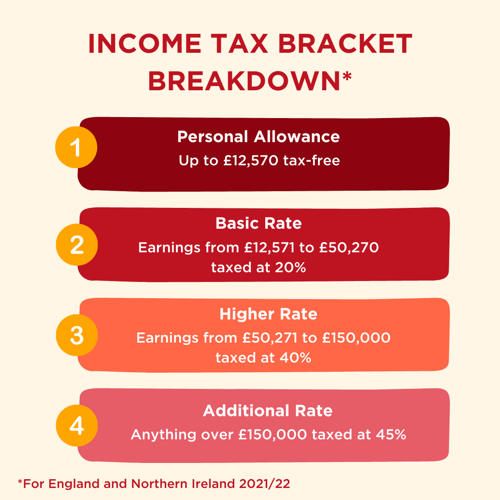
If you’re sharp-eyed, you’ll spot that you can actually earn a fair bit of cash before you start paying any tax on it. The Personal Allowance is the tax-free chunk of your earnings, and at £12,570 it means that a lot of students won’t have to pay Income Tax at all! Again, though, that doesn’t mean that HMRC won’t dip its fingers into your pocket. Remember we talked about National Insurance? Well, here’s what that looks like:
This is still broadly lumped under Income Tax, but it’s worth mentioning separately. Students are usually in the Basic Rate tax bracket, and the rules say that means they can earn up to £1,000 of savings interest tax-free a year. When people earn enough to pay Higher Rate tax, that allowance drops to £500 a year.
Not everything you buy is eligible for VAT. When it is, the tax is simply lumped into the price tag so you don’t have to do anything (other than decide if you can still afford it). If you’re running your own business, you sometimes have to register for VAT and start charging it to your customers. You can then claim back the VAT you’re paying on some of your business costs. You won’t need to bother about this until you’re earning over £85,000 (as of 2019/20), so for most students it won’t be an issue.
Council Tax is charged on pretty much all UK properties, from mansions to caravans. It’s based on the value of the property, but there are some important rules for students to understand:
Read our guide: Council Tax Debt
Okay, so you won’t actually pay tax on your loan as if it were income, but the chances are you’ll be paying it off through the tax system. Again, there’s a threshold involved – meaning you won’t have to pay any of your loan back if you don’t earn enough to qualify. The threshold depends on the kind of loan you’ve got.
For 2019/20:
As for how you’ll be making those repayments, it all depends on the way you pay your normal tax. If you work for an employer, you use PAYE. If you’re self-employed, it’ll be in your Self Assessment tax returns. Some people might actually be both, meaning they’ll have to use both systems. They won’t end up paying double, though. The payments made through PAYE count against your Self Assessment tax.
Postgraduate loans are slightly different. For these, you start paying once your earnings hit £21,000, and on other income over £2,000 a year that you’re declaring via Self Assessment.
The Universal Credit (UC) system doesn’t really care if you’re a student or not. You’ll still have to meet the normal criteria to qualify for it. If you’re studying full-time, you’ll need to fit one of the following descriptions to claim:
If you only study part-time, you might still be able to qualify for UC. There are a few other hoops to jump through, though, like being available for work. Either way, if you’re earning money while you’re a student, it can bring down the UC you can claim. That’s worked out based on the income you’re making minus a fixed amount to allow for expenses.
You apply for UC online, and you’ll be expected to provide some basic information about yourself and your circumstances (contact details, banking and financial information, etc.). You might have to ring up to book an appointment with a “work coach” - and won’t get your UC if you miss it!
Your personal tax specialist will get to work on your refund.
As they prepare your claim they might need to ask you a question or two to make sure you get the most from your refund. They’ll always try to call first and if they can’t get through they’ll send you an email or text from 01233 628648 so save that number in your phone.
If there’s a particular time you’d prefer we try to contact you, just let us know.
We'll now send these to HMRC.
It takes HMRC, on average, approximately 12 weeks to process these forms and release your refund (times can vary). We'll make sure we chase them during this time.
As soon as HMRC release the refund we'll contact you to confirm sending you your money.
We'll keep you updated if HMRC take longer than anticipated.
In the meantime keep good records of your travel and refer your friends to us to earn additional money.
Remember, the good habits you’ve built while saving for your new home don’t lose their benefits once the ink’s dry on your contract. Even after you’ve hit your goal and moved in, there’s still a lot to be gained from keeping your saving system going. Ideally, you’re going to want to stick to the 50/30/20 rule we mentioned before. That 20% you’ve got used to socking away is going to develop into an amazing investment in your own future if you stick with it.
Our standard charges are:
When we receive your refund from HMRC we take out our fee and then pay it the refund to you. There are no up front charges to pay for anything. If you are not due a refund then there is no charge.
Before we send your claim to HMRC we sent a copy to you with a full breakdown of all the fees so you can clearly see:
You will need to sign and send this back to us to say you have read, understood and agreed with it, along with a declaration that all the information you have provided about your claim is true. This means you will never be charged any fees you have not agreed to.
There are no further fees to pay, and no hidden charges.
All aftercare is included (if you need us to call HMRC on your behalf, if you have a problem you would like us to resolve with them, if your tax code needs correcting etc).
Your refund is covered by the unique RIFT Guarantee which means that whatever happens, your refund stays in your own pocket and will never go back to HMRC. If we fight any HMRC enquiries for you (still included in the cost) and if anything did go wrong (which it never has in 15 years) we would pay back the refund to HMRC ourselves.
We will also send you a reminder when it's time to see if you have a claim next year.
Does it apply to me?
The short answer is "yes".
While many people get their travel and work expenses reimbursed by their employers those in the Armed Forces, Construction Trades, Security and Offshore industries often don't.
To get the money back you have to put in a claim to HMRC to show what you've spent so they know how much to pay you back.
Sadly many people, 2 in 3, who are owed tax refunds don't claim them back - meaning they are losing a chunk of their wages.
It's our mission to improve knowledge about this so that all workers who should be claiming are claiming.
We know what it's like - time flies and it's hard to find a moment to get round to things.
The good news is, we take care of everything for you - the whole reason we do what we do is to take the stress off your hands and give you time back as well that hard earned cash.
All it takes is 10 mins on the phone or chat to get an average of £2,500 refunded. That's got to be the most valuable time you could spend on your phone today.
Once we've got your info we do all the chasing, calculations, sorting out the payments - and that's before we even get to our all inclusive aftercare!
Yes - absolutely! If you've paid too much tax, you're fully entitled to a tax rebate.
Travel and mileage tax refunds for travel to temporary workplaces are claimed under Income Tax (Earnings and Pensions) Act 2003, sections 336-339.
There's over 1000 pages of rules and regulations but our experts will get it sorted for you. They have qualifications from the Association of Tax Technicians, Associations of Accounting Technicians, and The Association of Chartered Accountants. Having these qualifications mean they are bound by all its rules, regulations, ethics and codes of conduct in addition to our internal standards.
HMRC can't issue automatic refunds for Work and travel expenses because it's not based on information they have - like your salary or tax code. You have to prove what you've spent and claim what you're owed, which puts far too many people off getting back their own cash.
I'm not sure I have the info?
To make your claim the key things we need to know are:
We have access to a number of specialised custom built systems that link to HMRC, Government depts, DVLA, travel routes, etc and can get the information for you.
I don't know anyone who's done it.
You're absolutely right to be cautious. There's a lot of scams to be aware of and a word of mouth recommendation from someone you trust is the best way to be sure.
We don't know who your friends are, but if they're in the Armed Forces, Construction Trades, Security or Offshore ask them if they've used us. 97% say they would recommend us.
A lot of people have - we've helped 130,000 customers make claims in the last 20 years - but British people don't really talk about money so it's not something that tends to come up in conversation.
Otherwise, check us out on Trust Pilot. It's the next best thing.
First we need to talk to you on the phone or online run through some questions about your work and travel and tell you how a claim is made.
If you would like to claim for you we send you a form to sign that lets us talk to HMRC on your behalf to do that.
We'll then give you your own Personal Tax Specialist who will gather all the information needed to calculate exactly what you're owed.
We send you the total to approve the amount and what our fee comes to and then submit it to HMRC for you.
You don't pay any fees upfront. To make it simpler for you we take the fee from the refund total and then pay it into your bank account.
Draught proofing your home could be worth a decent chunk of change at the end of the year. It’s one of the simplest things you can do to cut down the heat you’re wasting, too. While it’ll probably cost a couple of hundred pounds to get your draught proofing done professionally, it’s not that hard to do if you’re into your DIY.
You should think about your windows, obviously, but there are plenty of other ways to stop letting the warmth out. Your front door’s an obvious culprit, from the gap underneath to the keyhole and letterbox. You should also take a look at your pipework, loft hatches and even your chimney. If you’re not actually using your fireplace, just draught proofing your chimney could save £18 a year on its own.
You might well find yourself on an emergency tax code if your new employer can’t check your P45. If this happens, you’ll see one of these codes on your payslip:
These codes are only ever meant to be temporary, so it’s a good idea to get your proper tax code sorted out as quickly as possible.
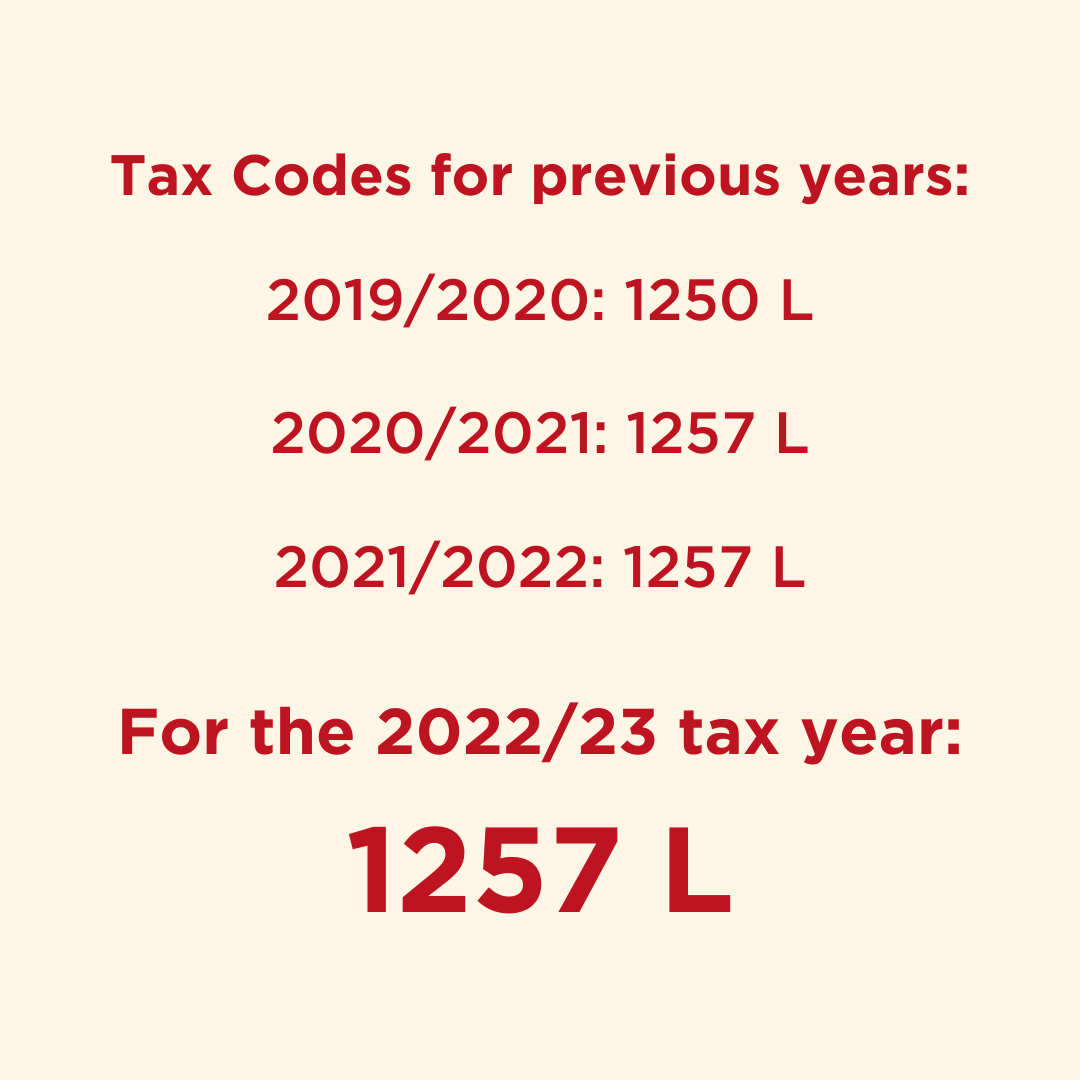
You might need to change your tax code if you start a new job, receive additional income, or if your personal allowance changes. It’s good to keep an eye on any tax code changes. If it’s wrong, you might be taxed too much or too little.
Sometimes, you might get your tax refund handled automatically through the PAYE system. If HMRC already has all the information it needs to work out how much tax relief you’re owed, then they can alter your tax code to make sure you end up only paying the tax you actually owe. There are a couple of potential hiccups with this system, though. For one thing, HMRC can only refund you the tax for any work expenses they already know about. When you travel for work, for instance, HMRC won’t automatically know how much mileage you’re doing or what other costs you're running up just to do your job.
The other problem is that your work expenses will probably change from year to year. When HMRC changes your tax code, it assumes your work costs will always stay the same. That means you’ll probably end up on the wrong tax code – which is something you really want to avoid. In either of these two cases, you’ll need to make a full tax refund claim to get back everything HMRC owes you, and you’ll need to get your tax code fixed quickly if it’s wrong. Thankfully, this is something that RIFT will automatically take care of for you when we sort out your tax refund paperwork. There’s no extra charge for this; it’s all part of the RIFT service!
No, if you aren't footing the bill yourself you can't claim back tax on the costs.
There's another little wrinkle here, too. Suppose your employer has provided you with a laundry room, but you don't like to use it for some reason. Maybe the machines sometime chew your socks up, or maybe the place just smells funny. Either way, the fact that those facilities exist means that you can't claim a uniform tax rebate. Likewise, if you're getting reimbursed for your costs already, you can't claim for them.
Another important point is that employers sometimes arrange to sort out tax relief on your behalf. In those cases, you obviously can't claim it again. However, not everyone realises that the arrangements are already in place when they make their claim. Fortunately, the taxman understands how this can happen. Probably the worst you could expect is a polite letter from HMRC explaining why your claim was denied. Obviously, it's still better not to make the mistake in the first place, though.
Your main thermostat isn’t the only way to control your heating system, and not every room in your home is going to need the same amount of heat. Depending on your situation, this could be as simple as turning down the radiators in rooms you’re not using much. Closing doors to rooms you’re not using can make a difference too. The Energy Saving Trust say, if you’ve got thermostatic radiator valves you could save even more. Fitting these could save you £75 a year.
You've got a few options to match what you're hoping to do with them:
While we’re talking about draughts, a few decent excluders will go a long way toward making the most of your energy use and cash. Draught excluders can help shore up the savings when you use them alongside your basic draught proofing. They’re easy to get hold of – or even to make yourself. Just a large piece of fabric stuffed with rice can make a decent enough excluder. You’ll need to think about where you use it, though. Draught excluders can be great at their job, but they’re only as good as where you put them. Stick one under a door, for instance, and it’ll be next to useless the first time someone opens it. Better to use an inexpensive weatherbar or brush strip in those cases. They’re attached to the door, so they won’t get nudged out of position when it moves.
Gym memberships always seem like a good investment at the time. You’ve put your money where your mouth is, now all you’ve got to do is stop filling that mouth full of chips, right?
The trouble is, with any investment, you’ve got to think about the returns you’re getting. Suppose you hit the gym 3 times in a month on a £30 membership scheme. That’s £10 per visit – and you’re paying the same even if you never set foot through the door!
Instead of pricey subscription packages, invest in a cheap set of weights or resistance bands. You can get them easily online, and YouTube is packed with free exercise tutorials you can follow from home. No monthly fees, no travel costs to factor in and nothing to stop you reaching your financial fitness goals.
If you’re claiming for more than £2,500 in work expenses, HMRC will expect you to send them a Self Assessment tax return to claim your tax refund. As always, RIFT will take care of this for you when we handle your HMRC tax rebate. We’ll get you registered and make sure your tax return’s filled in and submitted correctly.
A “tied” adviser, is someone who really only handles products from a single supplier. You can expect them to have detailed knowledge of that company’s products, but you probably won’t get a full picture of the alternatives available elsewhere.
A “multi-tied” adviser, is similar to a tied one, but will be able to help you with a wider variety of suppliers and options.
A “whole-of-market” adviser, is someone whose advice would cover a much larger range of providers and products. These are similar to Independent Financial Advisors in a lot of ways - but not all, as we’ll see in a moment.
Good question – and not always an easy one to answer.
It’s obviously best to go into any major money decision with good advice. That’s just common sense. Even so, paying for an Independent Financial Adviser (IFA) to look at your situation may not always be worth it.
Don’t get us wrong – there are plenty of reasons to talk to a financial adviser. You might find yourself in an unusual or complicated financial position, for instance. Maybe you need help setting goals or understanding the risks of investing. On the other hand, if you’ve got relatively simple needs and plans, flushing a load of cash away on an adviser might not be a good foot to set out on in retirement.
Generally speaking, the less money you’re playing with, the less help you’ll probably need managing it. However, every decision you make will matter – so again, blowing a ton of cash on professional advice may not be the smartest move up-front.
So, how much money are we talking about here? Obviously, there’s a range of prices on offer for financial advice services, so a lot depends on where you’re looking and what you’re asking for. Also, it’s easy to get wrong-footed at the start with offers of free first consultations. By all means, take advantage of these, just to test the water. Keep in mind, though – you could well be looking at a sudden bill of up to £500 the next time you set an appointment.
Once you’ve picked an adviser (and a price) you’re comfortable with, you’re probably going to find yourself staring facing an hourly rate for your actual advice. Prices for this kind of help can feel pretty steep if you’re not prepared. We’re talking in the range of anywhere between £75 and £350 an hour here, with £150 per hour being a reasonable average to expect.
Things change if you’re looking for more of a “hands-on” style of financial help. For instance, you might need your adviser to take more of a long-term role in handling how your retirement money’s invested. At this point, the costs involved will largely depend on the size of the portfolio you’re playing with (basically, what’s in your investment “basket”). Typically, you’ll be charged a percentage of the total value of your investments. Again, there’s a range of prices for this kind of direct management, but you’re probably looking at somewhere between 0.5% and 5%.
The bottom line of all this is that the kind of advice you need with your retirement savings – and the price it’s worth paying for it – will depend on what your actual goals are. If you’re still thinking about that, we’ve put together two articles to help point you in the right direction:
LISAs aren’t the only government system set up to help first-time buyers. For instance, the First Homes scheme (only available in England) can offer what are basically discounts of 30%-50% on the market value of your first home. There are a few limits on who qualifies for this, of course. You have to be 18 or over, a first-time buyer and your total household income can’t be more than £80,000 (or £90,000 in London). There are a few other twists and turns in the rules, and some councils prioritise certain types of buyer over others, but it’s definitely worth looking into if you think you might qualify. You can find all the basics on the gov.uk site.
Another smart option if you’re having trouble putting the cash you need together is to opt for a shared ownership arrangement. This is another scheme built to help first-time buyers grab that all-important first rung on the property ladder. Essentially, what you’re doing is buying a share (10%-75% of the total value) of a property from its landlord. A lot of the time, this will be a council or housing association. You then pay monthly rent at a reduced rate. You’ll still need to arrange a mortgage to buy that initial chunk of your new home, but it should be a lot more affordable than buying it outright from the start. As time goes by, you can gradually increase your share of the property until you own the whole place.
When you think of the main costs of buying your first place, your monthly rent and mortgage payments are probably the main things on your mind. There are a lot of other costs to consider, obviously, but we'll tackle these first.
Average rents charged in the UK are sharply on the rise. As of June 2022, for example, a standard rental agreement would run you £1,113 per month. Just 12 months before that, though, your rent would've been over £100 cheaper at £1,007. Obviously, the averages here won't give you the full picture on their own. A lot depends on the type of property you're talking about, for one thing. Also, rental rates can vary pretty widely across different regions in the UK. If you're renting in the Greater London area, for instance, you're probably going to get hit with much higher monthly payments. The average there is closer to £1,846 a month. Compare that to the North East, where the figures are typically much lower, and you'll see average monthly rent drop right down to £588.
Now, with most of the big stuff out of the way, we're getting into the gritty details. You're going to need to get your new home hooked up to the internet, with a decent phone service (although it's getting less unusual for households to ditch the landline entirely, since they're paying for mobile access anyway).
Average broadband costs can vary a lot, depending the package and extras you pick. A basic ADSL set-up, for example, will probably run you around £28.33 per month, with your home phone service coming as part of the deal. If you need a faster connection, you could be looking at closer to £39.75 for a superfast fibre connection (again, with your phone line rolled in), or even up to £61.90 per month for the fastest services with landlines included.
Service charges are fees you stump up to your landlord when you're renting your home. They're supposed to cover all the basic services your landlord has to provide, which should be spelled out in your lease. The amount you actually end up paying could vary from year to year, since your landlord's costs will probably change over time. Service charges are typically divided up between the leaseholders, so make sure anyone you're sharing the rent with understands what their chunk of the overall bill is.
It takes a few weeks to put together a really comprehensive tax refund claim. As soon as you're happy to go forward, we'll send your claim to HMRC for approval. It can take 8-10 weeks for the taxman to check your details and confirm your refund total, so the sooner you get us the information we need the sooner you'll have your money.
The best way to speed up your RIFT Tax Refund is to get your Authorising your agent (64-8) form back to us fast. This is the form that lets us tackle the taxman on your behalf. Without 2 physical copies of your 64-8 document, HMRC won't even speak to us about your claim. It's annoying, but it's all about protecting you.
As soon as your refund's paid out, we'll either send you a cheque or pay it into your bank account if you prefer. The choice is yours.
Have a look at our 'How Long Does A Tax Refund Take' page for more information about how long it takes to get your tax refund done and some pointers for how to make things happen as fast as possible.
Remember that you can claim for the last 4 tax years and you can make your claim at any time.
Please do!
Not only will you be doing them a big favour if you can get some cash back in their pockets but we'll pay you a £50 referral reward for anyone who does go on to claim through us.
Until the 9th of October we'll also pay you an extra bonus of £150 if 5 people claim with us (T&Cs apply)
If you tell them to apply now they'll get their tax refund in time for Christmas and you'll get something extra to stuff in your stocking. That could be £400 in your pocket as well as the warm glow you get from helping out your mates.
To get started:
Not sure which friends could claim? Find out more about who can claim tax refunds.
There's no limit to the number of people you can refer and we pay out the rewards every week. It could be a nice little extra in your pocket, as well as the lovely warm feeling you get from knowing you helped out a mate.
Find out more about the referral scheme.
In HMRC's language, a tax rebate is "a refund on taxes when the tax liability is less than the taxes paid". What it's definitely not is a prize or a dodgy way of ''cheating the system''. When you're owed a HMRC tax refund, it's because you've already paid too much tax.
When you're paying your own way to temporary workplaces, the odds are good that you're owed some tax back for your expenses. ''Temporary'' here just means it's somewhere you're working for less than 24 months on the trot. It's worth making sure you get back what you're owed, too. You can claim a tax rebate for up to 4 years, with an average 4-year rebate with RIFT coming to £3,000. This is based on average total claims data for a 4-year period. Refunds are subject to fees of 36%. Exclusions apply.
A lot of the time, people don't even realise how many of their day-to-day expenses qualify for tax relief. Unless you prove to HMRC what you're owed, though, the taxman won't have the information he needs to settle up. The tax rebate system's a little clunky in places, but RIFT's on-demand, 1-on-1 service means you'll never get lost or lose out.
Just answer a few simple questions and we can tell you whether it looks like the expenses you've had to pay out in the course of your work meant that you may have paid more tax than you should.
You can also use our tax refund calculator to see an estimate of how much you could be due if you make a claim.
Our standard charges are:
Don't worry if you had a mixture of self-employed and PAYE (employed by a company) work during the period you want to claim for. We can work out if you would be due a refund and let you know what the fee would be.
See our full list of services with prices and options.
When we receive your refund from HMRC we take out our fee and then pay you your refund. There are no up front charges to pay for anything. If you are not due a refund then there is no charge.
Before we send your claim to HMRC we send a copy to you with a full breakdown of all the fees so you can clearly see:
You will need to sign and send this back to us to say you have read, understood and agreed with it, along with a declaration that all the information you have provided about your claim is true. This means you will never be charged any fees you have not agreed to.
There are no further fees to pay, and no hidden charges.
All aftercare is included (if you need us to call HMRC on your behalf, if you have a problem you would like us to resolve with them, if your tax code needs correcting etc).
Your refund is covered by the unique RIFT Guarantee which means that whatever happens, your refund stays in your own pocket and will never go back to HMRC. If we fight any HMRC enquiries for you (which is included free of charge) and if they did demand any money back, we would pay back the refund to HMRC ourselves.
We will also send you a reminder when it's time to see if you have a claim next year.
If you don't have a P60 we you can use your last payslip or income statement. We can also get copies of the P60 directly from HMRC.
Visit our checklist for details of the documents you need and what to do if you are missing anything.
You can reach us on the phone or Livechat
You can email us or send us a question or feedback through our contact page at any time and you can leave us a private message through our Facebook page.
A tax return is a form you use to tell HMRC about your earnings and expenses. It's a complete overview of the taxable income you've made and the costs of doing business you've faced.
A tax refund is money HMRC gives back when you've paid too much tax. There are several reasons why you might overpay, and you often have to file a claim and prove you did.
There’s basically no acceptable excuse for missing self assessment tax return deadlines, even if you don't owe HMRC anything. If you miss the deadline there are a number of self assessment tax return penalties that you could be hit with:
We’re here to take care of everything - from completing your tax return, through calculating any refunds due, to speaking to HMRC on your behalf. You can also get more self assessment tax return tips and advice here with some clear ''dos'' and ''dont's''.
Find out more about self assessment deadlines and penalties.
With all the fiddly legalities neatly ironed out, you can move ahead with the exciting part—actually setting up your business. You're in good company, too. As of 2020, the UK boasted over 2 million limited companies (a business set-up that protects your personal cash and property if the sky falls in) actively trading, with about half of those being one-person operations.
When you need to kick off a business partnership, your main port of call will be the government's own website. That's where you'll be asked about the kind of set-up you're aiming for. One option is a limited partnership, which means you've got at least one general partner and one limited partner. With a limited liability partnership, on the other hand, there aren't any general partners. Confused yet? A general partner is someone who owns and controls a business, but also stand to lose some personal cash if the business goes bad. Limited partners tend to have fewer responsibilities and less overall authority, but their personal money's more protected. By the time you hit the set-up page on the government website, you and your partners need to have already agreed these key details so everyone knows exactly where they stand.
Keep checking back here for more money tips and updates. We’re experts at saving you cash and we’re always here to help. That’s the reason why you’re better off with RIFT.
We’ve all grown up in a world that respects and values gold. It’s a respect that dates back many thousands of years, and shapes how the metal’s viewed today by investors, businesses and virtually everyone else. As far back as 4,000BC, gold was being used in Eastern European cultures to make decorative objects, and across millennia its primary use was in jewellery and objects of religious worship. Despite this, it really wasn’t until around 1,500BC that gold first became a kind of global “money”. Egypt, whose Nubia region was rich in gold, made it an official standard of value and the first international medium of exchange.
Skim forward a couple of centuries and we find a kingdom in Asia Minor called Lydia, where the first gold coins were minted. By 50BC, the Romans had started using a gold coin they called the Aureus (literally, “golden”). Eventually, gold coins started changing hands all over the world. The Republic of Florence, in what today would be Italy, had the Ducat, while Great Britain had its Florin. The Ducat, in fact, ended up being the world’s top gold currency for another 5 centuries!
So, why’s the world still so excited about gold? After all, it’s too soft and too scarce to build anything useful out of, isn’t it? Even the gold used in jewellery often needs to be blended with other metals to give it strength. In fact, some people reckon we really shouldn’t be using it as a measure of value at all anymore.
To be fair, gold goes have some interesting properties. It’s non-toxic and never rusts and that softness we talked about makes it easy to work with. It’s even great for electronics, since it conducts electricity so well. If you want to get into the deep science of it, it’s ideal for nanotechnology, resists bacteria and can even be used in the fight against cancer! In real terms, though, the simple truth is that gold is beautiful, ageless and really rare - and eventually enough people decided that these factors made it important and valuable.
If you really want to make your retirement savings count, there are even more ways to bring down your basic minimum retirement pot target. Again, a lot of these advantages and opportunities stem from the fact that you’ll no longer be making decisions around the demands and costs of your job. When you’re booking holidays, for instance, you won’t be stuck jetting off during peak seasons. With time on your side, off-peak holidays could be a serious money-saver.
If you’ve been running a car mostly for getting to and from work, you’ll already have noticed your costs going down. In fact, it might be time to think about whether you really even need your own wheels at all. A lot of families need more than one car while they’re working, so even scaling back the number of vehicles you own can mean a major boost to your budget.
If ditching your wheels seems like too big a step to take, think about dropping any Personal Contract Purchase or lease agreements in favour of simple buying a car outright. You’ll be saving a lot on interest payments in the long run.
The other big thing to look at is your home. If you’re no longer putting a roof over your kids’ heads, it could be a good opportunity to “downsize”. You might have a lot of money tied up in your house, so selling up and buying a smaller property can release a serious chunk of cash. In some cases, you might not even have to get somewhere smaller, assuming you’re happy to move to an area with lower property values. You can do this whether or not you’ve paid off your mortgage, of course, which could at least bring down your monthly payments. A smaller property will also generally be cheaper and easier to maintain.
So that’s a basic run-down of the hows and whys of saving for retirement. Keep checking back here for more money tips and updates. We’re experts at saving you cash and we’re always here to help. That’s the reason why you’re better off with RIFT.
By the 31st of January, you have to file your online tax return for the previous tax year, and pay any tax you owe. Miss this by just one day and you're already looking at a £100 fine. You should get yourself registered as self-employed as soon as possible after you start trading. The deadline for getting yourself registered is the 5th of October in the year that you started your self-employment. Miss that, and you're risking penalties based on the potential lost tax.
Important Self Assessment deadlines include:
| 31st of January | This is the big one, you have to file your online tax return for the previous tax year and pay any tax due. You'll also have to make the first of any payments on account you need for the following year. |
| 5th of April | The end of the tax year. Soon after this date, you'll be contacted by HMRC to file your Self Assessment tax return. |
| 31st of July | If you're making payments on account, this is when the second one's due. |
| 31st of October | If you're sending in a paper Self Assessment tax return, this is the deadline for it. |
If you miss the deadline for a good reason, you may be able to steer clear of the penalties. HMRC will expect you to be extremely up-front and co-operative, though. You can read more about penalties for failure to notify on the HMRC website. Keep in mind that you may also need to register separately for VAT. Again, check the HMRC website for details.
Technically, you can submit your Self Assessment tax return at any time after the end of the tax year, as long as it's filed by the 31st of January the following year. That said, it's always better to get it done sooner. For one thing, you'll know earlier how much you owe. That means you have time to plan or save up for making the payment.
Missing the tax return deadline lands you in an automatic £100 late-filing penalty. Those fines ratchet up further after 3, 6 and 12 months. A genuine reason might stop the penalty pain, but don't count on it.
When you’re filing a Self Assessment tax return, the information and documents you need will depend on your situation and business. Here are some of the basics:
The point is to give HMRC as complete a picture of your business and finances as you can, so you only end up paying the tax you owe. The Self Assessment system can be complicated, so talk to RIFT to make sure you’re making the most of it.
You can make your Self Assessment payments by:
If you can’t afford to pay the tax you owe – don’t panic! The main thing to do is to let HMRC know you’re going to have trouble paying up. Do this as soon as possible once you realise there’s a problem. In most cases, they’ll be able to help you sort out a payment plan that’ll ease the financial pressure. A “Time to Pay” arrangement, for example, can see HMRC working with you to set a personal payment schedule you can realistically handle.
A mistake in a Self Assessment tax return can be a problem, but the system makes it easy enough to fix things if you’re on your toes. Don’t wait for HMRC to spot the mistake and start asking questions before you act, though. The moment you realise there’s an error, get to work correcting it. You can make changes to your tax return within 12 months of the filing deadline (the 31st of January). After that you’ll need to write to HMRC to get any corrections made.
A tax code is a little string of letters and numbers that tells your employer how much cash to hack off your pay before forking it over to you. You can find it on a bunch of documents - and it’s worth keeping an eye on it, since it can and will change once in a while. Look out for your tax code on:
If you spot a change in your code and don’t understand it, getting some expert advice from a professional accountant is a great idea. A good accountant can explain exactly what it all means, and sort it out for you if the taxman’s got his wires crossed. If you change your name or decide to work for yourself, for instance, you’ll need your tax code fixed so you don’t end up on the wrong side of HMRC.
Find out more about how to change your tax code
The amount you’re coughing up to HMRC comes down to 2 basic things: how much you’re earning and what your Personal Allowance is. Your Personal Allowance is listed in your tax code. Whatever you earn up to that amount each year, the taxman can’t lay a finger on it.
After your Personal Allowance is used up, the next chunk of your pay is taxed at the Basic rate. Once you hit the upper limit of that, anything more you earn gets hit with the Higher rate. Really big earners can find the top end of their pay being taxed at the even higher Additional rate.
On top of your Income Tax, you’ll also find yourself coughing up National Insurance contributions (NICs). Again, your employer handles this before you get your pay. If you’re on PAYE, you’ll be paying Class 1 NICs, which go toward stuff like your State Pension and a bunch of benefits you might find yourself claiming from time to time. Gaps in your payment history can lead to trouble down the road, but you can sometimes make voluntary payments to catch up.
Again, because the taxman loves his little codes, the NICs you pay are worked out from your National Insurance category letter. You can generally find this on your payslips, but most people using PAYE will be in category A. Here’s what they all mean:
Most people on PAYE never need to deal with the taxman directly to pay their normal tax. However, sometimes, HMRC’s going to want to stick its beak a little deeper into your business. Maybe you’ve got some extra cash coming in outside of your PAYE job, or maybe you’re trying to claw some money back through a tax rebate. When that happens, you might find yourself filing a Self Assessment tax return. Here are some examples of people who need to send returns:
That last point’s a big one. If you ever get a letter from HMRC demanding a tax return, don’t ignore it. Even if you’re sure it’s a mistake, it’d be an even bigger one to leave the taxman waiting.
When you leave a job you get a form called a P45. This pretty much just tells you what you’ve earned so far in the tax year, and how much of it HMRC got its mitts on. You’ll be able to double check stuff like your National Insurance number and tax code, too.
The main thing is knowing what to do next. If you don’t have another job to go to straight away, or if your new earnings are lower than before, you might be owed a slab of tax back. Basically, HMRC’s been taking tax from your pay on the assumption that you’ll keep making the same money for the whole tax year. If you stop work part-way through the year, you might well end up with a refund due.
There’s another important form called a P60. This one’s got the same kind of information in it, but it covers the entire tax year. If you don’t get one you need to kick up a fuss, since you might have a tougher time claiming back the tax you’re owed without it.
The Marriage Allowance is a way of you and your spouse (or civil partner) shifting your Personal Allowances between you. Basically, if one of you isn’t getting the full benefit of their Personal Allowance, they can transfer £1,190 of it to the other. To pick an example, if your spouse is bringing in £10,000 a year with a personal Allowance of £11,850, they’re missing out on some of the benefit. In that case, they could shift £1,190 of their unused allowance over to you, meaning you don’t pay tax on over an extra grand of income. That’s worth £238 a year.
When you use the Marriage Allowance the partner receiving the increased personal allowance will have the tax code 1383M for receiving it and your partner will be on tax code N for granting it to you.
We’re all used to the taxman taking a big bite out of whatever cash we’ve got coming in. When it comes to benefits, though, he’s a surprisingly fussy eater. Here are some of the payments he wants his share of:
While he’s stuffing his face on those, though, he’ll still manage to keep his hands off things like:
Unless you’re living overseas pretty much permanently, HMRC might still chase you for tax on what you’re earning. It’s all about whether or not you count as a “UK resident” for tax. A lot of that comes down to how much time you’re spending in the UK each year. If you’re here more than half the time, chances are you’re a UK resident.
If your overseas employer’s a UK company, you’ll probably still be paying National insurance, too. For foreign employers, you might find yourself coughing up the local equivalent instead. To check what taxes you have to pay, HMRC has a few tests:
One smart thing to do before you leave is check if you're owed a tax rebate from HMRC. If you're leaving part-way through a tax year, you may not have used up all of your tax-free Personal Allowance. If you're registered for Self Assessment tax returns, don't forget to file one as normal after the end of the tax year.
HMRC has a special form for people who are going to be away from the UK for a complete tax year. Visit their site for form P85 "Leaving the UK - getting your tax right" in good time before you leave.
If you’re earning abroad, there’s a tricky catch to watch out for. Depending on your situation, you could actually end up paying tax in 2 countries at once! The UK’s got some “double taxation” agreements around the world to make this less painful, so it's worth checking with to see what you're letting yourself in for.
If it turns out you’re not a UK resident for tax, you’ll normally be off the hook for your foreign income. You’ll still be paying UK tax on anything you’re earning here, though – along with things like UK bank account interest or rental income.
There’s a bunch of reasons why you might find the taxman picking your pocket. Maybe you’ve stopped working or left the country part-way through the tax year. Maybe you’ve been forking out for work travel or other essential expenses from your own pocket. If your circumstances have changed, like switching to a lower-paid job, then you might have paid too much tax over the year. You might even have been put on the wrong tax code. All of these things and more can mean you’re due a tax refund from HMRC.
The thing is, the taxman’s not always going to hand it over automatically. For one thing, he won’t necessarily know how much you’ve been spending on things like travel for work. When you don’t get an automatic refund of what you’re owed, you have to make a claim yourself. That means working out exactly what you’re due, and backing it up with records and evidence. It’s a tough job for most people, and it takes a real tax expert to get the most from the refund system. A tax refund specialist can help find out what you're owed and claim it back. Even if you’ve never claimed before, you could still get back what you’re owed for up to 4-years.
The key thing to know about HMRC’s calendar is that the taxman celebrates his personal New Year’s Day on the 6th of April. Yes, it’s weird and clumsy, but it's got something to do with Pope Gregory XIII and the 11 days that went missing in September 1752. No, that’s not a joke.
Anyway, here are some of the main dates HMRC keeps circled:
How much tax you can pry out of HMRC’s clutches depends on your situation. On average, though, a typical yearly refund claimed through a specialist like RIFT is worth around £750. If this is your first refund claim and you’re claiming for the full 4-years, that adds up to over £3000!
On average, it can take HMRC up to 12 weeks to process a tax refund claim so it pays to get started as soon as you can.
Find out more about how long it takes to get your tax refund payment.
When you're trying to bring down your Income Tax bill in the UK, there are a few basic things to check:
Most people in the UK get a tax-free Personal Allowance worth £12,570 per year. You won't start paying tax on your income until you go over that. There are also several other kinds of income that you won't need to pay tax on, such as:
Most people in the UK qualify for a tax-free Personal Allowance, which is the amount they can earn before they start to pay Income Tax. The standard Personal Allowance for 2022/23, for example, is £12,570. Anything you earn under that threshold won't be taxed.
If you're on the books and paid through the Pay As You Earn (PAYE) system, your tax is calculated automatically for you by HMRC, based on your tax code. This is why it's so important to check the code you're on, and to ask questions if it changes unexpectedly or looks wrong.
If HMRC notices that you've paid too much or too little tax, they might send you a P800 tax calculation form to explain the situation and tell you how they're squaring it up. However, when you've got expenses to claim a tax refund for, HMRC won't automatically know about them. That's why you need to make a tax refund claim to get your money back.
Yes, absolutely! In fact, only working for part of the tax year almost certainly means you're owed a tax refund. When HMRC works out the tax you'll pay through the PAYE system, it assumes that you'll be earning steadily throughout the tax year. If you stop working part-way through, your PAYE payments for the year will have been too high. That means you'll be owed some tax back.
HMRC certainly has the power to look into your financial affairs to make sure you're paying the tax you owe. Depending on the situation, they may be able to get information directly from your bank or building society. This can happen, for instance, if they're actively investigating your situation.
If your PAYE tax looks too high, there are a few things that might be worth looking into. For example:
Self Assessment generally is how people report any cash coming in that isn’t taxed PAYE. Self-employed people use the system to sort out their Income Tax and National Insurance – but a lot of other people have to file returns, too. For instance:
If you’re thinking of becoming your own boss, you need to let HMRC know quickly so you don’t end up choking on tax bills and penalties. That means registering online for Self Assessment by the 5th of October. Depending on how you’re set up (Sole Trader / Limited Company, etc.), you might have some other paperwork to handle as well.
Once you’re registered and have a Unique Taxpayer Reference number (UTR), you can go online and fill in your yearly Self Assessment tax return on the HMRC site. There’s a hard deadline of the 31st of January for filing and paying up what you owe. If that date blows by and the taxman doesn’t hear from you, you’ll be looking at a minimum of a £100 fine. The longer you keep him waiting, the worse the penalties get.
When you’re running a business, a lot of the cash you’re spending on essential costs can be used to bring down the tax you owe. Unlike with PAYE, the taxman doesn’t have his sights set on every single penny you’ve got coming in. It’s your profits he’s interested in. Costs that are completely necessary to run your business count against the income you’re paying tax on. The more you’re spending on your business the less tax you owe.
To get Self Assessment right, you need to get comfy with keeping records. Every time you spend cash on your business, you need to keep some evidence of it. Treat your invoices and receipts as if they were money. When it comes to filing your tax return, that’s exactly what they’ll be.
As for what counts as an “allowable expense”, it all depends on what business you’re in. The basic rule is that if it’s completely necessary and only for business use, it probably counts.
When you’re paying your tax via Self Assessment, HMRC doesn’t like waiting. In fact, the taxman hates hanging around so much that he makes you pay tax in advance on money you might not have even earned yet! Here’s how it works:
The good side to payments on account is that, when the January tax deadline rolls around, you’ll probably have already paid most of the tax you owe for the year. The bad side is that the amount you’ve paid is based on estimates. If your income drops from one year to the next, you’ll have paid too much tax and will need to claw some back. Find a specialist accountant or tax rebates expert to help you out.
The fines and penalties for not paying the tax you owe start to bite if you're even one day late with your payment:
When you're claiming a tax refund, the more information and evidence you can show to HMRC the better. You won't necessarily need to keep every last scrap of paper just to make your claim, but a good record of the mileage you've travelled for work is a great start. After that, the more receipts you can keep, the more tax you'll be able to claim back.
If you're really not a fan of paperwork, you could choose to use HMRC's flat-rate expenses system instead. Rather than keeping precise records of what it's costing you to do your job, you can claim fixed amounts that vary depending on the kind of work you do. You'll probably never get back all the tax you're owed this way, but it can be simpler overall to claim it.
It's certainly possible to find yourself facing a prison term and a criminal record for failing to pay the tax you owe. If you're found guilty of tax evasion, for instance, you could end up with anything from 6 months to 7 years in prison, not to mention the fines and legal fees involved.
It's not just tax evasion that can land you in prison, though. Every year, for instance, about 100 people are given prison sentences for falling behind in their Council Tax payments.
If child is at least 13 years old (for part-time work) or 16 (for full-time), they can start earning (there are age limit exceptions for certain types of work, like TV or the theatre). If your child's under 16, they won't need to pay National Insurance or be included on your payroll. If they're 16 or over, though, you can pay them a salary through the PAYE system. At that age, they'll be entitled to the National Minimum Wage. Obviously, if your child is already an adult, then all the normal rules for employers apply.
There are specific restrictions about employing younger people, so check the gov.uk site and your local council's rules for more information.
As of 2025/26, the full amount of the new UK State Pension is £230.25 per week. This applies to those who reached State Pension age after April 2016. If you reached State Pension age before April 2016, the full basic State Pension is £176.45 per week.
Your amount could be different depending on:
That’s assuming you retired today, because the amounts do change over time. The other thing that changes is how old you need to be to get it. Currently, that age is 65, but it’s already on the rise. People born after the 5th of April 1960, for instance, will have to wait until they’re 66 to claim their State Pensions. People born after the 5th of March 1961, on the other hand, won’t qualify until they turn 67. This will go up again to 68 for those born on or after April 1977. There's no official retirement age in the UK, and you can continue working past the State Pension age if you choose to do so
That amount’s guaranteed for as long as you live, but in itself really won’t buy you much of a standard of living. In fact, it’s hard to imagine living on it at all. So why have you been paying into it through your National Insurance contributions for all these decades, then? Well, your State Pension can be a major head-start toward hitting your retirement saving goals. By adding guaranteed cash to your income from private pensions for life, it’s a pretty big boost to your overall income.
The new State Pension increases each year by whichever is the highest:
If you have a protected payment, it increases each year in line with the CPI.
From 13 March 2020, the rules allowed employees to claim statutory sick pay (SSP) if they were unable to work due to COVID-19. This included those who were too ill to work, were self-isolating due to symptoms or who were "shielding" at home due to their vulnerable status.
With SSP, you can get up to £99.35 a week. It can be paid by your employer for up to 28 weeks and will start from the 4th day of you being unable to work. However, if your time off work started before the 25th of March 2022, you can get SSP for the first 3 working days if your absence was due to COVID-19. The same applies if you've received SSP within the last 8 weeks, including the 3-day waiting period before you received it.
For more information, check out GOV.UK.
For those most in financial need, the Universal Credit offers a lifeline. It’s a payment designed to help with your living costs if you’re on a low income, out of work or unable to work. You could receive it on top of SSP as a top-up benefit.
To find out more, check out GOV.UK’s guide to understanding Universal Credit.
For many people, the mortgage is their biggest monthly outgoing. If you've been experiencing difficulties trying to make these repayments, you may be able to arrange a "mortgage holiday" with your lender. This basically means your repayments will be paused for an agreed period—although you'll still have to pay the same amount eventually.
Mortgage lenders agreed with the government to offer these repayment holidays for 3 months to any household facing financial hardship because of the coronavirus pandemic. Meanwhile, many landlords also made use of a mortgage holiday for tenants with money worries.
You may have heard of friends or family being furloughed during the pandemic, or perhaps you’ve been furloughed yourself. The scheme ensured businesses did not have to face tough decisions about losing staff. As the start of the scheme, they were able to claim back up to 80% of a furloughed employee’s wages, with a cap of £2,500 a month.
The scheme was extended to the end of September 2021, when it finished.
In recognition of the increased risk faced by staff during the crisis, a new life assurance scheme was launched for eligible frontline health and care workers during the pandemic.
The families of workers who died from coronavirus in the course of their frontline essential work received a £60,000 lump sum, worth roughly twice the average pension pay for NHS staff.
Some charities accepted applications for grants during the pandemic, and continue to do so. For example, the Cavell Nurses' Trust offered support for short-term financial emergencies, including many situations arising as a result of coronavirus, including the need to self-isolate or a reduction in a partner’s income. you can find details on how to apply for current grant schemes on their website.
You could also explore other charitable grants using Turn2us, which searches for benefits and grants you may be eligible for.
Coming in a tenner cheaper than the newer 4th Gen model, this easy-to-use device has a built-in speaker to handle all your audio demands. It’s hooked up with the Alexa AI system, meaning you can ask it questions and get an instant reply. It’ll keep you up to date with the latest news and weather reports, and connect to your other smart home gadgets to control your lights, thermostats and even door locks. A very cool, low-cost system, ideal for beginners.
This is the main Apple rival to the humble Amazon Echo Dot. Instead of Alexa, it uses the Siri AI assistant system. Again, you can get it to answer questions, search the internet for information and control your smart gadgets with your voice. If you’re already a big Apple device owner, it’s a very nice addition to your home set-up. You can even hook it up to other Homepods to work as an in-home messaging system. It can recognise up to 6 people’s voices so no one’s left out of the loop.
Fitting good quality insulation around your hot water tank isn’t just good for your household budget; it’s good for the Earth, too. A decent insulation jacket will bring down a typical household’s carbon emissions by a massive 110kg per year. At the same time, you’re reducing the heat loss from your tank, so your water stays hot longer. It’s a win/win situation for everyone.
It’s not always easy to know how far to trust the advice you get in any walk of life. Luckily, with tax advisers you can check their credentials fairly easily. A good adviser will have properly regulated qualifications from a professional body to show you, so you’ll know their skills and knowledge are both up to standard and up to date. A fully accredited tax adviser has to have Professional Indemnity Insurance, too.
Here’s a quick list of professional bodies who can point you in the right direction when you’re looking for a tax adviser:
Tax relief can put money back in your pocket by refunding certain essential work expenses. You can claim an HMRC tax rebate for expenses like business mileage, professional subscriptions, and necessary tool replacements. The more you spend on eligible expenses and the higher your tax band, the more tax you can reclaim. If your claims exceed £2,500, a Self Assessment tax return is necessary, which RIFT can handle for you.
Check out our tax refund claim checklist for more information on HMRC tax rebates, and to see how RIFT gets that money back in your pocket.
Whether you work part-time around your studies or do some temping or casual work in the holidays, when there’s money coming in Her Majesty’s Revenue and Customs (HMRC) wants to know about it. If you’re working for an employer, then you’ll usually have tax taken off your pay through the Pay As You Earn (PAYE) system. Under PAYE, HMRC basically swipes a slice of your cash directly from your employer before you get it. It’s a pretty simple system when it works properly, but there are a few wrinkles that can see you paying more than you should.
When you’re your own boss, things are a little different. HMRC won’t necessarily chase you for every penny you make selling things online or whatever. If you’re making over £1,000 a year, though, the taxman will probably decide you’re running a business. That means you’ll have to register yourself as self-employed and start filing Self Assessment tax returns every year. Basically, HMRC will want to hear about all the money you’ve got coming in and going out of your business. You’ll only be taxed on your profits, so the cash you splash just to stay afloat can often bring down your total tax bill. Self Assessment comes with a set of deadlines to hit and rules to obey. The penalties for getting it wrong can be pretty nasty, too, so always go in with your eyes open.
There are other kinds of tax as well, like the Value Added Tax that gets lumped onto most of the things you buy or Council Tax you pay on the value of your property. For most students, though, it’s Income Tax that trips them up, so it’s really worth getting comfortable with the system early.
National Insurance isn’t exactly a tax, but it’s still pretty much collected like one. It’s used by the government to cover the costs of things like state benefits and pensions. If you don’t keep your payments up, for instance, then you might find yourself out of luck (and pocket) when you hit State Pension age. Employed people pay Class 1 NICs, again collected by their employers. Self-employed people pay Class 2 (flat weekly rate) and Class 4 (based on profits) NICs.
Another quick thing to keep in mind is that tax systems aren’t necessarily always going to be the same through the whole UK. Scotland, for example, has had its own Income Tax scheme since 2017. The rates and thresholds it sets are different from England’s. Wales can also partially set its own rates, by essentially lowering the amount of tax the UK government collects, but adding in a Wales-only tax rate on top. In practice, so far, it makes no difference to the total tax paid, but that could change in the future.
Your employer has to give you a P45 when you leave a job for any reason. That said, depending on your situation, you might not get your P45 on the exact day you leave. Generally, though, you ought to get it very soon after your tax and other deductions are sorted out for your final pay period at the job.
A P45 only counts for the specific tax year it refers to. Tax years run from the 6th of April in one calendar year to the 5th of April in the next. If you start work at a new job in the same tax year as you left your old one, you can show your P45 to your new employer so they can put you on the right tax code.
Basically, you just need to sit back and wait. Your old boss is legally required to shoot you a P45 after you’ve moved on. Obviously, you won’t have a P45 when you start your first job - but your new employer should sort you out there. When you’re starting PAYE work for the first time, they’ll give you a Starter Checklist to complete. You’ll need to get this done as early as possible so your boss can get your tax code squared away and you can be paid properly. You’ll also end up going through a Starter Checklist if you lose your original copy, because you can’t just get a replacement P45. The same goes if you haven’t had a PAYE job in more than a year, or if you start a second job without giving up your first.
Assuming this isn’t your first job, and your old boss doesn’t send you a P45, you need to start kicking up a fuss. That means nudging them directly to request your P45 – and doing it repeatedly if necessary until you get your form. They’re breaking the law if they don’t send it, so don’t be afraid to shout out.
Otherwise known as Easy Access accounts, these accounts are great for stashing away money for the short term. As you can usually withdraw from these accounts at a moment's notice and without charge, they come in handy in unexpected circumstances. Broken boiler? Simply transfer the money over to avoid using your credit card. Now we know that building up a safety blanket isn’t easy for some. A 2020 survey by Shelter and YouGov showed that nearly 40% of UK households are a single paycheque away from homelessness. Try your best to put away whatever you can into Instant Access savings. This way you can reduce the impact of unexpected bills. If you ever find yourself dipping into these savings, you may want to build your funds back up to the previous amount to provide some much-needed security.
Long-term goals are anything that you wish to achieve over 10 years from now. The main examples are helping your kids out or retirement. Now, there’s a reason that we’ve not mentioned compound interest so far. This is because it often takes over 10 years to see any notable difference. Put simply, compound interest is when you earn interest on the money that you’ve saved AND on the interest that you’ve earned. Imagine compound interest as a snowball rolling down a hill. As it collects more snow or interest in this case, the snowball will gradually grow in size. The longer you leave it to collect interest, the bigger your savings will grow. To calculate how long it will take to double your money you can use the Rule of 72. Simply divide 72 by the interest rate. If interest rates are 2% on average, it would take 36 years to double your savings if left untouched. However, in recent years the interest rates of banks have been significantly lower than this - meaning that it would take more than a lifetime to double your savings.
Investing in the stock market is often suggested as an alternative for the mid-to-long term. Stock-market investments tend to do better than cash if left long enough to ride out any highs and lows of the market. Typically speaking, this is said to be a minimum of 5 years. Now that is not to say that stocks come without risk. There is a possibility that you could lose the entirety of your investment as well as make a large profit. There are certain types of investing that are said to reduce this element of risk. By spreading your money across a number of markets and industries, something known as diversification, you can reduce the likelihood of your entire investment losing its value. It’s really important that we stress the importance of never investing money that you simply cannot afford to lose. If you do choose to invest, make sure you do it responsibly. And remember, these are just a few of the options available to you. Certain methods of saving are suited for both personal and financial circumstances. So if ever in doubt, speak to a financial advisor.
The income tax bands for England and Northern Ireland in 2023/2024 are as follows:
Scotland and Wales have their own tax bands. Wales generally aligns with England and Northern Ireland, while Scotland has unique rates.
Income from dividends is taxed at different rates per bracket so check out our guide to that.
Tax relief allows you to claim refunds for certain work-related expenses. The amount you can claim depends on your expenses and tax band. For claims exceeding £2,500, a Self Assessment tax return may be required.
Tax codes can be tricky business. In an ideal world, your code will let HMRC know of any circumstances affecting the tax you owe, along with how much you can earn tax-free. However, tax codes change over time, and they might not always keep pace with your situation. If your code changes unexpectedly, you can either kick up a fuss with the taxman to find out why or have an expert look into it for you. What you really shouldn’t do, though, is ignore it and assume it’s someone else’s problem to fix. If HMRC agrees there’s a problem with your code for the current tax year, then any refund you’re owed will come through the PAYE system.
You might get a P800 letter from HMRC for the previous tax year, which will explain how to get any refund you’re owed. They’ll only send one of these out if they already know there’s a problem, though. If you think you should have been sent a P800 but don’t have one, it’s time to contact the taxman and sort it out.
If your tax problems go back further, you might still be in luck. You can actually claim tax refunds stretching back up to 4 tax years. You’ll need to be pretty sure of your footing, though, so talking to a professional might be a smart move.
You might need to change your tax code if you start a new job, receive additional income, or if your personal allowance changes. It’s good to keep an eye on any tax code changes. If it’s wrong, you might be taxed too much or too little.
Here’s where things get a little more technical. When it comes to investments, there really is some truth to the old warning about putting all your eggs in one basket. That’s why the trick most advisers recommend is to “diversify” your investing so you’re not betting everything on one horse. The trouble is, unless you’re a stock market professional with some experience in the game, it’s tough to know where to put your money. If you’re new to investment – and even if you’re not – then an index fund might be a good option to look into.
Index funds are a kind of “mutual” investment you can use to manage your overall risk. Instead of dumping all your cash into a few hand-picked businesses, an index fund tracks a “market index”. It’s like a cross-section of how a particular market’s moving, instead of handcuffing your money to the fortunes of any one company. A “total stock market index fund”, for instance, is designed to track trends within the overall equity market. It’s like owning a bite of the entire market in a single investment, so if you’re looking to sock away a retirement portfolio, it’s a great way of diversifying your investments.
Index funds have several basic advantages to offer over going fully “hands-on” with your investment choices. For one thing, they can severely cut down the time you spend picking through your individual investments. The portfolio manager of your fund handles a lot of the essential research for you, investing in an index with the kind of stocks you want to put your money into.
At the same time, you’re diversifying your stocks to help protect your overall investment. Spreading your money around with an index fund means you’re less likely to take big losses if a couple of your investments go bad. Index funds can also be much cheaper than having your own fund manager hand-picking your stocks for you, along with being pretty tax-efficient. Since there’s less buying and selling going on than with an actively managed fund, you won’t be stacking up a load of extra capital gains onto your tax bill.
Let’s take a look at some of this in action. The Vanguard Growth ETF (exchange traded funds) list tracks the performance of a range of “growth stocks”. These are basically just stocks that are expected to do better than average in their fields, from technology to healthcare. According to Vanguard, this list is ideal if you’re new to the game, because of its lower minimum investment amounts and real-time pricing reports when you buy and sell. It’s a decent balance between having things managed for you and still having control of your transactions.
With the Standard and Poor’s 500 stock market index (S&P 500), you’re looking at 500 of the most profitable companies in the United States. We’re talking huge names like Apple, Amazon and Microsoft here – companies with long track records of flexing some serious money muscle. Annual returns from the S&P 500 index, as you’d imagine, have historically been strong – around 9% to 10% being fairly typical. Like any other investment, though, things can still go wrong even with world-leading businesses. For instance, in the chaos of the 2007 financial crisis and Great Recession, the S&P 500 dropped 57.7% between October 2007 and March 2009. Even so, it had completely recovered by March 2013. 2020’s COVID-19 pandemic dropped it by half again – but once more it bounced back by the end of the year to hit an all-time high in October 2021. In fact, in the entire history of the S&P 500, no 20-year investment has ever ended up in a loss. As we keep on saying, investment is a long-term game where the real rewards only come with time.
Insulation’s a really important thing to get right if you’re serious about bringing down your heating bills. Up to 40% of your home’s total heat loss goes straight through the walls, with another 25% through the roof. By comparison, windows and doors account for about 20% - and even your floors lose you 10%.
Of course, insulation’s not cheap, but it does pay off over time. It all depends on your situation. Internal solid wall insulation, for instance, can run you about £7,400 in an average semi-detached house. At a saving of £225 a year, you’re looking at over 30 years before it pays for itself. That said, fitting up to 270mm of loft insulation in a typical semi could only cost you £300, while saving you £150 a year in lost heat and cutting down your annual carbon output by 600kg. Even just insulating under your floorboards could save around £40 per year.
The point of all this is to realise that your home could well be leaking money unnecessarily. Those leaks could be from dodgy insulation, wasteful energy use or even just sticking with the wrong supplier. Either way, you can take control of it and start bringing your heating bills down. It doesn’t have to involve massive home renovations, either. Even just a few changes in your habits can help.
Keep safe and warm this winter – and keep checking back here for more tips and updates. Remember – you’re always better off with RIFT.
We’re getting into territory where you’ll need more skills, time, and patience. You’ll also need your laptop for most of these intermediate level ideas:
Dropshipping is a reasonably new way of selling products online. It’s when you take orders from customers - through your website, for example - and another company fulfils that order. You’re not making the products yourself, or having to put in stock orders and then hold that stock until somebody buys it.
For example, say you want to dropship car accessories - like seat covers. Rather than put an order in for 1,000 seat covers and then have to find 1,000 customers to buy them, you can dropship them. You list the seat covers on a website you’ve set up. You take the order, and send it to the manufacturer, who sends the seat cover to your customer. You charge the customer £10. The manufacturer charges you £5 for the product and £1 for delivery. You pocket £4!
It’s not quite as easy as it sounds. The manufacturer will supply that same seat cover to other dropshippers - so you’ll need to find a way to stand out. So think about what you want to sell - and who to. Then get on the search engines - you’ll find plenty of manufacturers who dropship, as well as tips to stand out in your niche.
Etsy is aimed at crafty types - but you can sell all sorts. For example, you could pay a graphic designer to create a cool t-shirt design, then sell the t-shirts on Etsy for a profit. You don’t even need to invest in tonnes of stock. Once you have your design, you can use print-on-demand services. It’s a similar principle to dropshipping, but takes it one step further - the merchandise doesn’t physically exist until somebody orders it. So when somebody orders your t-shirt design, you send the order to the print house. They print it up and ship it to your customer, and you make a tidy profit. Keep your costs down by sticking to basic black or white t-shirts and you can easily make a £5 to £10 profit per t-shirt.
Sites like Upwork can be great places to pick up small jobs if you have skills like graphic design, or can write, for example. But there are also loads of simple jobs advertised - like collating spreadsheets - that don’t require pro-level skills.
Sites like Fiverr are a similar deal. You advertise your skills, people pay for them. It’s less professional than the likes of Upwork. While there are professionals selling their digital skills, there’s also quite a lot of…plain weird stuff up for grabs on Fiverr. Anything you could dream of asking somebody to do on camera, for example - there’s almost certainly somebody on Fiverr willing to do it for money. The point is, if there’s an odd digital skills niche you think you can fill, Fiverr could be the place for you. And while basic skills and products go for $5, hence the name, there’s no limit to what you can upsell people on. That’s how some users have apparently made six-figure sums through the platform.
There’s a lot of good stuff to say about pensions. They’re great for minimising the tax you pay on your savings, and a simple, reliable system to build your retirement plans around. They also give you a lot of room to grow. You can get tax relief on up to £40,000 a year of contributions, or up 100% of your taxable earnings if that’s higher, with a tax-free lifetime limit of £1,073,100.
It’s already a great deal for most people, since it basically tops up your contributions by £20 for every £80 you pay in. If you pay higher rate tax, you can actually claim even more in a Self Assessment tax return. The very top earners making over £100,000 a year get an extra benefit on top, since they can use their pensions to stop themselves from getting a reduced tax-free Personal Allowance. If you’re making £100,000-£120,000 per year, you can find yourself paying out tax of up to 60%, so it’s important to make the most of opportunities like these.
If you submit a self assessment tax return and are paying into a pension check out our guide.
So overall, pensions sound great, right? Well, for the most part, yes. They do come with some drawbacks and limitations, though. The big one is that you really can’t get at your money throughout most of your life. You need to be at least 55 before you can make a withdrawal from you pension pot at all – and that age is set to go up to 57 by 2028. If you’re looking to cash in your investment a little sooner than that, you’re better off examining your other options before going all-in on a pension scheme.
If you're in a position to withdraw of the money from your pension pot without emptying it then it’s possible to end up paying tax on your cash at an emergency rate. When you take a lump sum from your pension, your provider has to apply an emergency income tax code to it unless you show them a P45 for the tax year. Since you generally only get a P45 when you leave a job, not everyone taking money from their pension pots will have one.
If you find yourself in this situation, you can claim a tax rebate after the end of the tax year or use form P55 which is designed to get your repayment to you faster.
Individual Savings Accounts are another popular option that most people never really think of as “investments”. The idea of fixed rate ISAs is pretty simple. They’re tax-free savings accounts that lock your money away for a set period in exchange for a set interest rate. You know what you’re getting, and you know when you’re getting it, so they’re usually considered pretty safe.
With a Fixed Rate ISA, you’re probably going to score more interest than you’d be offered with an easy-access one where you can take your cash out more freely. They’re easy to manage, too. You open your ISA, with a set limit on how much you can dump into it, then earn monthly or yearly interest on it until the term ends and you get it back out. Generally, the longer you’re putting your savings away, the more you stand to get in interest. When rates are low all over, though, there’s probably not a huge difference.
Again, these sound like pretty safe, low-hassle investments, right? Again, the answer’s yes – with a few quick words of caution. Your interest rate’s locked in from the outset. That means if rates in general rise, you won’t see the benefit. You’re also at the mercy of inflation. When the rate of inflation’s high and the cost of living’s rising, even top-rate fixed ISAs will struggle to keep the value of your investment.
ISAs, then, can be great when interest rates are high and inflation’s low, but that’s not always the financial climate you’re looking at and it’s all too easy to see any growth getting swallowed up.
Now we’re getting into what most people think of when we talk about investing. Exchange Traded Funds are investments that track how a particular industry, commodity or other “index” is performing. It’s like holding a range of smaller investments in a basket with the risks and rewards spread out among them. ETFs are pretty easy to buy and sell whenever you want, just like normal stock. As a “marketable security”, an ETF has a given price attached to it and can be traded on a stock exchange.
ETF prices can obviously go up or down at any time, so the price you paid to buy in the morning could be different from the one you’d be charged in the afternoon. That’s one of the things that makes them different from other “mutual fund” baskets that can only be bought or sold at the end of the market’s day.
As well as keeping your overall risk level under control, ETFs make it cheaper to manage your investments. You’ll be paying less in commission to brokers than if you were buying each of your stocks one by one, for instance.
ETFs you can buy:
Like ETFs, index funds are a way of diversifying your investments so you don’t get badly stung by poor performance in any one area. The value of your investment is based on how a particular “market index” is doing. There are a few key differences between these and ETFs, though. The value of an index fund is only set at the end of the trading day, so they can only be bought or sold at that price. ETFs will often have a lower minimum “buy-in” – sometimes set even below the cost of a single share! Index funds, on the other hand, often expect you to lay down thousands of pounds to get involved.
ETFs also offer advantages in terms of tax when you sell them. When you decide to pull your cash out of an index fund, for instance, your fund manager has to sell securities to get your money. When you’re doing this to make a gain, the benefit gets passed along to everyone who’s invested in the same fund. This gets complicated, but the bottom line is that it can leave you owing Capital Gains Tax even though you haven’t actually sold any shares yourself. When you sell an ETF, on the other hand, you’re generally just swapping it for cash with another investor.
As for which is the better choice for you, there are a few things to weigh up. Obviously, comparing the “expense ratio” is a big part of that calculation, since the ongoing costs of keeping any investment is going to count against any growth you get from it. You’ve also got to think about commissions when you buy or sell – which will obviously matter more if you move your money around often and less if you don’t.
If you’re paid for any of your jobs through the PAYE system, then that job will have a tax code attached to it. This lets HMRC know some important things like which job your Personal Allowance is linked to.
When you tell HMRC you have another PAYE job, you’ll get a New Starter Checklist to fill out. You’ll get this from your new employer. Pay attention to your tax code paperwork. Being on the wrong code can seriously affect the amount of tax you’re paying, and it’s down to you to get any mistakes sorted out—even if they weren’t yours! Getting caught on the wrong tax code can leave you with fines, pumped up tax bills and interest to pay.
If your main PAYE job pays more than the Personal Allowance you qualify for, you’ll get a tax code of 1257L for it (as of 2024/25). All this code means is that you've got a personal allowance of £12,570 and won't start paying tax on anything you earn below that. The letter at the end of this particular tax code confirms that no special circumstances apply for this job. Your second job will get a BR, D0 or D1 code instead, depending on which tax band your combined income falls into.
If you’re making a combined total of over £190 a week, you’ll also be paying National Insurance on your income from both jobs. Keep this in mind, since it’s important to remember that there’s more than Income Tax to factor into your tax budgeting.
Okay, but what if both of your jobs pay less than the Personal Allowance you're entitled to? Well, in that case you need to get things sorted out fast before they cost you money. Let's imagine your main job in 2024/25 pays you £12,570 and your side-gig pays £8,000. Applying your Personal Allowance to the main one means you're losing the benefit of £570 of it. If things go really wrong and your allowance gets slapped onto your second job, you're missing out on a whopping £4,000 of it! When this kind of thing happens, you need to get in touch with HMRC as quickly as possible. They've got a system for splitting your Personal Allowance between your jobs so that you don't end up paying too much tax overall.
It's worth pointing out that splitting your Personal Allowance might not be the best idea if the income from your PAYE jobs isn't predictable. If one of your gigs suddenly takes off and pays a lot more than expected, you might end up with the taxman sniffing around your circumstances because you've underpaid.
Let's say you've got a main job paying £35,000 a year and another one paying £20,000. Not too shabby overall, you think. However, if you don't square things with HMRC you might be looking at some trouble when they catch up to you. In total, you're making enough for some of your income to be taxed at the higher rate. Despite that, since your earnings for each job are below that threshold individually, you're only being taxed at the basic rate on each (after your Personal Allowance, of course). Again, you have to talk to HMRC to get this sorted out and prevent some tense situations with the taxman.
You might need to change your tax code if you start a new job, receive additional income, or if your personal allowance changes. It’s good to keep an eye on any tax code changes. If it’s wrong, you might be taxed too much or too little.
Look – we’re not your dad. We’re not going to lecture you on all the reasons you ought to stop flooding your lungs with deadly tobacco smoke all day. Those reasons are right there on the packs for you, often in graphic detail – and one of the main ones to read closely is the price!
It costs more to be a smoker practically every year, since it’s one of the few taxes every government feels good about raising. Taking the figures as of March 2022, it costs a shocking £2,000 a year to finance a 10-a-day smoking habit in the UK. That’s enough in itself to fund a proper dream holiday!
While it’s definitely possible to make healthy choices at a restaurant, there really aren’t too many of us who’d consider nibbling carrot sticks at an overpriced salad bar a proper treat when eating out. It’s certainly true that a fair few restaurants offer less indulgent choices – or at least let you know on the menu what kind of damage you’ll do to your diet by eating them – but having a meal out really does tend to tempt us toward less virtuous food options.
When you look at it from a financial angle, restaurant food gets even worse. Even healthy foods can be surprisingly expensive when you’re paying someone else to prepare them for you. Whatever you pick from the menu, you’re probably looking at anywhere between £15 and £100 a head – especially if there’s alcohol involved. All told, cooking a healthy, inexpensive meal at home is better for both your wallet and your waistline. You’ll almost certainly take on fewer calories, and you won’t end up choking on an overstuffed bill (including tip).
There are some definite health benefits – both physical and mental – to spending time relaxing with friends and family. After a tough work week, a weekend “decompression session” with your mates can be exactly what you need to blow off some stress and prepare to dive back in on Monday. The trouble is, most of us tend to think of socialising as being the same as drinking. Again, we’re not here to tell you to stick solely to joyless diet soft drinks when you’re out with friends, but it’s absolutely true that pumping too much alcohol into your body does short and long-term damage to your health and wealth.
A pint in a typical British pub will run you about £4.07 at the time this guide was written. We’re just talking about averages here, obviously. You could easily find your round costing over £6 a head, depending on where and what you’re drinking. Knocking a few back with your mates 4 times in a month can stack up to around £100 – a number that drops way down the moment you move over to non-alcoholic options.
If there’s one place where making healthier choices can really save you regular money, it’s in the supermarket aisles. When you fill your basket with pre-packaged and heavily processed foods, you’re paying for a lot of stuff that won’t ever end up on your plate – and even more that you’ll wish hadn’t. Expensive packaging, colourings and additives may make the produce look more appealing, but they do nothing for your health and can leave your wallet looking distinctly malnourished. Switching to healthier whole foods, on the other hand, will leave you with a better quality diet, a brighter long-term health outlook and more cash in your pocket.
Yes, absolutely – making healthier food and fitness choices is about taking care of yourself in preparation for a longer, fuller life. Beyond that, though, there’s the ever-nagging question of how good we look to other people – and we’re not just talking about whether we dare cram our sausage roll-sculpted physiques into a set of Speedos this summer.
When you go looking for important financial deals on things like life insurance, for instance, you’re asking a company to make judgements about what kind of risk you are. After all, an insurer is basically making a bet on how long you’re likely to stick around handing over premiums before they have to pay out on your policy. The worse your health choices look to them, the more they’re going to make you pay for your life cover. On the other hand, if you go in as a non-smoker with clean health and great fitness habits, you’ll almost certainly be looking at a much better deal.
The same thing goes for private medical cover. You’re going to look like a much safer bet to a medical insurer if your body’s a well maintained, high-performance machine than if it’s a clapped-out old banger. Those health choices matter, and the better they are the lower the cost of your medical insurance. Even if you don’t have private cover, keeping yourself as healthy as possible throughout your whole life will still save you money on prescription fees and trips to your GP.
Keep checking back here for more money tips and updates. We’re experts at saving you cash and we’re always here to help. That’s the reason why you’re better off with RIFT.
Not all tenancy agreements are the same, so it's essential to know exactly what you and your mates are signing up for. Here are some of the basic rental types:
A joint tenancy is an agreement that applies to every person you're sharing the property with. Everybody signs it up-front and it gives the same basic rights to each of them. Of course, in the real world, you'll most likely have some personal 'rules' to set up between you as well. You probably won't want every housemate having equal possession of any one bedroom, for instance. From a legal standpoint, though, you share the property and its facilities and have joint responsibility for paying the rent you've agreed to. Every tenant also has to keep to the terms and conditions listed in the agreement, which is usually referred to as 'joint and several liability'. As far as the law's concerned, you're basically all lumped together as a single tenant.
In a sole tenancy agreement, things are a little different. Instead of every person living at the property having joint possession of its space and facilities, you each get a separate agreement of your own to sign. If you handle your tenancy this way, it means that not everyone has the same rights over everything. So, for instance, each of you can have an exclusive right to use a specific bedroom. Meanwhile, the agreements will spell out shared areas like bathrooms or a kitchen, so that everyone can make use of them.
On the other end of the scale, we have sub-letting agreements. With these kinds of tenancies, only one of you actually has to sign the main contract, making you the 'sole tenant' of the property. However, you may then have the right to sub-let areas of the property to other people, who can sign up either as lodgers or sub-tenants. When it comes to paying the rent, it's the sole tenant who has to do the honours. As far as your landlord's concerned, their only agreement is with you, so you're the one they'll chase for the money. Of course, that doesn't automatically let your housemates off the hook. When they sign up as sub-tenants or lodgers to rent a room in the property, you'll make legally binding agreements with them to pay their share. While there are definite advantages to sorting out your rental agreement this way, there are some obvious pitfalls, too. If you're the sole tenant, for example, you'll quickly find yourself facing legal troubles, or even outright eviction, if you don't keep up the payments. Of course, since the sole tenant is, technically speaking, a landlord themselves from the moment they sub-let a room or take on a lodger, your housemates will have the same responsibility to pay rent to you.
HMRC don't hand out replacements for lost P45 forms, but your previous employer might be able to give you a copy. They can usually only do this if they use digital P45s, so if yours was on paper then they won't be able to print you another copy.
If you can't get a replacement for a lost P45 and start a new job in the same tax year without one, your employer can give you a starter checklist to fill in instead.
The Marriage Allowance scheme is pretty simple:
| Tax Free Personal Allowance | Transferable Amount |
| Earning less than £12,570 (2024/25 tax year) | £1,260 |
That counts for civil partnerships as well as marriages. As long as your partner isn’t earning more than the upper threshold for Basic Rate tax of £50,270, you can qualify.
| Amount you won't get taxed per year | Combined saving per year |
| £1,260 | £252 |
That’s assuming you had £1,260 of unused Personal allowance to transfer, of course. If not, claiming Marriage Allowance might suddenly see you paying some tax you weren’t before – although it could still work out better overall. The tax thresholds and Personal Allowance obviously change over time, but you can still claim back your tax for the last 4 years. The idea of Marriage Allowance is to make sure people get the full benefit of their Personal Allowance, even if they can’t use all of it themselves. Pensioners can apply, too - as can people living abroad, as long as they've got a Personal Allowance to transfer. Remember that you don't even need to have an income to have a Personal Allowance - so don't think you'll be left out because you aren't earning. Your partner will get a new tax code, while yours will sprout an M at the end of it. Those changes are nothing to worry about and we have everything you need to know on our tax codes explained pages.
You can see if you are receiving the Marriage Allowance as your tax code will be 1383M for receiving it and your partner will be on tax code N for granting it to you.
If you’ve already chosen RIFT to tackle HMRC for you, then you won’t have to lift a finger or pay a penny to claim your Marriage Allowance. We’ll do it automatically when we handle your tax refunds or returns, with no extra charge!
If you’re going it alone, you can get it all done online at the government website, as long as you’ve got both of your National Insurance numbers handy. Some proof of your identities will also be needed, as usual when you’re dealing with HMRC.
Once you're using the Marriage Allowance you'll see your tax code has been updated to 1383M to show that you have the additional 10% of your partner's allowance added to yours. They will now have a tax code N for granting it to you.
Marriage Allowance is a great way to lighten your financial load a little each year, and it shouldn’t be a real strain to claim it. When it comes to the heavy lifting of Self Assessment and tax refunds, though, that’s where the real experts get to work. Specialist help from RIFT means more money in your pocket and no hassles from HMRC. Get in touch with all your tax questions, problems and concerns, and let us show you why you’re always better off with RIFT.
No. In order to claim Marriage Allowance, the partner receiving the extra portion of Personal Allowance must only be paying Income Tax at the basic rate, while the one transferring it must be earning less than their own Personal Allowance.
You can see if you are receiving the Marriage Allowance as you will be on tax code 1383M.
Read our Tax Tips for High Earners to find other ways to make the most of your tax position
If your income while on Maternity Leave is below your Personal Allowance, and your partner pays tax at the basic rate, then you can claim Marriage Allowance to transfer some of your unused Personal Allowance to them.
Their tax code will then change to 1383M and you will be on tax code N for granting it to them.
When you're claiming tax relief for food, you need to keep hold of things like receipts and order tickets as evidence of what you’ve spent. If you're paying by card, keep the slip that comes out of the machine. You can also get this information from bank statements but that will be much harder work.
If you take cash out of a machine to pay then take a quick photo of the withdrawal receipt. However, as with your bank statement this will only show what you took out, not what you spent so get a photo of the till total or anything else that shows the actual price you paid.
It’s a good idea to take a photo the price board or menu as extra evidence of your claim. If the menu doesn’t change you don’t have to take the same picture everyday – just one to show the prices is fine.
Here are some examples that customers have taken in the past. You don't need to take an award winning photo, just a quick snap of the prices like this will do.
You won’t need us to send all the records for us to do your claim but we need to know that you have evidence of your spending in case HMRC do ask for it and to make sure you're protected by our RIFT Guarantee.
We can make a refund claim for your food related expenses as part of your travel tax refund, but not as a stand alone expenses claim.
You don’t need to keep lots of paper. Store any photos, screenshots or scans somewhere you can easily find them on your computer. For now, just hold onto them. We may need to ask you for these at a later date to support your claim.
It's a good idea to take a photo of the menu board or price list where you bought your food. If it doesn’t change, you don’t have to take the same picture everyday – just one to show the prices like these ones taken at real works canteens.
If you order your food online then save the confirmation email.
You probably won't need them all to back up your tax refund claim but we need to know that you have the evidence if the tax man does ask for it.
We can make a refund claim for your food related expenses as part of your travel tax refund, but not as a stand alone expenses claim.
It's tricky to claim tax relief if you don't have proof of what you've spent. We may still be able to include your food costs in your refund claim if you’re working on a site where we have details of standard costs for.
Just remember to start keeping your records from now on to make things easier next year.
Use our tax calculator to find out if you're due a refund.
Yes. If you are staying overnight for work and your employer does not refund the money you spent on meals then you can claim tax relief in the same way as you can with other work related expenses.
Again, it’s important that you’re honest. Don’t claim to have eaten a 3 course meal in the hotel restaurant if you popped out to the local takeaway.
Don't forget to claim for the cost of food purchased during travelling to your temporary workplace. Whether you buy your food from the buffet trolley, the service station or at a shop or takeaway en route remember to keep the evidence so that we can claim the tax relief for you.
If you can't get a receipt for your food, even a photo of the price board can be helpful in proving what you've spent. Just take a quick snap with your phone and keep it safe. The taxman's not trying to trip you up or cheat you out of money. All he's after is evidence to back up your claim, so he's sure you're paying the right amount of tax.
You won’t need to send us all the photos for your claim. We just need to know you have them in case HMRC do ask for some evidence of your costs to make sure you're covered by the RIFT Guarantee.
Sometimes but if the subsistence allowance completely covers the cost of your food while you’re away from home for overnight stays then you can’t claim anything else.
If the amount does not cover all your expenses for food then you will be able to claim the difference.
If you’ve made your lunch at home, then you can’t claim the costs. This is because the groceries are part of your personal shopping bill, not work related expenses.
It's often strange little details like this that easily trip people up. That's why we're here to help make sure you get the best refund possible and always stay on the right side of HMRC's rules.
Use our Tax Calculator to find out if you can claim.
If you’re self-employed, freelance, contracting or working CIS in construction, this will be handled under your expenses in your self-assessment tax return in the normal way.
The same principles apply though, you will need to be able to provide evidence of what you’ve spent in order to claim them as costs. Keep your meal receipts in the same way as you keep all your other records needed for your tax return.
You can still claim even if your canteen is subsidised - but only for the subsidised amount that you paid.
Make sure to keep a record of what you spend so that we can work out the total at the end of the year.
If you didn’t get a receipt or meal ticket then just take a photo of the menu board or price list where you bought your food. If it doesn’t change, you don’t have to take the same picture everyday – just one to show the prices is fine.
Many people assume it’s not worth the hassle of keeping records of what you spend on meals because the refund you get back won’t be worth it.
Shockingly it turns out that you're probably looking at about a staggering £90,000 spent on food over your working life – that’s enough to pay off an average mortgage 6 years early!
The cost of food varies a lot up and down the country, and depends on things like whether you have a subsidised canteen at work. Still, the average daily spend of a person at work is £5 - £10. This means you should be getting £250 - £480 more back from HMRC in your refund every year.
If you don’t claim you’re missing out, on average, around £12-25k over the course of your working life – and that’s a considerable amount of money for taking a few photos of what you had for lunch.
Let's have a look at some examples:
Bill, is a builder working on a construction site in London.
Were you keeping track? Bill’s spent £9.94 already – and he’s probably a bit dehydrated at that!
All pretty simple so far, right? Only, Bill had to trek down from his home in Scotland for this job and travel home at weekends. He claims his tax refunds for the food he buys during his work day, but he's still missing out badly.
This means he spends £22.25 on food during his travels to work.
We can make a refund claim for your food related expenses as part of your travel tax refund, but not as a stand alone expenses claim.
Use our Tax Refund Calculator to find out what you could claim.
If you’re travelling to a temporary workplace then you can claim the costs for food purchased during this time.
This might be when you are travelling during the working day to temporary workplaces or it might be if you have to travel a long distance to get to a temporary site that you’re staying over at.
Whether you buy your food from the buffet trolley, the service station or at a shop or takeaway en route remember to keep the evidence so that we can claim the tax relief for you.
Find out what you could claim with our Tax Calculator.
If you’re part of the Hungry Soldier scheme then you sign for your meals and the cost is taken directly out of your salary in arrears. You will need to keep a record of how much this adds up to each month and let us know what you spent.
The amount taken out should be shown on your payslip. You’ll need to give us copies of your payslips for your travel refund anyway, so you should be keeping those.
Use our Tax Refund Calculator to find out how much you could claim.
When you're claiming tax relief for food, you need to keep hold of things like receipts and order tickets as evidence of what you’ve spent. If you're paying by card, keep the slip that comes out of the machine. You can also get this information from bank statements but that will be much harder work.
If you take cash out of a machine to pay then take a quick photo of the withdrawal receipt. However, as with your bank statement this will only show what you took out, not what you spent so get a photo of the till total or anything else that shows the actual price you paid.
It’s also a good idea to take a photo of the price board or menu as extra evidence of your claim. If the menu doesn’t change you don’t have to take the same picture everyday – just one to show the prices is fine.
If you haven’t been good at keeping receipts to date, start keeping them from now on to make claiming easier next year. You wouldn’t throw away a £5 note, so don’t throw away your receipts as that’s what they could be worth to you.
We can make a refund claim for your food related expenses as part of your travel tax refund, but not as a stand alone expenses claim.
Use our Tax Refund calculator to find out how much you can claim.
You don’t need to keep lots of paper. You can take photos or scans of them and save them somewhere you can easily find them on your computer.
For now, just hold onto them. We may need to ask you for them at a later date to support your claim.
You may not need to send them to us for your tax refund claim but we need to know that you have the evidence to hand if HMRC does ask for it so that you're protected by the RIFT Guarantee.
This depends on quite a few factors about your personal situation, so it’s best to speak to us directly and we’ll talk it through with you and let you know what to do.
You can claim for your meals bought in the Cookhouse or Mess during working hours though.
Read more about tax refunds for the Armed Forces.
This depends on whether your permanent residence is elsewhere. If you’re not sure and want to talk it through with us then give us a call and we’ll let you know how the rules apply to your situation.
If it is then you can claim tax relief against the costs of any takeaways or meals out you have to buy.
If you ordered online keep a copy of the email confirmation or save a screenshot.
If you went to the takeaway, then take a photo of your receipt or the menu board.
Use our Tax Calculator and find out if you're due a refund.
If you’re in Substitute Living Single Accommodation (SSA), you’ll get an additional allowance given to purchase food as you won’t be entitled to use the Cookhouse. You get this as a supplement in your pay so you can only claim if your expenses exceed the amount of the allowance.
Find out more about tax refunds for members of the Armed Forces.
Food that you don't personally pay for can't be claimed against for tax relief. For example, if you're at sea in the Royal Navy, your meals are provided for you and don't count toward you tax refund.
You should keep track of any meals you have to buy onshore or off-base, though, as those can often count.
Read more about tax refunds for the Armed Forces.
If you’re part of the Hungry Soldier scheme then you sign for your meals and the cost is taken directly out of your salary in arrears. You will need to keep a record of how much this adds up to each month and let us know what you spent.
The amount taken out should be shown on your payslip. You’ll need to give us copies of your payslips for your travel refund anyway, so you should be keeping those.
Use our Tax Refund Calculator to find out how much you could claim.
When you're claiming tax relief for food, you need to keep hold of things like receipts and order tickets as evidence of what you’ve spent. If you're paying by card, keep the slip that comes out of the machine. You can also get this information from bank statements but that will be much harder work.
If you take cash out of a machine to pay then take a quick photo of the withdrawal receipt. However, as with your bank statement this will only show what you took out, not what you spent so get a photo of the till total or anything else that shows the actual price you paid.
It’s also a good idea to take a photo of the price board or menu as extra evidence of your claim. If the menu doesn’t change you don’t have to take the same picture everyday – just one to show the prices is fine.
If you haven’t been good at keeping receipts to date, start keeping them from now on to make claiming easier next year. You wouldn’t throw away a £5 note, so don’t throw away your receipts as that’s what they could be worth to you.
We can make a refund claim for your food related expenses as part of your travel tax refund, but not as a stand alone expenses claim.
Use our Tax Refund calculator to find out how much you can claim.
You don’t need to keep lots of paper. You can take photos or scans of them and save them somewhere you can easily find them on your computer.
For now, just hold onto them. We may need to ask you for them at a later date to support your claim.
You may not need to send them to us for your tax refund claim but we need to know that you have the evidence to hand if HMRC does ask for it so that you're protected by the RIFT Guarantee.
This depends on quite a few factors about your personal situation, so it’s best to speak to us directly and we’ll talk it through with you and let you know what to do.
You can claim for your meals bought in the Cookhouse or Mess during working hours though.
Read more about tax refunds for the Armed Forces.
This depends on whether your permanent residence is elsewhere. If you’re not sure and want to talk it through with us then give us a call and we’ll let you know how the rules apply to your situation.
If it is then you can claim tax relief against the costs of any takeaways or meals out you have to buy.
If you ordered online keep a copy of the email confirmation or save a screenshot.
If you went to the takeaway, then take a photo of your receipt or the menu board.
Use our Tax Calculator and find out if you're due a refund.
If you’re in Substitute Living Single Accommodation (SSA), you’ll get an additional allowance given to purchase food as you won’t be entitled to use the Cookhouse. You get this as a supplement in your pay so you can only claim if your expenses exceed the amount of the allowance.
Find out more about tax refunds for members of the Armed Forces.
Food that you don't personally pay for can't be claimed against for tax relief. For example, if you're at sea in the Royal Navy, your meals are provided for you and don't count toward you tax refund.
You should keep track of any meals you have to buy onshore or off-base, though, as those can often count.
Read more about tax refunds for the Armed Forces.
When you're claiming tax relief for food, you need to keep hold of things like receipts and order tickets as evidence of what you’ve spent. If you're paying by card, keep the slip that comes out of the machine. You can also get this information from bank statements but that will be much harder work.
If you take cash out of a machine to pay then take a quick photo of the withdrawal receipt. However, as with your bank statement this will only show what you took out, not what you spent so get a photo of the till total or anything else that shows the actual price you paid.
It’s a good idea to take a photo the price board or menu as extra evidence of your claim. If the menu doesn’t change you don’t have to take the same picture everyday – just one to show the prices is fine.
Here are some examples that customers have taken in the past. You don't need to take an award winning photo, just a quick snap of the prices like this will do.
You won’t need us to send all the records for us to do your claim but we need to know that you have evidence of your spending in case HMRC do ask for it and to make sure you're protected by our RIFT Guarantee.
We can make a refund claim for your food related expenses as part of your travel tax refund, but not as a stand alone expenses claim.
You don’t need to keep lots of paper. Store any photos, screenshots or scans somewhere you can easily find them on your computer. For now, just hold onto them. We may need to ask you for these at a later date to support your claim.
It's a good idea to take a photo of the menu board or price list where you bought your food. If it doesn’t change, you don’t have to take the same picture everyday – just one to show the prices like these ones taken at real works canteens.
If you order your food online then save the confirmation email.
You probably won't need them all to back up your tax refund claim but we need to know that you have the evidence if the tax man does ask for it.
We can make a refund claim for your food related expenses as part of your travel tax refund, but not as a stand alone expenses claim.
It's tricky to claim tax relief if you don't have proof of what you've spent. We may still be able to include your food costs in your refund claim if you’re working on a site where we have details of standard costs for.
Just remember to start keeping your records from now on to make things easier next year.
Use our tax calculator to find out if you're due a refund.
Yes. If you are staying overnight for work and your employer does not refund the money you spent on meals then you can claim tax relief in the same way as you can with other work related expenses.
Again, it’s important that you’re honest. Don’t claim to have eaten a 3 course meal in the hotel restaurant if you popped out to the local takeaway.
Don't forget to claim for the cost of food purchased during travelling to your temporary workplace. Whether you buy your food from the buffet trolley, the service station or at a shop or takeaway en route remember to keep the evidence so that we can claim the tax relief for you.
If you can't get a receipt for your food, even a photo of the price board can be helpful in proving what you've spent. Just take a quick snap with your phone and keep it safe. The taxman's not trying to trip you up or cheat you out of money. All he's after is evidence to back up your claim, so he's sure you're paying the right amount of tax.
You won’t need to send us all the photos for your claim. We just need to know you have them in case HMRC do ask for some evidence of your costs to make sure you're covered by the RIFT Guarantee.
Sometimes but if the subsistence allowance completely covers the cost of your food while you’re away from home for overnight stays then you can’t claim anything else.
If the amount does not cover all your expenses for food then you will be able to claim the difference.
If you’ve made your lunch at home, then you can’t claim the costs. This is because the groceries are part of your personal shopping bill, not work related expenses.
It's often strange little details like this that easily trip people up. That's why we're here to help make sure you get the best refund possible and always stay on the right side of HMRC's rules.
Use our Tax Calculator to find out if you can claim.
You can still claim even if your canteen is subsidised - but only for the subsidised amount that you paid.
Make sure to keep a record of what you spend so that we can work out the total at the end of the year.
If you didn’t get a receipt or meal ticket then just take a photo of the menu board or price list where you bought your food. If it doesn’t change, you don’t have to take the same picture everyday – just one to show the prices is fine.
Many people assume it’s not worth the hassle of keeping records of what you spend on meals because the refund you get back won’t be worth it.
Shockingly it turns out that you're probably looking at about a staggering £90,000 spent on food over your working life – that’s enough to pay off an average mortgage 6 years early!
The cost of food varies a lot up and down the country, and depends on things like whether you have a subsidised canteen at work. Still, the average daily spend of a person at work is £5 - £10. This means you should be getting £250 - £480 more back from HMRC in your refund every year.
If you don’t claim you’re missing out, on average, around £12-25k over the course of your working life – and that’s a considerable amount of money for taking a few photos of what you had for lunch.
Let's have a look at some examples:
Bill, is a builder working on a construction site in London.
Were you keeping track? Bill’s spent £9.94 already – and he’s probably a bit dehydrated at that!
All pretty simple so far, right? Only, Bill had to trek down from his home in Scotland for this job and travel home at weekends. He claims his tax refunds for the food he buys during his work day, but he's still missing out badly.
This means he spends £22.25 on food during his travels to work.
We can make a refund claim for your food related expenses as part of your travel tax refund, but not as a stand alone expenses claim.
Use our Tax Refund Calculator to find out what you could claim.
If you’re travelling to a temporary workplace then you can claim the costs for food purchased during this time.
This might be when you are travelling during the working day to temporary workplaces or it might be if you have to travel a long distance to get to a temporary site that you’re staying over at.
Whether you buy your food from the buffet trolley, the service station or at a shop or takeaway en route remember to keep the evidence so that we can claim the tax relief for you.
Find out what you could claim with our Tax Calculator.
Moneybox is a great little app with some really useful features and options under its hood. Depending on the kind of savings account you need, you can pick from Moneybox’s Simple Saver (if you need instant access to your rainy day stash) or versions with notice periods of 45,95 of 120 days. It only takes a few minutes to sign up, and you can kick off your account with as little as £1.
As for how you actually use Moneybox, you can set it up to accept regular weekly or monthly pay-ins, use it for “round-up saving” (basically socking away the change into your account whenever you spend) or both. You’ve also got a lot of control over the way your money’s saved or invested. You get interest on the basic kinds of savings account they offer (with the rates going up slightly for the versions with longer notice periods), or you can put the money into various types of ISA. You can even do things like put your round-ups toward your eventual pension pot if you want.
The nice thing about the Plum app is that it lets you group all your various bank accounts and cards into a single place. The idea is that seeing everything all together like this will give you a full and clear picture of your earnings, spending and savings. It’s a smart system, too. It can use the information you give it to study your spending habits and make better decisions to boost your saving power.
Plum is a free app, so it won’t cost you anything at all to use it for basic saving. However, there are some other pretty handy features you might decide are worth laying down a subscription fee for. Maybe you’re interested in hearing about investment opportunities, setting certain kinds of deposit rules or using its advanced budgeting tools, for instance. You’ll also need a Plum Plus/Pro subscription to open an Easy Access Premium account, with a slightly higher interest rate than the free version.
One of the most useful things about savings apps in general is how they help train you to handle your money better. For example, Chip is all about saving without stressing out over it. It can study your spending habits, make suggestions about how much you should be able to save and even move what you can spare into a savings account for you. You can set goals for yourself, like saving toward a holiday or a house deposit, then let the app guide you toward small, affordable and regular savings you can make toward your target. If you don’t want to stick to its suggestions, you don’t have to – and its AI systems will remember your decisions and use them to offer better advice in future. You can also get access to your cash whenever you want it.
Another bank-in-your-pocket type of service, Monzo links up with other popular services like Apple Pay and Google Pay. It’s got some interesting features, like the ability to switch your energy provider. You can divide your income into different categories for your savings, bills and general spending, and set specific budgets to help control the cash you’re splashing. There’s even an option to buy now and pay later with Monzo Flex.
You can save in a range of ways with Monzo, from fixed-rate savings accounts to Easy Access ISAs. You can also set up separate “pots” to save toward any specific goals you have. Again, there’s a round-up saving feature to help make your saving more automated and sustainable.
These four examples really are just the tip of the savings app iceberg, and more are cropping up all the time. Depending on your savings goals and the kind of phone you use, you might find the exact combination of features you’re looking for in other options like Starling Bank, Revolut or Money Dashboard. They’ve all got something to offer, like Moneyhub’s friendly little “nudges” when you’ve got upcoming payments to make, so look around a bit before making up your mind.
If we had to make just one money-saving app recommendation, though, make sure you’ve grabbed the RIFT app to help you make and track your tax refund claims. You can even refer your friends to RIFT straight from your phone’s address book for their own tax refunds, earning cash rewards and prize draw entries just for being a good mate.
Keep checking back here for more money tips and updates. We’re experts at saving you cash and we’re always here to help. That’s the reason why you’re better off with RIFT.
The idea of transferring £2,022 straight out of your current account into a savings account that’s not meant to be touched is scary for many. If you’re worried you’ll struggle to cover bills and living expenses, it’s just not possible.
But that doesn’t mean it’s beyond your financial reach to save that much in a year. In fact, when you break it down, it’s suddenly much more manageable.
Take that £2,022, and divide it among the 52 weeks of the year. Don’t worry, we’ve done it for you! It works out as £38.88 a week, which of course sounds a lot easier to do. Set a reminder each week to transfer that £38.88 into your savings account so you don’t go spending it!
Or, better yet, if you have both a checking and savings account with the same bank, you can set up an automatic transfer. So, the money goes straight into your savings each week. You won’t even have to think about it.
Okay, we know – simply transferring £38 once a week isn’t much of a challenge for some. But if you’re new to saving, it’ll help you get into the habit of putting money aside for the future. However, if you think you can afford to put away a little bit more each week, why not add a bit of fun to your saving journey?
Here’s how it works. On Monday, transfer £1.50 into your savings. Then on Tuesday, £3. Then Wednesday, £4.50. Each day, increase the amount you save by another £1.50.
By the time Sunday comes around you’ll transfer £10.50 in your account, making it £42 after a week. The following Monday, restart at £1.50 and work your way up each day, carrying on the same pattern for a year.
If you stick to the challenge week in, week out for a year, you’ll have £2,184 saved up and ready for you to use! Take the family on holiday, buy new furniture or even invest it. Not bad!
We get it – Contactless payments and paying for things by phone mean it’s easier than ever to spend without thinking about it. But have you ever actually stopped to look at how much money leaves your current account? You might be in for a nasty shock.
Plenty of banking and budgeting apps out there can split your payments and categorise them. They’ll separate them into necessities like energy bills, shopping trips for clothes, and leisure activities like gig tickets and restaurant bills. With a breakdown like this, you can see the things that you’re perhaps spending a little too much on and cut back a little to make a difference.
For example, are you going out to eat or getting a takeaway every week? The average cost of a restaurant meal in the UK is between £15 and £25. Let’s assume for argument’s sake that each meal costs £25 – just by cutting out a single restaurant visit per month, you’ll save £300 a year. That puts you well on your way to your savings goal.
And what about streaming services? Fair enough, they only cost around £10 a month each, which is very reasonable – but how many are you signed up to? Around 60% of British households now pay for at least one streaming subscription, but we reckon the majority are paying for more than one. Netflix, Spotify, Amazon Prime, Apple TV, Disney +, NowTV- the list is endless!
When it’s a direct debit payment, it’s easy to forget you’re paying for the service until the money leaves your account. Take a look at how often you use each subscription service and see if it’s worth unsubscribing for a while.
If you use it, keep it! It’s not that big an expense for keeping entertained. But if you’re not using one anymore, unsubscribing for a year could save you around £120!
The 1p challenge is a great way to save hundreds of pounds over one year without hitting your day-to-day finances. But the truth is, if you’ve got a target of around £2,000 to save, you’ll need to step up your game a bit.
Briefly though, the 1p challenge requires you to save a penny on the first day, then 2p the following day, then 3p, adding a penny each day until the end of the year when you save £3.65. After a full year, you’ll have £667.95 saved.
It's great but it still doesn’t come close to that £2000 target. However, that doesn’t mean you can’t do a 365-day challenge of your own. Instead of starting off with 1p, start off with £3.01. That’s roughly the price of a cup of coffee on the high street. Just like the original method, add a penny to the amount you save every day. By the end of the year, you’ll be saving around £6.60 (or the cost of lunch) every day. And when you add it all up after you’ve completed your year of saving, you’ll have well over £1700 saved up! That’s not that far from the target at all…
It’s no secret that groceries are really starting to shoot up in price as a result of inflation, import costs and availability. But there are always a few useful cheat codes you can use to keep that weekly supermarket bill to a minimum.
Most supermarkets have reward schemes that take money off your bill. Usually when you spend a certain amount, buy certain products, or return a number of times to the store. For example, Tesco’s Clubcard reward scheme marks down the price of particular groceries across the store, but you only pay the discounted price when you’re a Clubcard member. So, what’s stopping you?
Some products end up being up to 50% cheaper with rewards schemes, so keep an eye out for the items that are on offer and choose these over the fully priced alternative.
But of course, it’s not just Tesco. There are also app based reward schemes like Lidl Plus with exclusive rewards just for app users. And Sainsburys take £2.50 off your bill for every 500 Nectar points you earn. So, whichever supermarket you go to, it’s always worth signing up to their reward scheme if they have one.
If you’re not a member of any reward schemes, don’t worry. There’s still one big thing you can do to save money on your bill: go for supermarket own-brand.
You’ll always find people that claim to be able to taste a great difference between branded and supermarket own groceries. But in most cases, the biggest difference is in price.
The staples on your shopping list, like eggs, flour, oats, spices, can cost anything from 60p to over £1 more when you go for the branded version.
Take a look at the items you regularly put in your basket to see if you could do with a brand change. It may seem like it’s nothing big at first. But, by the end of the year, those small decisions will have turned into big savings!
There you have it! Those are just a few ways to save some cash in 2022. Of course, this isn’t an exhaustive list, and there are plenty more challenges and ideas out there, so do your own research too. Remember though, some ideas won’t suit everyone. Make sure you consider your full personal and financial circumstances. And if you’re in doubt, speak to a financial advisor.
Yes, as well as your 4 quarterly updates, a final tax return (also called a Final Declaration) will still need to be submitted by the following 31st January.
The final declaration
After the tax year ends (5 April), you have until 31 January of the following year to submit a final declaration.
This is where you:
Think of quarterly updates as progress reports and the final declaration as your official statement.
No, it only changes how and when you report your income.
There are no changes to making payment.
Yes, for Self Employed and income from property of more that £50,000. Those above £30,000 will be included from April 2027.
Yes gross income (or turnover) is before any deductions such as expenses. The qualifying income thresholds would apply to your share if income from jointly owned property.
You’ll need to keep digital records for all of them and we’ll send updates for each income stream separately.
HMRC can issue fines or penalties for missed submissions.
MTD has introduced a points-based penalty system for late submissions and financial penalties for late payment.
Late submission penalties:
How points accumulate:
Points reset:
If you submit all your required updates on time for a full compliance period (usually 24 months), your points reset to zero.
Late payment penalties:
Example scenario:
How to avoid penalties:
Partnerships are not currently in scope of MTD.
Yes. Income from self employment, UK property and foreign property are in scope of MTD. It is gross income from self employment and rental income.
Not until April 2027
Not yet. Currently it is planned that this group will be included from April 2028.
Qualifying income is that from self employment and income from property. PAYE would not be considered in the qualifying income threshold test.
We’ll manage this for you. You’ll need to keep digital records for Income Tax if all of the following apply:
Under MTD for Income Tax, you'll submit quarterly updates instead of one annual tax return.
The quarterly cycle:
Each tax year is divided into four quarters:
In your quarterly update you must report on:
These are summary updates—you're reporting the figures calculated by your MTD-compatible software based on the digital records you've kept.
For construction industry workers, understanding how MTD interacts with the Construction Industry Scheme is crucial.
CIS deductions still apply:
MTD doesn't replace CIS. If you're a subcontractor, contractors will still deduct tax from your payments at 20% or 30% (or 0% if you have gross payment status). These deductions continue exactly as before.
Quarterly updates include CIS information:
When you submit your quarterly MTD updates, you'll report your construction income and the CIS tax that's been deducted. Your MTD-compatible software should help you track these deductions throughout each quarter.
CIS deductions count toward your tax bill:
The tax already deducted under CIS is credited against your total tax liability. At the end of the tax year, HMRC calculates your final tax bill and offsets the CIS deductions. If too much was deducted, you receive a refund. If too little, you pay the difference.
Example scenario:
Imagine you're a self-employed electrician. In quarter one, you earn £15,000 from construction work, with £3,000 deducted under CIS (20%). When you submit your MTD quarterly update, you report the £15,000 income and note the £3,000 already paid. Your software calculates whether you're on track for a refund or additional payment at year-end.
Importance of accurate contractor statements:
You need the monthly payment and deduction statements from your contractors to complete your MTD updates accurately. Keep these statements organised and check them against your own records.
While MTD requires significant changes, it offers several advantages for construction workers and contractors:
Real-time tax visibility:
Instead of waiting until the end of the tax year to discover your tax bill, MTD gives you a clearer picture throughout the year. You'll know approximately what you owe each quarter, helping you plan and budget more effectively.
Reduced errors:
Digital record-keeping and automatic calculations significantly reduce mathematical errors and missed deductions. MTD-compatible software can automatically categorise expenses and calculate allowances, reducing the risk of underpaying or overpaying tax.
Better cash flow management:
Quarterly updates help you spread your tax planning across the year. You can set aside money gradually rather than facing a large unexpected bill. For construction workers managing irregular income and CIS deductions, this visibility is particularly valuable.
Integration with CIS:
MTD software can integrate CIS deductions directly into your tax calculations. The tax already deducted under CIS is automatically accounted for, giving you a clearer view of whether you'll receive a refund or owe additional tax.
Time savings in the long run:
While there's an initial learning curve, digital record-keeping can save time compared to managing paper receipts and manual bookkeeping. Many MTD-compatible apps allow you to photograph receipts, track mileage, and categorise expenses on the go.
Improved compliance:
Regular quarterly submissions mean you're less likely to miss deadlines or forget important deductions. The software prompts you to submit updates, reducing the risk of penalties.
To comply with MTD, you must use software that meets HMRC's standards.
What makes software MTD-compatible:
You cannot:
Features to look for (construction-specific):
Finding compatible software:
HMRC maintains a list of MTD-compatible software providers on GOV.UK. You can filter by type of tax (Income Tax, VAT), business size, and features needed.
If you are a RIFT customer your subscription will include access to software as part of the service.
If you are a RIFT customer your subscription will include access to software as part of the service.
If you choose to do your own submissions HMRC has estimated that the initial cost to purchase the software will be around £320 and then £110 per year on an ongoing basis.
Some estimates have put the total investment required at four times that cost.
You'll need a MyRIFT account to hold all the information needed to make your tax refund claim with us. It's free to set up and it's the easiest way to update your info, track your documents and make your claim.
New to RIFT
If you're new to RIFT and wanting to get your claim started, have checked that you're due a refund by answering the 4 simple questions, and filled in your name, email address and created a password then you've already created your account. You should also have received a Welcome to RIFT email that contains more information about what happens next and has all the links you need.
Login page to continue updating your information.
If you need to reset your password, you can do that from the login page.
If you need any help, give us a call on 01233 628648 or use the Live Chat to talk to one of our Customer Service Team.
Returning to RIFT
If you've claimed with us before using a paper Refund Pack or Forms by Phone and not yet set up your MyRIFT account then get in touch by calling 01233 628648 or using the Live Chat below and we can get your account created and make it easier for you to claim this year.
Once you're logged in you'll be able to fill in your personal details, work locations, expense details and upload relevant documents. It's everything you're used to doing when making a claim with RIFT, but much quicker and easier now. You can also track the progress of your claim whenever, and wherever, you want to.
Once you are happy you have uploaded all the necessary information, press submit and we will take it from there!
You can call or Live Chat with us us 8.30am to 8.30pm Monday to Friday and 9.30am to 1.30pm Saturday.
Outside of these time you can send us an email to info@riftrefunds.co.uk or go to our Facebook page and send us a private message
If you're already a RIFT customer and have given us information online before then you'll have done that using your MyRIFT account. If you can remember your login details, you can sign, update your info for this year, upload your documents and get started right away.
It might be a year or more since you last used your MyRIFT account, so if you can't remember the details (email and password) you used to set it up just get in touch using the Live Chat here on the site, call 01233 628648 or drop us an email to info@riftrefund.co.uk and we'll get it all reset and ready for you to use again.
If you've claimed with us before using a paper Refund Pack or Forms by Phone and not yet set up your MyRIFT account then get in touch and we can get your account created and make it easier for you to claim this year.
If you're not sure if you've got an account get in touch and we can check for you. If you have, we'll help you get started, if not, we'll get you set up.
You can call or Live Chat with us us 8.30am to 8.30pm Monday to Friday and 9.30am to 1.30pm Saturday.
Outside of these time you can send us an email to info@riftrefunds.co.uk or go to our Facebook page and send us a private message
If you forget your password for your MyRIFT account, look below the log in button and you'll see a helpful link to ‘reset your password’.
Click the link, enter the email address you use to login to your MyRIFT account and we will email you a link to reset your password.
Once you get the email, open it and click the link which will take you a page where you'll be asked to create, and then confirm, the new password you want.
Press ‘change password’ and you will be taken to the homepage of your MyRIFT account.
If you can't remember the email address you used when setting up your account, or need help with anything else, please give us a call on 01233 628648 or use the Live Chat below and we can get you all set up.
If your email address has changed since you set up your account, or if you want to use a different email address for any reason then it's easy to update.
If you still have access to your old email account, use it to login and then you'll be able to update your email address on your MyRIFT Personal Dashboard.
If you no longer have access to your old email address, or can't remember it, and need us to update your account to your new address then give us a call on 01233 628648 or use Live Chat and our team will be happy to get it all sorted out for you.
There are a couple of reasons that you may have a MyRIFT account and not realise it.
Account created a long time ago
The most common is that you set one up when you first made an enquiry to RIFT, and that could have been quite a while ago. If you answered the 4 questions on our website to see if you were due a refund you would have been given the option to set up your account. Do you remember filling in your name, email address and creating a password? If so that's when it was set up and you would have also received a confirmation email.
If you have an account already, and can remember the details you gave when it was created, you can use them to login, reset your password or update your email, and then continue with your claim online.
If you aren't sure of any of the details you used and need us to reset them, give us a call on 01233 628648 or use Live Chat and our Customer Service Team can help you.
Account created for you by Customer Services and never needed
If you made a claim with us over the phone one of our Customer Service Team may have asked you if you would like them to set an account up for you to use. If they did this then you would have been sent an email with instructions on how complete the set up and create your password and confirm login details, but if this was it the case it was probably more than a year ago now.
What this means is that the account is sitting there in the system, even if you never needed to use it.
It's easy to get it reactivated so that you can update your info, upload your documents and track the progress of your claim this year, though.If you do still have the set up email, you can follow the instructions but it's probably easier to just give us a quick call on 01233 628648 or use Live Chat and we can get it all working for you.
You can call or Live Chat with us us 8.30am to 8.30pm Monday to Friday and 9.30am to 1.30pm Saturday.
Outside of these time you can send us an email to info@riftrefunds.co.uk or go to our Facebook page and send us a private message
If you're having trouble logging in and need to check the email address you used to set up your account, simply give us a quick call on 01233 628648 or use the Live Chat and our we'll be able to quickly check for you.
Once you know, you can log in and carry on, or if you'd like to update the email on the account then we can do that for you there and then.
You can call or Live Chat with us us 8.30am to 8.30pm Monday to Friday and 9.30am to 1.30pm Saturday.
Outside of these time you can send us an email to info@riftrefunds.co.uk or go to our Facebook page and send us a private message.
If you’re not an employee, you won’t use a P87 form to claim back any overpaid tax HMRC owes you, because your income isn’t taxed through PAYE before you get it. That doesn’t mean you can’t get tax relief for your work expenses though. For self-employed people, for example, many of the basic, everyday costs of running their businesses can bring down their tax bills through the Self Assessment system.
One important thing to realise is that it’s possible to be an employee and self-employed at the same time. In that case, your tax situation can be a little more complicated, but you can still claim back some tax for the essential expenses of your PAYE job with a P87 form.
Here’s your 50% section. Half of your total income should be allocated to essential living costs and purchases. This is where your mortgage or rent payments belong – which are the biggest expenses most people have. You’ll also need to slot in things like:
Drop 30% of your income into this category. Here’s the stuff that you can do without, but wouldn’t necessarily want to skip all the time. Examples include:
Here’s where the remaining 20% of your income goes. You’ve got a ton of options for what to do with your savings – enough for a whole article of its own, in fact. For the moment, though, how you divide your spare cash into short and long term savings will depend on your situation and needs. One thing that’s worth thinking about, though, is how quickly you might need access to your money. Dipping into your savings to cover an emergency bill is a lot easier if you’ve got some cash in an instant access savings account, for instance. You don’t need to put all your eggs in one basket, but making sure you can get your hands on a chunk of your savings in a hurry is a solid move.
Yes, as long as you’ve got a receipt from the taxi driver.
We can’t claim without the receipt because prices can vary a lot and we need evidence of your actual expenses for HMRC. We can only claim for the actual taxi rides you made, not the average cost between two destinations.
Have a look at our checklist of the documents or paperwork we'll need for your claim.
Use our tax calculator to see if due a tax refund for your travel and expenses.
No this is completely different. Seafarers deduction deals with residency issues and how many days you are out of the country. Our claim is for your travel from your home to the heliports.
Tax refunds aren't just for offshore travel expenses, either. The tax rules also allow offshore workers to claim for hotel bills and a number of other expenses. If you're footing those bills yourself, you could be due some cash. Working offshore is challenging enough already. You don't need the taxman drilling deeper into your wages than he's supposed to.
Use our tax calculator to find out if you're owed a refund.
Yes, as long as you’ve got the receipt.
We can’t claim without the receipt because costs for hotels can vary a lot, even for the same room on different dates.
We need evidence of your actual expenses for HMRC. We can only claim for the actual stays you made.
Have a look at our checklist of the documents or paperwork we'll need for your claim.
Definitely. Most of our offshore clients work two weeks on, two weeks off and we can claim on average £700 - £900 per year.
Use our tax calculator to see if you're owed anything for the past 4 years.
If you’re having any problems with getting your travel history, we've listed 2 possible options below:
Don’t worry to much if you can’t remember everything, we don’t need exact dates and locations for your first claim, just give as much detail as you can.
By the time you come to make any future claims you'll know what to keep each year so we'll probably be able to claim a lot more for you.
Having money coming in from overseas can be a huge headache when it comes to paying your tax. This is a massive topic, full of wrinkles, exceptions, dangers and pitfalls. A lot depends on whether you’re considered to be a “UK resident” for tax purposes – and there’s a series of tests to work out exactly where you stand there. You can even be a “non-domiciled resident”, meaning a UK resident whose permanent home is abroad. If the worst comes to the worst, you could even find yourself being taxed in more than one country on the same income. The UK has some “double-taxation” agreements in place around the world to try to solve this, but they’re not universal. When in doubt, talking to a tax professional can save you a lot of hassle when you’re dealing with overseas income.
Even if you actually live overseas, you can still find yourself paying UK tax on any UK income you’ve got. This can include anything from wages and savings interest to rent money and pensions (usually not your State Pension, though). If you qualify for a Personal Allowance, of course, you’ll still get the benefit of that. If not, you’ll be paying tax from the very first penny you earn.
As for claiming back any tax you’re owed, you can either do this through your normal Self Assessment return or form R43.
A P60 is a really useful tool for claiming a tax rebate from HMRC, but you can still make a claim without one if necessary. When you’ve got RIFT working on your refund, there are other ways we can track down the information needed for your claim. We can use things like payslips and income statements, for instance – and can even get key information directly from HMRC.
If you've lost your P60, grabbing a replacement P60 from your work shouldn’t be a major hassle. The same goes for P60s from previous years if you need those as well. Just talk to your employer and explain what you need. This can be a real boost to your tax refund if your claim stretches back over more than one year.
Since a P60 is the record of all the tax you've had deducted over a year, it’ll probably be your first tip-off that you’re owed a rebate in the first place. On top of that, it’s got a lot of the most important information needed to show HMRC that you've paid too much tax. To kick things off, compare your P60 to your payslips. If something doesn't add up, you’ve got your first clue right in your hands.
Because a P60 is a record of your PAYE earnings and tax over a year, Sole Traders won’t usually get (or even need) them. Being self-employed, Sole Traders use Self Assessment tax returns instead of PAYE. Of course, it’s completely possible to be a Sole Trader but still also receive PAYE income from another job. In that case, you’ll still get a yearly P60 as normal from your PAYE employer.
You can claim for work related costs such as:
To make a claim you'll need:
On average it can take HMRC around 10-12 weeks to process a claim. These timescales can vary though depending on the time of year.
When claiming a tax refund from HMRC you can claim back for the last 4 tax years. This means your refund value could be substantial.
A P87 tax refund form is for employees who are taxed through the Pay As You Earn (PAYE) system, and have work expenses to claim tax relief for. It doesn’t matter what kind of work you do. If you’re paying from your own pocket for the essential costs of doing your job, you could be owed a tax refund. 2 out of every 3 UK workers miss out on the refunds HMRC owes them, mostly because they never even realise they can make a tax rebate claim.
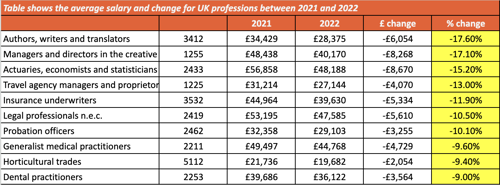
Worryingly enough, it’s even possible to end up paying too much tax on your private pension. If you overpay tax on the actual income from it, your provider may simply pay you back. If not, you might get a P800 from HMRC to settle the books. If neither of those things happens, though, it’s time to call HMRC.
For lump sums, it all depends on whether we’re talking about a “defined benefit” or “defined contribution” scheme.
For defined benefit lump sums, you should get an automatic repayment if you’re on Self Assessment. If you’re not, you’ll need to send a P53 form to the taxman to square it all up.
For defined contribution schemes where you’ve used up your entire pension pot, you’ll find yourself using form P53Z or P50Z, depending on whether or not you’ve got any other taxable income. If there’s anything left in your pot, you’ll use form P50 to get your refund, as long as you’re not taking regular payments from your pension. If you are, we’re back to waiting for a P800 calculation from HMRC if your provider doesn’t refund you automatically.
You'll need the P55 form to claim back overpaid tax after you’ve “flexibly accessed” your pension pot, without emptying it. You can use it to claim back tax if you’ve taken part of your pension pot and won’t be taking regular payments from it, and if your pension body can’t give you a tax rebate itself.
For pensions you’ve inherited, believe it or not, the rules get even trickier. It might be worth talking to a tax expert if you don’t know where you stand.
Whenever you pay money into your pension, the government tops it up with an extra contribution based on the tax band you’re in. It’s like getting back the tax you paid on that portion of your earnings.
If you've "flexibly accessed" your pension pot without emptying it you may end up paying too much tax on the money withdrawn. Learn how to use a P55 form to claim it back.
Your tax relief on pension contributions is paid automatically, and depends on the highest rate of tax you pay. While the same basic system is used across the UK, Scotland has slightly different tax brackets so they have their own rates and thresholds.
If you’ve “flexibly accessed” your pension pot, without emptying it you may need a P55 form to claim back any overpaid tax on the money.
The pension tax relief you qualify for depends on the highest tax band you’re in. Basic rate taxpayers get tax relief of 20%, higher rate payers get 40% and people paying the additional rate get 45%.
In Scotland, the pension tax relief rates are:
Salary sacrifice is a system where an employee can agree to a lower salary in exchange for some other benefit. Examples of these benefits might include childcare vouchers or contributions to a pension scheme. When an employee chooses to use salary sacrifice, it can mean they end up paying less in Income Tax and National Insurance.
Salary sacrifice might not be such a great option for people earning lower incomes, since you’re not able to reduce your salary below the legal Minimum Wage.
It might be difficult without but lets just double check you can't get hold of them ((P60, payslip last 3 months, passport, driving licence.). It will save you a lot of work if you set up a PTA. HMRC website is safe to use with sensitve info, help us get and accurate refund and accelerate the time to submit your refund claim.
We can absolutely still help you with your refund but this way will be much quicker, safer and reliable with the HMRC website, we've been doing this for over 25 years and this is 100% the best and easiest way.
Everyone is different but we've helped over 140,000 customers and the customers that do it this way find it much easier. It's a super safe platform on HMRC for sensetive info, be more reliable info and help our expert team get the most they can for you.
Its a Personal Tax Account. HMRC provides this for everyone, it will have all your info there and you can give limited access to our team to get info needed quickly and safely.
You don't have to but it will make things a bit harder for you, and we could end up with the wrong info. It will only give our Tax Specialist Team limited access through what they call an agent portal, and you'll still be able to remove us at any time for any reason.
We'll send you an email with a specific link for you to provide us with access, you'll just need to follow the steps on the HMRC website. Call us to find out more and get your link to a Personal Tax Account
This will just be one part of it, our Tax Specialist Team will assess your info and then submit a refund claim based on getting the most back for you, we also gaurentee the refund if all the info is correct, spend hours working directly with HMRC for you and make sure the money you're owed is back with you. We've succesfully claimed around £380m back in 25 years.
We can help you on the phone if you want, although it's a simple HMRC website. You'll just need to click the link we send to take you straight there and then follow the steps. Give it a try and just call us up if you need help.
Not everyone, but for 25 years we've tried to make things easy for customers and we appreciate this is really sensitive info so using a secure HMRC website is the best way. It's also super easy.
Just hit the link below to set up your personal tax account
If your income’s under £17,500 and you need to claim back some tax on savings or PPI interest, you can use HMRC’s R40 form to get your money back. This will probably take around 6 weeks. For people with higher incomes, there are a couple of extra hoops to jump through. If you’re a basic rate taxpayer, you’re allowed to earn up to £1,000 before you owe any tax on it. For higher rate taxpayers, the threshold is £500. Either way, this is called your Personal Savings Allowance (PSA). If you’ve had tax taken from your interest without using up your PSA, you can use form R40 to claim it back.
You’re not limited to claiming back your overpaid tax from your current job, either. If your previous employer has already given you your final pay-out and you’re now working somewhere else, there’s not much to do. You’ll probably simply get your refund through your pay. If you already had your new job before you left your old one, then HMRC will settle up when they next check your tax code. Again, though, this all depends on them having all the information they need. If they don’t have the full picture, you’ll need to fill in the blanks for them.
A lot of people decide to go into business for themselves after leaving a PAYE job. If you find yourself on benefits like Jobseeker’s allowance or Employment and Support Allowance, you won’t be able to claim back any refund you’re owed straight away. If HMRC decides you’re owed anything back, you’ll get it either at the end of the tax year or when you start a new job.
If you’re not getting benefits, and you’ll be getting a workplace pension before the end of the tax year, once again you’ll get back anything you’re owed the next time your tax code is checked. Otherwise, you’ll have to make your claim yourself – either directly or through the Self Assessment system, depending on your situation. You can either hash this out with HMRC yourself or you can use RIFT. We've been claiming back overpaid tax for people like you since 1999. We know the rules like the back of our hand. The average 4-year tax rebate from RIFT is worth £3,000.
For anyone who’s left one PAYE job and is looking to start another within 4 weeks, tax problems can often be handled by just making sure your new employer has parts 2 and 3 of your P45 form. If you’re owed tax back from previous tax years, then you’ll either get a P800 form or RIFT can deal with it for you. Meaning all you have to think about is how you'll spend you refund.
Our standard charges are:
When we receive your refund from HMRC we take out our fee and then pay it the refund to you. There are no up front charges to pay for anything. If you are not due a refund then there is no charge.
Before we send your claim to HMRC we sent a copy to you with a full breakdown of all the fees so you can clearly see:
You will need to sign and send this back to us to say you have read, understood and agreed with it, along with a declaration that all the information you have provided about your claim is true. This means you will never be charged any fees you have not agreed to.
There are no further fees to pay, and no hidden charges.
All aftercare is included (if you need us to call HMRC on your behalf, if you have a problem you would like us to resolve with them, if your tax code needs correcting etc).
Your refund is covered by the unique RIFT Guarantee which means that whatever happens, your refund stays in your own pocket and will never go back to HMRC. If we fight any HMRC enquiries for you (still included in the cost) and if anything did go wrong (which it never has in 15 years) we would pay back the refund to HMRC ourselves.
We will also send you a reminder when it's time to see if you have a claim next year.
Please do!
Not only will you be doing them a big favour if you can get some cash back in their pockets but we'll pay you a £50 referral reward for anyone who does go on to claim through us.
Until the 9th of October we'll also pay you an extra bonus of £150 if 5 people claim with us (T&Cs apply)
If you tell them to apply now they'll get their tax refund in time for Christmas and you'll get something extra to stuff in your stocking. That could be £400 in your pocket as well as the warm glow you get from helping out your mates.
To get started:
Not sure which friends could claim? Find out more about who can claim tax refunds.
There's no limit to the number of people you can refer and we pay out the rewards every week. It could be a nice little extra in your pocket, as well as the lovely warm feeling you get from knowing you helped out a mate.
Find out more about the referral scheme.
Our standard charges are:
Don't worry if you had a mixture of self-employed and PAYE (employed by a company) work during the period you want to claim for. We can work out if you would be due a refund and let you know what the fee would be.
See our full list of services with prices and options.
When we receive your refund from HMRC we take out our fee and then pay you your refund. There are no up front charges to pay for anything. If you are not due a refund then there is no charge.
Before we send your claim to HMRC we send a copy to you with a full breakdown of all the fees so you can clearly see:
You will need to sign and send this back to us to say you have read, understood and agreed with it, along with a declaration that all the information you have provided about your claim is true. This means you will never be charged any fees you have not agreed to.
There are no further fees to pay, and no hidden charges.
All aftercare is included (if you need us to call HMRC on your behalf, if you have a problem you would like us to resolve with them, if your tax code needs correcting etc).
Your refund is covered by the unique RIFT Guarantee which means that whatever happens, your refund stays in your own pocket and will never go back to HMRC. If we fight any HMRC enquiries for you (which is included free of charge) and if they did demand any money back, we would pay back the refund to HMRC ourselves.
We will also send you a reminder when it's time to see if you have a claim next year.
If you’re ready to invest your time, there’s serious money to be made from these pro-level options. The good news? You still don’t have to invest in any expensive equipment - at least not at the start.
Starting a successful Youtube channel is not as complex as you might think and you don’t even need to be on camera yourself - you could take photos with your phone and narrate using your webcam’s microphone. Plenty of popular channels even do perfectly well with a stock video subscription. Where there’s time invested, there’s a greater return. And you’re now in the territory of no longer trading your time for money. While time does go into creating the video, that video can stay on Youtube for as long as you like, so it can pay you back again and again in ad revenue and sponsorships - ONCE you’ve got yourself a loyal audience. It’s likely going to take months or years to get there - but it’s totally doable. And it requires no extra equipment to start with.
Podcasts are another option if you’re not sold on having your face on camera. There are podcast studios you can rent out by the hour in many cities - they can cost just £15 an hour to rent out, with all equipment included. But there’s no reason you can’t start out using your laptop mic and some free software. If you’ve got a Mac, for example, GarageBand will do the job nicely.
You can post your podcast episodes in multiple places - like Spotify and Soundcloud. So there’s potential to have a fairly wide reach on multiple platforms. Much has been made of platforms like Spotify paying music artists fractions of pennies per stream. But that’s not necessarily the case for podcasts. Your content is your own - musicians can’t easily put adverts and endorsements in their songs, but you can put them in your podcast episodes!
So you’ll get paid by the platform for your steams, AND can charge advertisers to be featured in the content of your show. It could be a simple shout-out, or could be a review of their product they pay you for. Again, you’ll need to invest your time into growing an audience before the ad money starts rolling in. But like a Youtube video, your podcast episodes can, in theory, pay you back forever.
Do you like gaming? Why not start a Twitch channel? Twitch’s revenue system is a little different to Youtube, Spotify, and co. Instead of just giving you a cut of the ad revenue your content generates, Twitch users pay you directly for the content they like. They purchase credits and can give them to content creators as rewards. So with Twitch, it’s actually possible to make decent money without huge audience numbers. As long as you find an audience who likes what you do, they can reward you directly.
You don’t have to be JK Rowling to write a book that will make you some cash. Sure, it would be great to get a novel on the New York Times bestseller list. But writing how-to guides and self-publishing can be just as lucrative. Again, it’s all about finding your niche. Maybe you know loads about a particular type of car? Or maybe you’re an expert in native birdsong? The point is, you don’t have to write the next Twilight saga. Just write about what you know. Find the right self-publishing platform, and get the word out to people you think will like it. Social media is a great place to start.
This is probably the most traditional route into property investment. You buy a secondary property, rent it out to tenants over a long period of time, using the rent to pay for the mortgage or recoup the cost of the property.
Unless you’re already sitting on a chunk of money to buy the property outright, you’ll need to take out a specific buy-to-let mortgage. These differ from your standard residential mortgage in a couple of ways. Firstly, the minimum 5% deposit for a residential property often rises to 25% for a buy-to-let. Monthly payments are also often higher so you’ll need to crunch your numbers to make sure your bottom line isn’t affected.
With the stamp duty holiday now over in the UK (at time of writing March 2022), an additional fee must be paid on top of your initial deposit which is currently 3% of the total value in most cases.
Once you’ve got your property you’ll officially gain the status of landlord. With this comes extra legal obligations such as ensuring a safe environment to your tenants. If you prefer a hands-off approach you can hire a property manager for an additional cost. If you consider yourself handy with DIY, now’s the best time to polish up on your skills to prevent any bumps further down the road. It's also worth noting that once you become a landlord you'll also need to submit a self-assessment tax return each year too.
Due to government measures, buy-to-lets have less profitable punch when compared to the past. Although the first £1,000 of your property’s rent is tax-free, higher and additional tax rate payers feel the pinch the most when it comes to profit. Previously, landlords could deduct mortgage interest payments from their rental income. Today’s landlords can only take advantage of a 20% tax credit on their interest. This means that if you currently pay 40% or 45% tax on your salary, you’ll be paying more for your property’s income.
It is possible to set up a limited company to include these mortgage interest payments within, however if you’re new to property investment, it may be a good idea to seek professional advice.
Acting as the halfway house to house renovation, pre-renovating is all about putting in the hard labour for potential buyers.
Imagine that a family has just inherited a fully-furnished house that hasn’t been looked after and is in need of a full decoration. They list this property under market value at £130,000 with average house prices in the same area valued at £160,000. After stripping the property to its bare-bones and tidying up the garden, you’re now able to sell the property for £140,000 thanks to a bit of elbow grease.
Unlike a full renovation, your aim isn’t to transform the entire house. Instead, the most used method is to buy a property that’s generally looking worse for wear, tidying it up with some simple cosmetics, before selling it on again for a quick profit to renovators or movers looking for a DIY project.
The main challenge with this method is that it takes a particular type of house in order to reap the profits. You must be able to identify the fine line between an unpolished gem and a house that’s barely worth its bricks. Knowing the area will help you roughly gauge how much margin you have upon the completion of your work. Doing your research before purchase can help lessen this risk.
Stamp duty, and solicitor fees are other things to think about as they can also eat into your profit. Ensuring these are all calculated beforehand will put you in good stead before getting your hands dirty. The best case scenario is to line-up a buyer beforehand so that you can avoid estate agent fees and ensure a speedy transaction upon completion.
In comparison to pre-renovating, renovating sees larger scale works done to improve the appeal of a home. This method can be quite pricey and requires a bit of property know-how to get the best returns. As well as buying the house itself, an additional budget is needed to redesign certain aspects that will bring it to the top of a buyer’s wishlist. If you’re in need of some motivation, Hamptons estate agents found out that renovators made £48,190 on average per home during the pandemic.
When looking for a property, popping into an auction may be your best bet if estate agents aren’t quite cutting it. Although there will be bargains, be mindful of bidding wars. Thinking in the eyes of the buyer will pay dividends when you come to selling the property. Follow Kirstie and Phil’s advice of location, location, location. Even the best renovations won’t attract buyers to an undesirable part of town.
It is worth noting that the stamp duty holiday has now ended, meaning that you’ll now have to pay an additional cost depending on the purchase price. By keeping your friends close and tradesmen closer, you can lower labour and material costs that often turn out to be more than expected. Picking where to put your money is a big part of the job. Statement pieces such as a new kitchen can add somewhere between £20,000 and £30,000 to a house’s value. Loft conversions rack up even more profit, adding up to £100,000 if you manage to fit a bedroom and en-suite in there.
The foundations of any good renovation is to buy ahead of the curve in an up-and-coming location. As a general rule, you don’t want to spend any more than 70% of the renovated asking price after costs are deducted. This way you’ll make your budget work harder and ensure a tasty chunk of profit at the end.
A Real Estate Investment Trust (REIT) is when you put money into shares of a company who invest in property. Although you won’t own the property itself, you will own a stake of the company who does, allowing you to make income without the substantial startup costs.
As REITs are required by law to pay at least 90% of their income each year as dividends, the success and profit levels of the trust will determine how much money you receive in return. The more you invest into a REIT, the greater your dividends will be. As with all stocks, the price can fluctuate over time. Although property isn’t seen as high risk as other markets, it’s important to understand that your investment can still fall or rise in value.
To get started in the REIT direction, all you need to do is invest through an ISA or a SIPP since these companies are listed on the London Stock Exchange. If you’re unsure on the differences between the two account types you may want to read our article on them here.
Similar in a way to REITs, property crowdfunding is when fellow investors get together to put money into property. However, rather than buying shares of a company, you are actually buying a small share in a property. What makes this method attractive is that you can kickstart your property investment journey for a fraction of the cost when compared to other routes.
As there are different types of property crowdfunding, we’ll stick with the most common form. Through a crowdfunding platform you invest anywhere from £100 to £1,000 into a property. You then earn money through the property being let to tenants and the rent is divided according to each investor’s share.
As you’ll technically be in the business of renting, your risks are the same as a landlord, only at a much smaller scale. Your property’s value may fall or there may be times when your property sits vacant, meaning no income is gathered at all.
Performance is very hard to predict even if platforms will estimate how much will be returned. Depending on the platform, you’ll either be paid monthly, quarterly, or annually so it might not be best for those looking for a reliable income. It’s worth keeping an eye out for platform management and managing agent fees who will take a percentage of the total income. You may find cheaper rates on some platforms but be careful to limit your risk if they do not have a good reputation.
What we need from you:
Why do I need to send documents?
We need certain documents to verify your details and process your tax claim. Without them, we can’t move forward with your refund.
What we need from you:
Why do I need to send documents?
We need certain documents to verify your details and process your tax claim. Without them, we can’t move forward with your Self Assessment.
What we need from you:
Why do I need to send documents?
We need certain documents to verify your details and process your tax claim. Without them, we can’t move forward with your refund.
To help us meet AML requirements, we kindly ask you to provide the following documents:
Proof of identity:
A valid government-issued photo ID, such as:
Proof of address:
A valid document that evidences your current residential address, such as:
This must be different to the Proof of Identity provided.
No – we’ll contact you directly to confirm your prize and payment.
If you’ve had a tax refund yourself, you know how it works and that people really do need to claim it from HMRC.
Many people are rightly wary of scams or think their employer makes sure they haven't paid too much tax so you can reassure them that you have made a claim and it works.
The quickest way to refer your friends is in the RIFT App or using our online form.
You can also phone, email, FB, Livechat us with your friends email address or mobile number so we can send them an invitation to see if they are due a refund and send you a reward if they claim with us.
Absolutely! We want you to get the credit – and the cash – when they make their claim.
If they can tell us your name and your postcode, mobile or email address then we should be able to see that it was you who sent them our way and make sure that you get paid if they claim.
Alternatively you can tell them your RIFT reference number so they can quote it to us when they get in touch. That way, you can be sure.
Logging into the app or using the refer a friend form means they get sent a link that includes your reference number so there’s never an issue with that.
You and your friends can also find us on Facebook, and Instagram. Feel free to keep getting the word out by sharing our posts and tagging your friends to let them know they could have a refund claim.
We pay your referral rewards once the person you referred has made a successful claim with us.
If you think you are missing a payment the first thing to do is check with your friend if they got in touch and started a claim with us. You can also check the progress of all your referrals in the app.
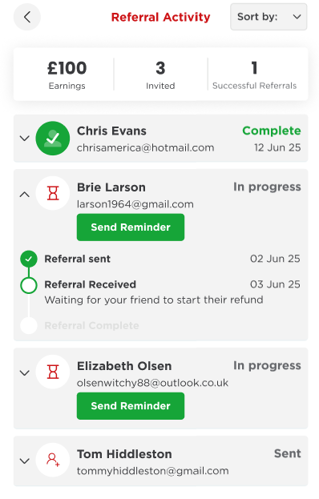
If they’ve started their claim, that’s great news for you both as they’ll be getting a refund and you’ll be getting your reward. As you’ll know from your own claim, the process can take several weeks after they first get in touch with us to get their claim completed and sent to HMRC. As soon as that happens though, you’ll get your payment.
It might be that the person you referred either wasn’t owed anything by HMRC this year, decided not to use RIFT, had already been referred by someone else or didn’t use your reference number when they first got in touch with us.
If they did use the link we sent them, and they’ve had their refund payment but you haven’t got your reward then please get in touch with us right away.
Anyone who uses their own vehicle or public transport to travel to temporary workplaces or Armed Forces postings and training (under 24 months) may be due a tax refund.
You can refer anyone to us that you think we can help. With 1 in 3 UK taxpayers paying too much tax, and over 87% of people who are referred to us being due a refund, there’s a good chance that people you know are missing out on money that could really make a difference.
Absolutely, please pass our details to anyone you think we can help.
If they’re paying from their own pockets for work travel or other essential expenses, then the odds are good that they’re owed money.
When you refer them we'll send an email with a link to the website where they can check if they are due a refund and read a bit more about RIFT.
In fact, 87% of people referred to RIFT find out they’re owed tax back from HMRC.
When you refer someone to RIFT using app or the refer a friend form, we send them a one-off email or text with a link in it.
When they click that link, we’ll know automatically it was you who referred them.
You and your friends can also find us on Facebook, and Instagram. Feel free to keep getting the word out by sharing our posts and tagging your friends to let them know they could have a refund claim.
If they decide to phone us instead to check if they’re owed tax back, remind them to tell us who referred them so we can get you your rewards.
If they can tell us your name and your postcode, mobile or email address then we should be able to see that it was you who sent them our way and make sure that you get paid if they claim.
Once you log in to the app you can use the form to refer people either directly from your phone contacts or by adding their details manually.
For every friend you refer who makes a claim, we'll pay you £100 for your first successful referral and then £50 for every one after that.
There's no limit to the number of people you can help by referring them to RIFT.
And that's not all! After you receive your first referral payment you become a VIP and have access to a choice of monthly rewards.
We’ve made Refer a Friend more rewarding for everyone:

It's simple to get started.
Just fill out our referral form with your friend's details (name and mobile number or email address) and we'll handle the rest here on the website or in the RIFT app.
We’ll send them a one-off email or SMS to let them know they might have a refund claim with a link to our website where they can check.
If they do claim a refund through us, we'll pay you £100 as a thank-you bonus for your first successful friend and £50 for every one afterwards.
Once you get your first successful referral payment, you become a VIP and can choose a reward each month.
You can track the how all your referrals are progressing in the RIFT app.
There’s not limit to how many people you can send our way and you’ll get a reward for every one who claims.
If you would like to be entered into the prize draw as your VIP reward for the month:

You can only be entered into one of the monthly reward categories each month. This refreshes at the start of the next month.
Please see full Terms and Conditions for all of the details.
It’s easy!
You can refer friends:
For every friend you refer who makes a claim, we'll pay you £100 for your first successful referral and then £50 for every one after that.
There's no limit to the number of people you can help by referring them to RIFT.
And that's not all! After you receive your first referral payment you become a VIP and have access to a choice of monthly rewards.
Once your friend’s refund is completed, your reward will be paid to you automatically.
You’ll become a VIP referrer once you’ve made at least one successful referral.
Your current status is shown in the RIFT Tax Refund app and we’ll let you know by email when your VIP status is activated.

Once you're a VIP don't forget to choose your monthly reward!
When you're a VIP you'll earn:
VIPs can unlock exclusive offers and promotions at different times throughout the year, keep an eye on your email to see what's coming.
Visit the VIP page here on the site or explore the VIP area in the app.
If you're not yet a VIP all you need to do is make one successful referral to join the club.
If you win, your reward will be paid the following Friday:
We'll pay into the bank account we pay your refunds into and you can which one this is by logging into MyRIFT and checking the Banking Details section.
When you are a VIP you will be able to go into the RIFT Tax Refunds app each month and choose either:

If you win on the scratchcard or are able to choose a voucher, your reward will be paid the following Friday.
If you enter the prize draw, the winner will be selected at the start of the following month,
You can only select one reward per month.
You can track your referrals in the RIFT Tax Refunds app in the Referral Activity. It shows who you’ve referred and their current status.
Yes, your friends also benefit by getting expert support and the best chance at their full tax refund from RIFT.
No there isn't. The more successful referrals you make, the more you earn.
Some of our top referrers have made hundreds of pounds.
Only new customers count as valid referrals. If your friend has claimed with us before, it won’t qualify for a referral reward.
No, this is no longer part of the Refer a Friend offering.
If anyone calls in about it, please raise it with your Team Leader.
If you would like to play the scratchcard as your VIP reward for the month:

Referrers can only be entered into one of the monthly reward categories each month. This refreshes at the start of the next month.
Please see full Terms and Conditions for all of the details.
If you would like to choose a voucher as your VIP reward for the month:

Referrers can only be entered into one of the monthly reward categories each month. This refreshes at the start of the next month.
Please see full Terms and Conditions for all of the details.
If you’ve had a tax refund yourself, you know how it works and that people really do need to claim it from HMRC.
Many people are rightly wary of scams or think their employer makes sure they haven't paid too much tax so you can reassure them that you have made a claim and it works.
The quickest way to refer your friends is in the RIFT App or using our online form.
You can also phone, email, FB, Livechat us with your friends email address or mobile number so we can send them an invitation to see if they are due a refund and send you a reward if they claim with us.
Absolutely! We want you to get the credit – and the cash – when they make their claim.
If they can tell us your name and your postcode, mobile or email address then we should be able to see that it was you who sent them our way and make sure that you get paid if they claim.
Alternatively you can tell them your RIFT reference number so they can quote it to us when they get in touch. That way, you can be sure.
Logging into the app or using the refer a friend form means they get sent a link that includes your reference number so there’s never an issue with that.
You and your friends can also find us on Facebook, and Instagram. Feel free to keep getting the word out by sharing our posts and tagging your friends to let them know they could have a refund claim.
We pay your referral rewards once the person you referred has made a successful claim with us.
If you think you are missing a payment the first thing to do is check with your friend if they got in touch and started a claim with us. You can also check the progress of all your referrals in the app.
If they’ve started their claim, that’s great news for you both as they’ll be getting a refund and you’ll be getting your reward. As you’ll know from your own claim, the process can take several weeks after they first get in touch with us to get their claim completed and sent to HMRC. As soon as that happens though, you’ll get your payment.
It might be that the person you referred either wasn’t owed anything by HMRC this year, decided not to use RIFT, had already been referred by someone else or didn’t use your reference number when they first got in touch with us.
If they did use the link we sent them, and they’ve had their refund payment but you haven’t got your reward then please get in touch with us right away.
Anyone who uses their own vehicle or public transport to travel to temporary workplaces or Armed Forces postings and training (under 24 months) may be due a tax refund.
You can refer anyone to us that you think we can help. With 1 in 3 UK taxpayers paying too much tax, and over 87% of people who are referred to us being due a refund, there’s a good chance that people you know are missing out on money that could really make a difference.
Absolutely, please pass our details to anyone you think we can help.
If they’re paying from their own pockets for work travel or other essential expenses, then the odds are good that they’re owed money.
When you refer them we'll send an email with a link to the website where they can check if they are due a refund and read a bit more about RIFT.
In fact, 87% of people referred to RIFT find out they’re owed tax back from HMRC.
When you refer someone to RIFT using app or the refer a friend form, we send them a one-off email or text with a link in it.
When they click that link, we’ll know automatically it was you who referred them.
You and your friends can also find us on Facebook, and Instagram. Feel free to keep getting the word out by sharing our posts and tagging your friends to let them know they could have a refund claim.
If they decide to phone us instead to check if they’re owed tax back, remind them to tell us who referred them so we can get you your rewards.
If they can tell us your name and your postcode, mobile or email address then we should be able to see that it was you who sent them our way and make sure that you get paid if they claim.
Once you log in to the app you can use the form to refer people either directly from your phone contacts or by adding their details manually.
For every friend you refer who makes a claim, we'll pay you £100 for your first successful referral and then £50 for every one after that.
There's no limit to the number of people you can help by referring them to RIFT.
And that's not all! After you receive your first referral payment you become a VIP and have access to a choice of monthly rewards.
We’ve made Refer a Friend more rewarding for everyone:
It's simple to get started.
Just fill out our referral form with your friend's details (name and mobile number or email address) and we'll handle the rest here on the website or in the RIFT app.
We’ll send them a one-off email or SMS to let them know they might have a refund claim with a link to our website where they can check.
If they do claim a refund through us, we'll pay you £100 as a thank-you bonus for your first successful friend and £50 for every one afterwards.
Once you get your first successful referral payment, you become a VIP and can choose a reward each month.
You can track the how all your referrals are progressing in the RIFT app.
There’s not limit to how many people you can send our way and you’ll get a reward for every one who claims.
If you would like to be entered into the prize draw as your VIP reward for the month:
You can only be entered into one of the monthly reward categories each month. This refreshes at the start of the next month.
Please see full Terms and Conditions for all of the details.
It’s easy!
You can refer friends:
For every friend you refer who makes a claim, we'll pay you £100 for your first successful referral and then £50 for every one after that.
There's no limit to the number of people you can help by referring them to RIFT.
And that's not all! After you receive your first referral payment you become a VIP and have access to a choice of monthly rewards.
Once your friend’s refund is completed, your reward will be paid to you automatically.
You’ll become a VIP referrer once you’ve made at least one successful referral.
Your current status is shown in the RIFT Tax Refund app and we’ll let you know by email when your VIP status is activated.
Once you're a VIP don't forget to choose your monthly reward!
When you're a VIP you'll earn:
VIPs can unlock exclusive offers and promotions at different times throughout the year, keep an eye on your email to see what's coming.
Visit the VIP page here on the site or explore the VIP area in the app.
If you're not yet a VIP all you need to do is make one successful referral to join the club.
If you win, your reward will be paid the following Friday:
We'll pay into the bank account we pay your refunds into and you can which one this is by logging into MyRIFT and checking the Banking Details section.
When you are a VIP you will be able to go into the RIFT Tax Refunds app each month and choose either:
If you win on the scratchcard or are able to choose a voucher, your reward will be paid the following Friday.
If you enter the prize draw, the winner will be selected at the start of the following month,
You can only select one reward per month.
No – we’ll contact you directly to confirm your prize and payment.
You can track your referrals in the RIFT Tax Refunds app in the Referral Activity. It shows who you’ve referred and their current status.
Yes, your friends also benefit by getting expert support and the best chance at their full tax refund from RIFT.
No there isn't. The more successful referrals you make, the more you earn.
Some of our top referrers have made hundreds of pounds.
Only new customers count as valid referrals. If your friend has claimed with us before, it won’t qualify for a referral reward.
If you would like to play the scratchcard as your VIP reward for the month:
Referrers can only be entered into one of the monthly reward categories each month. This refreshes at the start of the next month.
Please see full Terms and Conditions for all of the details.
If you would like to choose a voucher as your VIP reward for the month:
Referrers can only be entered into one of the monthly reward categories each month. This refreshes at the start of the next month.
Please see full Terms and Conditions for all of the details.
If you would like to be entered into the prize draw as your VIP reward for the month:
You can only be entered into one of the monthly reward categories each month. This refreshes at the start of the next month.
Please see full Terms and Conditions for all of the details.
You’ll become a VIP referrer once you’ve made at least one successful referral.
Your current status is shown in the RIFT Tax Refund app and we’ll let you know by email when your VIP status is activated.
Once you're a VIP don't forget to choose your monthly reward!
When you're a VIP you'll earn:
VIPs can unlock exclusive offers and promotions at different times throughout the year, keep an eye on your email to see what's coming.
Visit the VIP page here on the site or explore the VIP area in the app.
If you're not yet a VIP all you need to do is make one successful referral to join the club.
If you win, your reward will be paid the following Friday:
We'll pay into the bank account we pay your refunds into and you can which one this is by logging into MyRIFT and checking the Banking Details section.
When you are a VIP you will be able to go into the RIFT Tax Refunds app each month and choose either:
If you win on the scratchcard or are able to choose a voucher, your reward will be paid the following Friday.
If you enter the prize draw, the winner will be selected at the start of the following month,
You can only select one reward per month.
If you would like to play the scratchcard as your VIP reward for the month:
Referrers can only be entered into one of the monthly reward categories each month. This refreshes at the start of the next month.
Please see full Terms and Conditions for all of the details.
If you would like to choose a voucher as your VIP reward for the month:
Referrers can only be entered into one of the monthly reward categories each month. This refreshes at the start of the next month.
Please see full Terms and Conditions for all of the details.
If you would like to be entered into the prize draw as your VIP reward for the month:
You can only be entered into one of the monthly reward categories each month. This refreshes at the start of the next month.
Please see full Terms and Conditions for all of the details.
You’ll become a VIP referrer once you’ve made at least one successful referral.
Your current status is shown in the RIFT Tax Refund app and we’ll let you know by email when your VIP status is activated.
Once you're a VIP don't forget to choose your monthly reward!
When you're a VIP you'll earn:
VIPs can unlock exclusive offers and promotions at different times throughout the year, keep an eye on your email to see what's coming.
Visit the VIP page here on the site or explore the VIP area in the app.
If you're not yet a VIP all you need to do is make one successful referral to join the club.
If you win, your reward will be paid the following Friday:
We'll pay into the bank account we pay your refunds into and you can which one this is by logging into MyRIFT and checking the Banking Details section.
When you are a VIP you will be able to go into the RIFT Tax Refunds app each month and choose either:
If you win on the scratchcard or are able to choose a voucher, your reward will be paid the following Friday.
If you enter the prize draw, the winner will be selected at the start of the following month,
You can only select one reward per month.
If you would like to play the scratchcard as your VIP reward for the month:
Referrers can only be entered into one of the monthly reward categories each month. This refreshes at the start of the next month.
Please see full Terms and Conditions for all of the details.
If you would like to choose a voucher as your VIP reward for the month:
Referrers can only be entered into one of the monthly reward categories each month. This refreshes at the start of the next month.
Please see full Terms and Conditions for all of the details.
We all have a certain tolerance for risk. However, when it comes to keeping a roof over your head the stakes are much higher. When it comes to how much you need to save, most people will say you need between 3 to 9 months of expenses. Note how we said expenses and not outgoings.
In the absolute worst-case scenario of losing your job overnight, it’s possible to limit your spending to just your essentials. This is where budgeting comes in handy. Something you can learn about in our How to Budget Money for Absolute Beginners video. Click the play button below.
To work out your basic expenses you’ll need to sit down and add up all of the following:
Once this is all added up, you now have the figure for one month’s expenses. As an example, if your expenses were £1,000 a month and aimed for a 6-month emergency fund, your target would be £6,000. If you have a high amount of credit card debt, it may be worth trying to reduce this before trying to build your emergency fund. High-interest rates can soon make paying this back extremely difficult and counteract any savings you make. When choosing how many months to aim for depends on your circumstances.
As you’re planning for the worst-case scenario, you may find it equally easy or difficult to find a new job. The more months you can afford without a steady income, the more security you have. If in doubt, always err on the side of caution. The last thing you’ll want is to run out of money and still be without an income.
And remember, building up an emergency fund will be easier for some than it will be for others. Certain methods of saving are best suited for different individuals and their circumstances. So if ever in doubt, speak to a financial advisor.
Whether your course or assignment lasted for a single week or 2 long years, it will still count as a “temporary workplace” in HMRC’s eyes.
That means you may qualify for a tax refund for costs like essential travel.
The amount you can claim, naturally, will depend on how far and how often you travelled in a tax year.
If you’re part of the Armed Forces community, you can claim back tax for your travel expenses for training or temporary postings of 24 months or less.
If you’ve paid too much tax in the last 4 years, whether you’ve been travelling in your own vehicle or by public transport, you could have a tax rebate claim worth over £3,000 on average.
There are other military expenses you can claim for, too - and you can even get a refund if you’ve been posted overseas
No. You make a tax refund claim for the eligible costs you run up in a tax year (from the 6th of April to the following 5th of April). If you attended a course from July in one year to June the next, for example, your refund claim would cover the period from July to April.
To qualify for a tax refund, you need to be covering the costs of your own travel - paying fuel costs for your own vehicle or ticket costs for public transport (including things like rail and air travel). If you’ve received a travel warrant for a journey, for instance, you couldn’t include that in your claim since you didn’t pay the travel cost yourself.
Yes, absolutely! Travel is usually the single biggest part of a tax refund claim, but other eligible costs can include things like Mess Dress and food or accommodation bills when you’re travelling to temporary workplaces or training locations.
To get the most from an Armed Forces tax refund, you need to claim for more than just travel costs to temporary postings. Military tax refund claims can also include things like:
Yes — and confusion over this leads to many Armed Forces personnel missing out on their mileage claims! The GYH, HTD and MMA rates are lower than those set by HMRC, so you can claim back the difference as a tax refund if you have qualifying expenses.
With RIFT, even complicated Armed Forces tax refunds are simple and hassle-free. Our specialist teams are experts in military money and travel, and take care of all the hard work and heavy lifting of claiming your refunds.
Here’s the basic paperwork it takes to get back everything HMRC owes you:
With the basics sorted, we’ll ask you a couple of simple questions about your money situation. HMRC will want to know about any other cash you’ve got coming in, for example, or whether you’re paying off a Student Loan or have a private pension.
There are specific rules about your accommodation that affect the military refund you’re owed, so talk us through your living arrangements, too. We’ll help you set up a Personal Tax Account, if you don’t already have one. It’s free, and means you can see all your important tax, employer and other information in one place.
To keep everything simple, we’ll set you up with a MyRIFT account as well. With MyRIFT, you can track your claim and update all the important details from anywhere in the world. Keeping your information up-to-date is essential, so MyRIFT puts you in the driving seat and on the fast track.
HMRC will expect your refund claim to be backed up with evidence of the costs you’re claiming for. A lot of the essential information will come from your payslips and similar documents, so you may not need a lot of extra paperwork.
A RIFT tax specialist will talk you through the kinds of evidence you’ll need. We can also help you replace or track down documents, evidence and paperwork if you no longer have it.
HMRC’s going to want to see a thorough breakdown of your travel costs before coughing up your refund. Your wage slips show whether you've already received any expenses toward your travel.
Since you’re only owed a refund on costs you’ve actually paid out yourself, any expenses you’ve received will bring down what you’re owed by HMRC. If you’ve received nothing toward your travel, your wage slips will prove this.
Don’t stress out too much if you don’t have these to hand. You can download your wage slips from the JPAC website and RIFT can get your P60s straight from HMRC for you.
Yes, definitely! These are very important documents and the cornerstone evidence for putting your tax refund claim together. Try to keep a copy of your Assignment Orders for every base you’ve travelled to. If you’ve got gaps in your record, you can print your orders off from JPA as long as you do it within 60 days.
MyRIFT keeps everything simple and fast. You can upload important documents and track your claim’s progress from anywhere in the world. If you don’t have every last scrap of information, MyRIFT can even help track down details of your drafts so you never miss out on the refunds you’re owed.
On average, it can take HMRC up to 12 weeks to process a tax refund claim.
Find out more about how long it takes to get your tax refund payment.
Of course – and you really should, whether you’re still in the Armed Forces or not. Your essential work expenses might vary from year to year, but as long as you’re reaching into your own pocket for essential costs like travel to temporary postings, you’re still owed some tax back.
Better yet, your next year’s claim with RIFT will be even easier than your first. We’ll already have most of the information we’ll need to get your money back from HMRC. You can claim back what you’re owed for up to 4 years, whether you’re still in the Armed Forces or not.
If you’ve moved into civilian work and still travel to temporary workplaces, RIFT can keep getting your refund cash back for you. If you’ve decided to become self-employed instead, we can even take care of your Self Assessment paperwork, keeping your tax bill down and making sure you stay in HMRC’s good books.
Sometimes, HMRC will change your tax code after you’ve made a tax refund claim.
They do this on the assumption that the costs you claim tax relief for won’t change year-on-year. However, if your costs do change, this means you can end up on the wrong tax code. RIFT works with HMRC to make sure your tax code is always correct, including regular automated checks.
If you do notice an unexpected change in either your tax code itself or your wages, or if HMRC sends you a notification of a change directly, get in touch with us immediately. If there’s a problem or an error, we’ll get it fixed.
Depending on your situation and the information you’ve provided in your refund claim, you might be asked to file a tax return the following year. If so, RIFT can help.
You can read the letter DIN '2015DIN01-005' the MOD sent us for assurance that Armed Forces tax refunds are 100% legit and allowed.
Once we’ve got all the information and we are your tax agent, we will calculate your refund. If you are eligible, we put our money where our mouth is and start paying out. We’ve worked out exactly what you’re owed, so why wait weeks longer for HMRC to get up to speed?
We built the service because our customers told us they wanted a faster way to get their refunds. No more putting your holiday or spending plans on hold while your claim makes its way through HMRC’s systems. You’ve earned it, so why wait for it?
None at all! Whatever your refund comes to, we’ll pay the first half 1 working day after you’ve confirmed the total we calculated, with the rest coming once HMRC confirms and pays out your claim.
You’ll normally get your first 50% pay-out within one working day of telling us you accept our calculation between Monday and Thursday. If you confirm after 2pm on a Friday, you’ll get your cash on Monday.
Rapid Refund costs an extra 8% plus VAT, on top of our normal fee for PAYE tax refunds.
For CIS refunds, it’s a flat fee of £354 plus VAT.
Once you’ve confirmed that you’re choosing Rapid Refund, we’ll call you within 24 hours to guide you through the process. You can upload your documents in MyRIFT or email them to us.
As we’ve calculated your refund and you are eligible for the offer, we put our money where our mouth is and start paying out. We’ve worked out exactly what you’re owed, so why wait weeks longer for HMRC to get up to speed.
Yes, we have just re-vamped the name from RIFT FastPay to Rapid Refund.
None at all! Whatever your refund comes to, we’ll pay the first half 1 working day after you’ve confirmed the total we calculated, with the rest coming once HMRC confirms and pays out your claim.
You’ll normally get your first 50% pay-out within 24 hours of telling us you accept our calculation between Monday and Thursday. If you confirm after 2pm on a Friday, you’ll get your cash on Monday.
Rapid Refund costs an extra 8% plus VAT, on top of our normal fee for PAYE tax refunds.
For CIS refunds, it’s a flat fee of £354 plus VAT.
Your Personal Tax Specialist will let you know once they have calculated your refund.
The paperwork your tax refund claim requires depends on what you're claiming. For flat rate uniform tax rebates, most people won't need to keep anything specific. HMRC's flat rates don't require a lot of bookkeeping to claim. You do still have to know roughly what you spent in a year, though. If it's costing you significantly more than HMRC's estimates, then good records will help you prove it. Keeping paperwork and breaking down all your expenses in a tax refund claim can be much more complicated than using HMRC’s flat rates, but it could be your best bet if the taxman’s guesswork is wide of the mark.
The way you save money affects Inheritance Tax. Savings accounts and ISAs are fully taxed above the threshold. However, pensions under trust schemes are often exempt, but without trust, the exemption may not apply unless the beneficiary is a spouse or civil partner. Seek an Independent Financial Adviser for clarity.
Nice and simple, this one. If you find you’ve overpaid tax because of a redundancy payment, you can simply call HMRC to arrange a refund. Depending on the situation, you might be able to get your money before the end of the tax year. Job done!
If you’ve had a tax refund yourself, you know how it works and that people really do need to claim it from HMRC.
Many people are rightly wary of scams or think their employer makes sure they haven't paid too much tax so you can reassure them that you have made a claim and it works.
The quickest way to refer your friends is in the RIFT App or using our online form.
You can also phone, email, FB, Livechat us with your friends email address or mobile number so we can send them an invitation to see if they are due a refund and send you a reward if they claim with us.
The scheme's very simple. Just fill out our referral form with your friend's details (name and mobile number or email address) and we'll handle the rest.
We’ll send them a one-off email or SMS to let them know they might have a refund claim with a link to our online form where they can check for free.
Remember to give them a nudge afterwards to make sure they are contacting us with your reference.
If they do make a refund through us, we'll pay you £50 as a thank-you bonus. There’s not limit to how many people you can send our way and you’ll get a reward for every one who claims. Every time 5 people you refer to us have claimed, you'll get an extra £150 on top!
87% of people referred to us do turn out to be owed money, so that could be a lot of extra cash in their pockets – and yours!
Absolutely! We want you to get the credit – and the cash – when they make their claim.
If they can tell us your name and your postcode, mobile or email address then we should be able to see that it was you who sent them our way and make sure that you get paid if they claim.
Alternatively you can tell them your RIFT reference number so they can quote it to us when they get in touch. That way, you can be sure.
Logging into the app or using the refer a friend form means they get sent a link that includes your reference number so there’s never an issue with that.
You and your friends can also find us on Facebook, and Instagram. Feel free to keep getting the word out by sharing our posts and tagging your friends to let them know they could have a refund claim.
We pay your referral rewards once the person you referred has made a successful claim with us.
If you think you are missing a payment the first thing to do is check with your friend if they got in touch and started a claim with us. You can also check the progress of all your referrals in the app.
If they’ve started their claim, that’s great news for you both as they’ll be getting a refund and you’ll be getting your reward. As you’ll know from your own claim, the process can take several weeks after they first get in touch with us to get their claim completed and sent to HMRC. As soon as that happens though, you’ll get your payment.
It might be that the person you referred either wasn’t owed anything by HMRC this year, decided not to use RIFT, had already been referred by someone else or didn’t use your reference number when they first got in touch with us.
If they did use the link we sent them, and they’ve had their refund payment but you haven’t got your reward then please get in touch with us right away.
Anyone who uses their own vehicle or public transport to travel to temporary workplaces or Armed Forces postings and training (under 24 months) may be due a tax refund.
You can refer anyone to us that you think we can help. With 1 in 3 UK taxpayers paying too much tax, and over 87% of people who are referred to us being due a refund, there’s a good chance that people you know are missing out on money that could really make a difference.
Absolutely, please pass our details to anyone you think we can help.
You can check in our RIFT App or ask your friend if they got in touch and started a claim with us. If they didn't you, you can always encourage them to get started.
Referrers are entered into the Bronze, Silver or Gold categories based on the number of £50 payments they have received within the last year, on the end date of the promotion.
Referrers can only be entered into one of Bronze/Silver/Gold categories when the prizes are drawn at the end of each promotion, regardless of how many referrals they make or payments they receive. It is possible for referrers to move between categories during a promotion, e.g. from Bronze to Silver, if they receive further £50 payments before the campaign end date.
There is currently 1 cash prize draw for each category, with the amount that can be won being £150 for Bronze, £300 for Silver and £500 for Gold.
To enter the Star Prize draw, the referrer needs to make a referral between the current promotion dates and the actual or potential claim must still be “live” at the end of the promotion – i.e. filed or actively engaging.
Anyone who makes a referral that starts a claim with us during the promotional period is in with a chance to win a RIFT Magic Moment.
Although referrers can only be entered into one of the Bronze, Silver and Gold categories, they can be entered into one of them plus the Star Prize draw if they make a referral during the current promotion. It is possible that a referrer could win the Star Prize (if there is one) and a cash prize from Bronze, Silver or Gold.
Please see full Terms and Conditions for all of the details.
Yes! There’s no upper limit to what you could earn by referring your mates, colleagues and family to RIFT. You'll get £50 reward for each person who goes on to claim their refund with RIFT, plus another £150 for each 5 people you referred.
If they’re paying from their own pockets for work travel or other essential expenses, then the odds are good that they’re owed money.
When you refer them we'll send an email with a link to the website where they can check if they are due a refund and read a bit more about RIFT.
In fact, 87% of people referred to RIFT find out they’re owed tax back from HMRC.
When you refer someone to RIFT using app or the refer a friend form, we send them a one-off email or text with a link in it.
When they click that link, we’ll know automatically it was you who referred them.
You and your friends can also find us on Facebook, and Instagram. Feel free to keep getting the word out by sharing our posts and tagging your friends to let them know they could have a refund claim.
If they decide to phone us instead to check if they’re owed tax back, remind them to tell us who referred them so we can get you your rewards.
If they can tell us your name and your postcode, mobile or email address then we should be able to see that it was you who sent them our way and make sure that you get paid if they claim.
At limited times only we offer 'Double Up' where you can be rewarded with £100 for every friend you recommend who successfully claims with us rather than the standard £50.
We last ran this promotion in February 2025, where for any referral from an eligible referrer, we will increased the amount paid per successful referral (one that results in a tax refund claim being filed with H M Revenue & Customs) to £100.
This might be difficult to swallow, but younger people really do have the edge when it comes to saving. We know, it sounds strange, given their lower average incomes and their Student Loan repayments. The thing is, when you’re younger you’ll usually have fewer unavoidable drains on your finances. From the ages of 20 to about 40, a lot of people in the UK aren’t yet coping with mortgage payments or the costs of raising kids, for instance. Again, just crunching the raw numbers, a typical Brit under 40 will have more disposable income and fewer expensive bills to pay each month. If you only start your retirement saving once all those other costs kick in, you’ll have a much harder time hitting your goals.
You might have heard it said that Albert Einstein considered a thing called “compound interest” to be the most powerful force in the universe. It’s kind of an urban legend at this point, given that the story didn’t start going round until long after Einstein was dead. Either way, though, the basic idea’s pretty sound.
So what’s compound interest and why does it matter? Well, at its heart it’s just a way of letting your money work a little harder on its own. When your savings are earning interest, over time, the interest itself starts earning interest, too. It’s like a snowball rolling down a hill. Every time it turns, it picks up more snow. Better yet, as the ball gets bigger, each roll picks up a larger amount of snow than the roll before. Over years, the interest on your interest can pack a lot of extra cash into your savings.
The same principle applies to investments, including pensions, although there’s obviously some risk involved. The returns are invested alongside your original investment to speed up the rate your money grows. It takes years to see the best benefits, of course, but that just makes it more important to start as early as you can.
This is just good sense, but getting yourself into the right kind of saving habits earlier in life is always the best plan. Those first few steps toward setting up your retirement pot need to be in the right direction, and getting used to the idea of keeping living costs under control and saving consistently will help keep you on track for life. You’re basically building a relationship with the actual idea of money, and getting that balance right from the start can dramatically improve your financial situation when you come to retire.
We’ve talked about pensions quite a lot, both in this guide and some of our others. There are obviously pros and cons to them, when you compare them to other kinds of saving or investing. You can watch more about those in our video, “Long-Term Saving: SIPP or ISA – Which Should You Choose?” – but for now, the main thing to know is that pensions are a really good way of saving for the long haul, with some very nice tax features to them.
In practical terms, though, one of the main benefits is also one of the strangest. You really don’t have easy access to your pension savings most of the time. They’re generally locked away tight until you hit the age of 55. That sounds like a pretty severe limitation – and it’s absolutely supposed to be. However, that very restriction is also one of your pension’s greatest strengths. Locking your money away like this keeps your retirement pot leak-proof, so it’ll still be there when you need it. As always, though, the sooner you get started, the more you stand to benefit.
If you are self employed, or submit a self assessment tax return for any other reason check out our information on self assessment and pensions.
Remember, if you’ve taken part of your pension pot and won’t be taking regular payments from it, and if your pension body can’t give you a tax rebate itself you may need a P55 form to claim tax relief on that money.
It’s simple mathematics. Whatever you’re saving toward, the sooner you start the easier it’ll be. Think about the kind of retirement you’re going to want. Will you need cash to travel, take cruises and spoil your grandkids rotten? The things you’ll be able to do with your life after retirement are going to depend very much on the decisions you make in your younger years. Retiring with only enough to cover your day-to-day living expenses is going to leave you with a gaping hole in your bucket list.
10 years really isn’t a huge chunk of time when you compare it to your entire working life. However, the difference that decade of saving makes can be massive. Let’s assume you’re a youngster of 25, looking to build a retirement pot of £300,000 by the time you hit State Pension age. Just to throw some fairly realistic numbers in, we’ll say you earn £29,000. According to Royal London, you’d be looking at socking away savings at a monthly rate of £380 to hit your goal. Delaying the start of your saving plan by just 10 years, however, would bump those monthly contributions up to a whopping £540 per month.
Obviously, there are some estimates and averages in those predictions, but the point is that starting earlier makes the climb toward your ideal retirement a lot less steep. When you consider that 10 years is also the length of time the average UK saver is expected to outlive their pension pot (so says the World Economic Forum), you start to see the scale of the late-saver problem.
A pretty eye-opening report from the University of Amsterdam has found that retiring sooner can actually add years to your life! While a lot of people still claim that working longer helps to keep your mind and body active, there’s another side to that coin. As the study shows, retiring earlier can cut your chances of death over the next 5 years by a staggering 42%. Admittedly, the research findings mainly apply to male Dutch civil servants – but the basic principle probably still applies to more or less anyone.
Why would this be the case? Well, for one thing, slaving all day at work isn’t always the healthiest way to spend your time. Once you’re out from under the daily grind, you’ve got more time to look after yourself, get exercise and eat well. You’re also more likely to be able to sort out quick medical attention for any sudden health concerns. For another thing, work is just sometimes flat-out stressful. That alone can ramp up your risk of life-threatening conditions like strokes and cardiovascular disease. You can’t hold back the hands of time forever but, statistically speaking, the younger you are when you retire, the healthier you’ll be.
Yes, you should still get a P45 from your last employer when you retire. You should hang onto it, too. Your pension provider will expect you to have it to hand, and you'll need it to keep your tax code straight if you make any withdrawals from your pension.
During our opening hours you can get hold of us for a chat:
Of course, busy work lives can often mean that you can’t get free to talk during opening hours. No problem! Just use our contact page, send us a private message through Facebook or email us at info@RIFTrefunds.co.uk.
If you need to update your personal information or refund claim details, the easiest way is to log into your MyRIFT account. You can even upload documents there.
To track the progress of your tax refund claim, you can either use your MyRIFT account or your free MyRIFT app.
You can also help spread the tax refund love by referring your friends to RIFT through our website or your MyRIFT app.
It doesn’t take a huge amount of paperwork to claim a tax refund with RIFT. However, the more evidence you have to back up your claim, better the result. Here are some of the most important documents for claiming your tax refund:
Don’t worry too much if you don’t have every last scrap of paperwork to hand. We can help you track down even the trickiest details to work out exactly what you’re owed.
Getting your tax refund with RIFT is simple and stress free. Here’s how it all works:
On average, it can take HMRC up to 12 weeks to process a tax refund claim.
Find out more about how long it takes to get your tax refund payment.
So, are tax refunds legal? Is RIFT Tax Refunds a legitimate company? The answer to both of these questions, of course, is a resounding yes!
The thing that most people never realise about HMRC is that they only want the tax you owe them – and not one penny more. When you shell out from your own pocket for some of the essential costs of your job, HMRC lets you claim back some tax for those expenses. It’s all completely legal – in fact, HMRC actively wants you to claim back what you’re owed.
At RIFT Tax Refunds, we take all the stress and paperwork out of claiming your yearly tax rebates. We crunch the numbers, fill in all the forms and tackle the taxman for you to make sure you get what’s yours.
With RIFT Tax Refunds, there are no up-front charges or hidden fees. In fact, if it turns out that you don’t have any tax to claim back, we don’t charge you anything at all!
Our standard charges are:
When you make your tax refund claim with RIFT, everything’s included in our single, simple fee. That includes sorting out the documents, tracking down any missing details, calculating and filing your claim and dealing with HMRC for you. RIFT also gives you year-round aftercare at no extra charge, covering things like:
Any time you have a question or a worry, you can get in touch with us for advice, guidance and practical help. It’s all part of the service.
What’s more, your refund comes with a unique RIFT Guarantee. As long as you’ve given us the information we need to handle your claim properly, we’ll keep both you and your refund completely safe. If HMRC ever disagreed with the amount we claimed and demanded some cash back, the guarantee means we’d pay them from our own pockets, not yours. It wouldn’t cost you a penny!
Yes you'll need a MyRIFT account to access the app. MyRIFT holds all the information needed to make your tax refund claim with us. It's free to set up and it's the easiest way to update your info, track your documents and make your claim.
New to RIFT
If you're new to RIFT and wanting to get your claim started, have checked that you're due a refund by answering the 4 simple questions, and filled in your name, email address and created a password then you've already created your account. You should also have received a Welcome to RIFT email that contains more information about what happens next and has all the links you need.
Login page to continue updating your information.
If you need to reset your password, you can do that from the login page.
If you need any help, give us a call on 01233 628648 or use the Live Chat to talk to one of our Customer Service Team.
Returning to RIFT
If you've claimed with us before using a paper Refund Pack or Forms by Phone and not yet set up your MyRIFT account then get in touch by calling 01233 628648 or using the Live Chat below and we can get your account created and make it easier for you to claim this year.
Once you're logged in you'll be able to fill in your personal details, work locations, expense details and upload relevant documents. It's everything you're used to doing when making a claim with RIFT, but much quicker and easier now. You can also track the progress of your claim whenever, and wherever, you want to.
Once you are happy you have uploaded all the necessary information, press submit and we will take it from there!
You can call or Live Chat with us us 8.30am to 8.30pm Monday to Friday and 9.30am to 1.30pm Saturday.
Outside of these time you can send us an email to info@riftrefunds.co.uk or go to our Facebook page and send us a private message
If you're already a RIFT customer and have given us information online before then you'll have done that using your MyRIFT account. If you can remember your login details, you can sign, update your info for this year, upload your documents and get started right away.
It might be a year or more since you last used your MyRIFT account, so if you can't remember the details (email and password) you used to set it up just get in touch using the Live Chat here on the site, call 01233 628648 or drop us an email to info@riftrefund.co.uk and we'll get it all reset and ready for you to use again.
If you've claimed with us before using a paper Refund Pack or Forms by Phone and not yet set up your MyRIFT account then get in touch and we can get your account created and make it easier for you to claim this year.
If you're not sure if you've got an account get in touch and we can check for you. If you have, we'll help you get started, if not, we'll get you set up.
You can call or Live Chat with us us 8.30am to 8.30pm Monday to Friday and 9.30am to 1.30pm Saturday.
Outside of these time you can send us an email to info@riftrefunds.co.uk or go to our Facebook page and send us a private message
If you forget your password for your MyRIFT account, look below the log in button and you'll see a helpful link to ‘reset your password’.
Click the link, enter the email address you use to login to your MyRIFT account and we will email you a link to reset your password.
Once you get the email, open it and click the link which will take you a page where you'll be asked to create, and then confirm, the new password you want.
Press ‘change password’ and you will be taken to the homepage of your MyRIFT account.
If you can't remember the email address you used when setting up your account, or need help with anything else, please give us a call on 01233 628648 or use the Live Chat below and we can get you all set up.
If your email address has changed since you set up your account, or if you want to use a different email address for any reason then it's easy to update.
If you still have access to your old email account, use it to login and then you'll be able to update your email address on your MyRIFT Personal Dashboard.
If you no longer have access to your old email address, or can't remember it, and need us to update your account to your new address then give us a call on 01233 628648 or use Live Chat and our team will be happy to get it all sorted out for you.
There are a couple of reasons that you may have a MyRIFT account and not realise it.
Account created a long time ago
The most common is that you set one up when you first made an enquiry to RIFT, and that could have been quite a while ago. If you answered the 4 questions on our website to see if you were due a refund you would have been given the option to set up your account. Do you remember filling in your name, email address and creating a password? If so that's when it was set up and you would have also received a confirmation email.
If you have an account already, and can remember the details you gave when it was created, you can use them to login, reset your password or update your email, and then continue with your claim online.
If you aren't sure of any of the details you used and need us to reset them, give us a call on 01233 628648 or use Live Chat and our Customer Service Team can help you.
Account created for you by Customer Services and never needed
If you made a claim with us over the phone one of our Customer Service Team may have asked you if you would like them to set an account up for you to use. If they did this then you would have been sent an email with instructions on how complete the set up and create your password and confirm login details, but if this was it the case it was probably more than a year ago now.
What this means is that the account is sitting there in the system, even if you never needed to use it.
It's easy to get it reactivated so that you can update your info, upload your documents and track the progress of your claim this year, though.If you do still have the set up email, you can follow the instructions but it's probably easier to just give us a quick call on 01233 628648 or use Live Chat and we can get it all working for you.
You can call or Live Chat with us us 8.30am to 8.30pm Monday to Friday and 9.30am to 1.30pm Saturday.
Outside of these time you can send us an email to info@riftrefunds.co.uk or go to our Facebook page and send us a private message
If you're having trouble logging in and need to check the email address you used to set up your account, simply give us a quick call on 01233 628648 or use the Live Chat and our we'll be able to quickly check for you.
Once you know, you can log in and carry on, or if you'd like to update the email on the account then we can do that for you there and then.
You can call or Live Chat with us us 8.30am to 8.30pm Monday to Friday and 9.30am to 1.30pm Saturday.
Outside of these time you can send us an email to info@riftrefunds.co.uk or go to our Facebook page and send us a private message.
Once you log in to the app you can use the form to refer people either directly from your phone contacts or by adding their details manually.
For every friend you refer who makes a claim, we'll pay you £100 for your first successful referral and then £50 for every one after that.
There's no limit to the number of people you can help by referring them to RIFT.
And that's not all! After you receive your first referral payment you become a VIP and have access to a choice of monthly rewards.
By the end of the next working day
Your Personal Tax Specialist will let you know once they have calculated your claim.
The Individual Savings Account (ISA) system’s a pretty popular way of getting started in investment funds. There are a couple of basic types of ISA, so let’s kick things off by breaking them down a bit. Here are the main flavours ISAs come in and what they actually mean:
CASH ISAs
Cash ISAs are a lot like traditional savings accounts. As with all ISAs, there are limits on how much you can pay in each year, but the good news is that you don’t pay any tax on your interest. Depending on the type of cash ISA you pick, you might have instant access to your money and a variable interest rate or a fixed rate of interest and some restrictions on how you get your hands on your money. With some ISAs, you need to lock your money away for a set time and then receive a set pay-out at the end. The longer you lock the cash up, the more interest you’ll generally get.
Cash ISAs are usually seen as a reasonably safe bet, since you have a pretty good idea of what to expect from them going in. It’s worth remembering that your investment could still be losing money in real terms if the interest doesn’t keep up with the rate of inflation, though.
Stocks and Shares ISA
Stocks & Shares ISAs still protect your returns from the taxman. However, your money’s invested in a range of investment types, from individual shares in businesses through to government bonds. Depending on how you want to set it up, your ISA can either be managed for you (for a fee) or you can choose where your money gets invested yourself.
Another nice feature of ISAs is that your money’s covered by the Financial Services Compensation Scheme (FSCS). This basically means you’re protected for up to £85,000 of losses if your ISA provider collapses. That sounds great – and it really is. However, don’t fool yourself into thinking it protects the value of your actual investments. Losses that come from the basic ups and downs of the market aren’t covered by the scheme.
The basic limit for how much you can pay into an ISA is £20,000, as of 2021-22. You can split your allowance across more than one type of ISA, though. As with any other kind of investment, it’s possible to walk out with less than you had walking in with a stocks & shares ISA. However, you’ve got a decent chance of making money over the long term this way.
Yes, you certainly can! In fact, you can claim back any tax you’re owed, for any reason, for up to 4 tax years. As with any other kind of tax refund, you’ll still need to give HMRC some basic information about the work travel and other expenses you’ve paid from your own pocket.
If you don’t have all the information you need, RIFT can help track it down for you. We can even get the essential details about your previous jobs if the companies you worked for or the sites you worked at no longer exist!
Judging from Ofgem’s report, we’ve almost never been this fed up with the businesses supplying energy to our homes. In fact, 1 in 4 of us isn’t satisfied with the accuracy of our bills or how easy they are to make sense of. So why are we sticking around instead of switching?
Well, for one thing, a lot of us just aren’t paying close enough attention to our tariffs. Fixing your energy tariff can be a good way to protect yourself against rising prices. However, once the fixed term ends it’s easy to find yourself rolling into a higher variable rate. At the moment, about 65% of us are still on high-priced variable tariffs. With the cheapest tariff basket rising by £22 after the price hikes we’ve been seeing since September, now’s the perfect time to switch. It’s not complicated to compare deals and swap to a better one, so it’s definitely worth looking into.
This might sound obvious, but it’s worth spelling out. Wasting energy is the same as wasting money. Even pretty small changes to your daily routine can add up over the course of a year.
Just to pick an example, nudging your thermostat down only 1 degree could net you an overall saving of as much as £85-£90 over the year. The chances are you’ll barely notice the difference in temperature – but you’ll definitely feel it in the weight of your wallet. The savings start basically immediately, and you’re in complete control. Experiment for a day and see how you feel. If you’re still warm enough, you can gradually dial your thermostat down even further until you’re happy with the balance of warmth and cost.
Beyond your actual heating, it’s worth putting a little more thought into the ways energy’s being wasted in your home. A study from uSwitch, for instance, found that just leaving appliances on standby when we’re not using them is costing UK households a whopping total of £227 million a year! Meanwhile, swapping out your lightbulbs for energy-saving LED types can save you £7 per bulb each year. Considering that these bulbs last for ages, there’s a fair amount of money to be raked in here.
This one’s simple, but surprisingly effective. Just pick a day of the week to keep your cash in your pocket. If you want to get the most out of this, choose the day you’d normally expect to spend the most (on non-essentials, of course. Don’t starve yourself).
If you’re finding it tricky not to open your wallet, try cutting down on your mobile screen-time so you’re not peppered with adverts all day. Other easy tricks include swapping out your usual weekend nonsense for free local activities in walking or cycling distance. Don’t cheat yourself out of too much fun, obviously. Getting the balance right is the key to staying on track.
Keeping with the theme of diversifying your investments in order to protect them, let’s take a quick look at mutual funds. These are what you get when a bunch of shareholders have their money grouped together to be invested by a fund manager. The cash might be invested in bonds, stocks or other kinds of securities, and investing this way can get you access to investments you couldn’t have afforded to make on your own. The fund manager handles where the combined money actually goes, using their own research, experience and expertise to make investment decisions. You can decide for yourself what level of risk you’re prepared to accept, and balance that against your overall expectations.
So, how do mutual funds compare to ETFs and index funds? For one thing, the point of an actively managed mutual fund is to try and outperform the kind of “averaged-out” levels of growth you get with an index fund that automatically tracks a cross-section of a given market. You do pay for that personalised attention, though, so active mutual funds are often pricier than index-tracking ones. They’re also less predictable and, while you might manage to perform better than an index fund in the short term, it can be hard to point to any really consistent benefits over the longer term.
As you’ve probably noticed, one of the key tricks people use to reduce the risk and make bigger investments is to group up and pool their resources going in. This is what property crowdfunding’s all about. You team up with other investors to buy a property and split the ownership (along with the expense). You see this a lot with buy-to-let investors. They divide the costs going in, then split the rental income between them.
This can be a decent option, but like any other investment you need to think ahead a bit. Most of these deals involve splashing out for a management agent, unless you’re shouldering all of that workload yourselves. Also, depending on how the crowdfunding side of this was arranged, there may also be platform fees to cough up. Those kinds of costs all need to be weighed against the eventual rental income, along with any ongoing costs for property upkeep and so on.
The platform you use may be able to offer some educated guesses about the returns you can expect. However, keep in mind that predictions might not always match reality – and again, management fees can eat into the bottom line. On the other hand, the share of the rent you’re receiving isn’t the end of the story when you own property. If the place goes up in market value, your investment has grown. Once again, though, that’s not something that’s easy to predict, so investing in property might not be an ideal choice for people looking for steady returns. Rent only comes in if you can find tenants, after all, and you’re on the hook for most kinds of repair work.
The final thing to consider about property crowdfunding is how easy it is to get your money back out. Depending on your set-up, the platform you’re using might streamline this by letting you sell your share of the property directly through them. This can still take time, though – and make sure you check the deal you signed up to. Some platforms will require you to keep your money tied up for years before cashing out.
We’ve touched on these before, but bonds are like a kind of fixed-term loan that you make to a government or company. There’s an interest rate established going in, which you’re paid throughout the duration of the bond. At the end of that time, the bond ends and you get your money back.
Bonds (sometimes called gilts when they’re from the government) have a reputation as a relatively low-risk type of investment, with the trade-off being that they usually offer fairly modest returns. They have a rating system to give you an idea of what to expect from them, running from AAA to D. The higher the rating, the safer the investment is expected to be. The name of the bond will usually also give you some basic information and expectations. For instance, a “4% RIFT 2028” bond will pay out 4% interest per year, then expire and return your money in 2028. You’ll often, but not always, find that you’ll be offered better interest rates on longer-term investments.
To get started in bonds, you can use the government’s Debt Management Office to invest in gilts directly. For corporate bonds, the London Stock Exchange has a Retail Bond Platform. To start investing there, you’ll need to have at least £1,000 to front up. Remember that you’re not buying shares in a company here. As we mentioned already, this is more like a loan you’re making. That doesn’t kill off the risk altogether, though. If the business goes under, for example, you could still be looking at some losses. You probably won’t stand to lose everything like a shareholder can, though. You’ll count as a creditor if the business becomes bankrupt, for example, so you’ll stand a decent chance of getting at least a good chunk of your money back.
If investing individually in fixed-income options sounds like too much work, you can opt for a collective fund like a unit trust. Collective bond funds work pretty much the same way as the other mutual funds we talked about above. Instead of your money going into one or more individual bonds with a fixed term, it gets spread out over potentially hundreds of different bonds and/or gilts. Generally speaking, you’re going to have to pay a fee for someone to manage all of this for you, which will drag your returns down, but you’ll be cutting back on the risk factor and won’t be tied to any specific expiry dates on your investments.
This is an updated version of a money management trick that’s been around forever. Back in “the old days” when pretty much everyone was working cash in hand, people would physically split their income into separate envelopes – one for bills, one for spending and one to save. Is that sounding familiar already? Once you’d tucked money into an envelope, you could use it as necessary for its specified purpose. However – and this is important – you couldn’t move it from one envelope to another except in emergencies.
Now, no one’s suggesting that you empty out your bank accounts and start buying envelopes. There’s a modern twist on the same basic idea, though.
Here's what to do:
Once you get comfortable with all this, you can even take things a step further. You could open separate accounts for different kinds of expenses, for instance, or explore your savings options a little further. Make sure you keep your eyes open for the best deals, though. You can often get some pretty good rewards for opening accounts with a new bank, so shop around before diving in.
Scotland has its own system of tax bands and rates. Here’s a breakdown of the brackets there:
| Personal Allowance | Up to £12,570 tax-free |
| Starter Rate | Earnings from £12,571 to £14,732 taxed at 19% |
| Basic Rate | Earnings from £14,733 to £25,688 taxed at 20% |
| Intermediate Rate | Earnings from £25,689 to £43,662 taxed at 21% |
| Higher Rate | Earnings from £43,663 to £150,000 taxed at 41% |
| Top Rate | Anything over £150,000 taxed at 46% |
The UK has a total workforce of about 30 million people, and well over a million of them have more than one source of regular income. That number is increasing too but not everyone affected by it is entirely happy about it. Whether they’re having to find extra cash because money’s too tight on their main job or they simply want to expand into other areas of work, more and more UK workers are taking on extra jobs.
There are a few important things to know about second jobs:
One of the basic protections we mentioned above is that you can’t be made to put over 48 hours a week into any one job. If you’re over the age of 18, you can decide for yourself to put in more time than this – but it still can’t be a necessity of the job.
Pretty much everyone paying tax in the UK gets a Personal Allowance. That’s the amount of money you can make in a year before paying any Income Tax on it. So, for instance, most people get a Personal Allowance of £12,570 for the 2022/23 tax year.
A Personal Allowance is linked to a single job, and you only get one. That’s why it’s generally going to be a good idea to make sure it’s linked to the job that pays you the most. Your second job will be taxed from the very first penny it brings in. If you have a job that pays under the Personal Allowance threshold, attaching your Personal Allowance to it means you won’t be getting the full benefit of your tax-free allowance. On the other hand, if you’ve got two jobs and neither pays more than the Personal Allowance, you can arrange to have it split between them.
Let’s put it in real terms. Dana has a main job paying £15,000 a year, and a second one that only brings in £5,000. Assuming she pays tax at the English, Welsh or Northern Irish rates, she’ll pay 20% Income Tax on the £2,430 from her main job that’s over her Personal Allowance. She also pays out 20% from everything she makes in her second job, since there’s no Personal Allowance attached to that. If her Personal Allowance were linked to her other job instead, she’d be wasting a massive £7,570 of it.
Another thing to watch out for when you’ve got more than one job is your tax band threshold. If your combined income from both jobs comes to over £50,000, you need to let HMRC know about it. The tax band you’re in will depend on the combined total income from all your jobs, but if you don’t talk to the taxman, then you’ll only be taxed at the basic rate on everything. If some of your income falls into the higher rate band, you’ll end up owing a chunk of extra tax at the end of the year.
If you’ve used up your personal allowance elsewhere - another job, for example, you may find that you have a 0t tax code for your second job.
The Self Assessment system is designed to be as simple as possible to use. Even so, you’ve got to understand the tax rules to make sure you’re not overpaying – or worse, storing up serious trouble by paying too little. If you need to get a refund and you file your returns online, you can log into your Self Assessment account to check your calculation and request a repayment. If you’ve got a Personal Tax Account or a Business Tax Account, you can do the same through those.
For those who file their tax returns on paper, there’s still a decent chance that HMRC will refund you automatically – assuming they realise there’s a problem. Failing that, you can write to them directly. It’ll probably take a couple of weeks to get your money refunded, either by cheque or to the card you paid with.
Get in touch with us and we can give you expert advice and if you need us to we can talk to HMRC on your behalf to try and get things straightened out.
There’s a chance we can reduce your debt and even get you a refund. Often people find that their refund will be big enough to clear the debt and still leave them with a little extra. While that's not such good news as getting to keep your whole refund it does give you peace of mind that the debt is gone and there are no fines or interest stacking up. With that cleared you'll be able to claim again next year and keep all of it.
If the debt is too large to be covered by any refund we can help arrange a payment plan for you or for you to pay it back through your tax code throughout the year.
Genuine mistakes do happen as well, so we can investigate and find out if that is the case.
There are lots of reasons that people might have unknowingly underpaid their tax. The important thing is to be able to show HMRC if it was an honest mistake as soon as you can. Showing willingness to get things sorted out will go a long way.
The one thing you shouldn't do if you think you owe HMRC money is ignore them. They will pursue it and the longer you leave it the worse it will be when they finally catch up with you.
Read more about what happens if you've underpaid tax.
You can't claim tax relief just for using Self Assessment. However, depending on the kind of work you do, there are many kinds of allowable expenses you can claim for. In general, any essential costs of running your business could count against the profits you pay tax on.
If you decide to sell your business, some of its assets, or your share in it then make sure you claim your Business Asset Disposal Relief (previously known as Entrepreneurs’ Relief) which allows you to pay a reduced Capital Gains Tax rate and maximise your profits when you sell up
Self Assessment is a system HMRC uses to collect Income Tax in the UK. Tax is usually deducted automatically from wages, pensions and savings. People and businesses with other income must report it in a self assessment tax return.
It's not just the self-employed who need to worry about Self Assessment tax returns. You’ll need to submit one if:
Find out more about Self Assessement Tax Returns.
If you’re self-employed, freelance, contracting or working CIS in construction, this will be handled under your expenses in your self-assessment tax return in the normal way.
The same principles apply though, you will need to be able to provide evidence of what you’ve spent in order to claim them as costs. Keep your meal receipts in the same way as you keep all your other records needed for your tax return.
Self-employed people work out their taxes through the Self Assessment tax return system. This means they don't claim refunds from HMRC in the same way as employed people. However, if you're self-employed, there are still lots of unavoidable expenses that can bring down your tax bill. Under Self Assessment, your essential business costs are counted against the profits you’re being taxed on. If what you’re spending on your work clothes is necessary to do your job, then you should be declaring the amounts in your tax returns.
It’s definitely worth setting goals for yourself whenever you have to make a major money decision. You can’t start by picking the type of property you want and then working out how you can afford it. Instead, start by looking at what kind of mortgage you can get, then use that figure to see what you can buy with it. Remember – goals are important, but they need to be realistic from the outset.
Once you know how much you’ll need as a deposit, it’s time to start saving toward it. Again, setting a specific goal will help you to focus on saving. If you’ve never needed to save serious cash before, it’s a good idea not to get too ambitious too fast. That doesn’t necessarily mean dropping your target, though. Just be realistic about how far away it is and how long it’ll take you to get there.
Setting up a simple standing order into a savings account is a great way to get started. If you set it so the money goes out on your monthly payday, you’ll probably hardly notice it.
Shopping for food definitely comes out of the “everyday essentials” section of your monthly budget. That doesn’t mean you’ve got no control over the cost, though. There are plenty of simple, effective ways to bring down your bills.
Here's a few examples
The Nest doorbell will work with almost any kind of door, and has either wired or battery-powered options to pick from. Its camera can be set to alert you whenever it detects activity, so you can either answer the door in real time or have it trigger pre-set messages. It can even tell the difference between people, packages, animals and vehicles, with HDR and night vision capabilities to keep the image clear in difficult conditions. You get 2 hours of event history as standard, but can boost it to 30 days with a £5 monthly/£50 yearly Nest Aware subscription. For £10 a month or £100 a year, you can ramp that up even further to 60 days of history with Nest Aware Plus.
Another big name in the smart doorbell world is Ring. The 2nd Gen model boasts a built-in rechargeable battery, real time notifications and a live view option. Tech-wise, it’s got 1080p video and 2-way talk, along with a souped-up motion detection system. If you’re already an Alexa user, the fact that Ring plays well with your existing set-up is a nice plus. The Basic Protect plan offers 30 days of video history for £2.50 a month/£24 a year. You can bulk that up to Protect Plus for £8 a month/£80 a year for assisted monitoring and cellular backup options. This is basically the cheapest way to hook your home up with a smart doorbell, both in terms of the up-front and ongoing costs.
The Arlo doorbell features direct video calling, 2-way audio and a siren for emergencies. It’s got an HD camera with night vision capabilities and runs off a rechargeable Li-ion battery. When someone triggers the bell, the system calls your mobile directly, and you can hook it into your existing mechanical or electrical chime. It’s a mid-priced system that works with both Google Home and Alexa, and its cloud history subscriptions will run you £2.79 a month for 30 days or £12.99 a month for 60 days.
With this kit you get 2 smart bulbs, a bridge (to let you control them remotely) and a 2-year warranty. The phone app they use lets you set timers, alarms and notifications, and you can set them up for voice control through the usual suspects, Alexa, Google Home and Apple Homekit. These bulbs are built for A+ energy efficiency and have a handy dimmer function.
With a 2-year “Promise and Professional Support” service, these bulbs are designed to work with Alexa, Google Home and IFTTT (If This Then That) systems. You don’t need a separate bridge to use features like voice control, and they have customisable “wake up” and “sleep” functions to gradually come on or dim over a set period. You can set up timers and schedules with the Sengled Home app, and they can last almost 23 years at 2.7 hours of use per day. That makes them 80% more efficient than traditional incandescent bulbs.
This is another option that works with your existing Alexa, Google Home or Apple Homekit set-up. More than just a basic light bulb, the LIFX Mini can shift to over 16 million colours under your control, with no bridge required. You can use either the app or your own voice to control the bulbs – saving energy by dimming them when needed, for instance. Again, these bulbs have an impressive LED lifespan, estimated at 22.8 years if you use them for 3 hours per day.
Setting up a smart home isn’t as complicated or pricey as you might expect. It could pay off pretty well in energy savings in the long run, too. Check back here for more hints, tips and updates. We’re here to save you money and keep you safe, so you know you’re always better off with RIFT.
The cool thing about this system is that it learns from you. It watches the way you use it and gets to know how warm you like your home. When you’re away, it shuts the heating off to save energy and money. In fact, it can even use its own sensors and your phone’s location service to switch on its energy saving features while you’re not at home. The app also allows you to control your heating and hot water yourself, wherever you are, and gives you a breakdown of what you’ve saved.
This is the UK’s favourite smart thermostat, and again it works perfectly with your existing heating system. You can control it through your phone, or even just with your voice. Heating an empty home is a serious waste of money for many families. Given that you can save an estimated £110 per year with Hive, it pays for itself surprisingly quickly. Comes with the option to set your own energy saving targets, along with a boost setting with an automatic shut-off.
Specialised work clothing sometimes actually means things like safety gear. Keeping things like helmets, goggles or protective gloves in good order is obviously essential to your work. If you're paying for this yourself and not getting reimbursed by your employer, then you should qualify for tax relief. You still can't claim tax back against the initial cost of buying them, though.
Also, you may find that the clothes you wear to work may sometimes be different from those you wear at work. A PE teacher, for example, might show up in the morning in normal clothes. Actually doing the job, however, might mean changing into a sports kit later in the day. The kit is an essential part of the work, so would usually entitled the teacher to tax relief.
Usually, yes. The only exception is when your club has paid you the full 45p per mile, tax-free, for the first 10,000 miles in a year and 25p per mile for anything over that. If they've paid less than that, e.g. 10p per mile, then you can claim the difference.
Use our tax calculator to find out if you are due any money back.
You may be able to claim for training depending on several factors, including time spent at training and the mileage from the home ground or cost of public transport to get there.
Use our tax calculator to find out how much you could be due back.
Many sports professionals have a full-time or part-time job to supplement their income, and may earn additional money by coaching or instructing their sport. If you become very successful then you may earn additional money through things like sponsorships or advertising contracts – all of which you’ll need to declare to HMRC through submitting a self-assessment tax return.
As long as you pay tax on your earnings we can look into making a claim for you.
A P45 is the form you get when you leave a job. It shows how much tax you've paid so far in the current tax year, and it's used by your next employer to work out what tax code you should be on.
A starter checklist is the form used when you don't have a P45 to show your new employer for some reason—perhaps because this is your first job in the tax year. As with the P45, though, it's used to make sure your tax code's correct for your new job.
If you don't have a P45 when you start a new job, you'll need to fill in a 'starter checklist' instead. This form will allow your new employer to make sure you're on the right tax code. Your starter checklist will ask you if this is:
If you've got any taxable benefits or pension income, you'll be asked about those, too—along with some basic financial questions, like whether or not you're paying off a Student Loan. Once you've answered the questions, your employer should have enough information to work out your tax code. Being on the wrong tax code can lead to a lot of headaches, so it's important to make sure you give the right information in your starter checklist.
Not necessarily. The HMRC rules say you can claim back your money for up to 4-years, so it may not be too late. Even if you've never even thought of claiming before, you could still get back what the taxman owes you. A full 4-year tax refund can add up to literally thousands of pounds, so it really isn’t something you want to miss out on.
Cash ISAs are a lot like traditional savings accounts. As with all ISAs, there are limits on how much you can pay in each year, but the good news is that you don’t pay any tax on your interest. Depending on the type of cash ISA you pick, you might have instant access to your money and a variable interest rate or a fixed rate of interest and some restrictions on how you get your hands on your money. With some ISAs, you need to lock your money away for a set time and then receive a set pay-out at the end. The longer you lock the cash up, the more interest you’ll generally get.
Cash ISAs are usually seen as a reasonably safe bet, since you have a pretty good idea of what to expect from them going in. It’s worth remembering that your investment could still be losing money in real terms if the interest doesn’t keep up with the rate of inflation, though.
Stocks & Shares ISAs still protect your returns from the taxman. However, your money’s invested in a range of investment types, from individual shares in businesses through to government bonds. Depending on how you want to set it up, your ISA can either be managed for you (for a fee) or you can choose where your money gets invested yourself.
Once you’ve made sure you’re claiming all the help available to you, it’s time to get your money organised. Start by collecting up all the important documents you’ll need. We’re talking about bills, statements, receipts, payslips and so on – anything that’ll help you pinpoint exactly where your money’s coming from and where it’s going. Keep an eye on your bank balance throughout the month so you’re never caught by surprise by an automatic payment that leaves you shorter than you’d realised.
It’s worth being systematic about this. For instance, you might find it helpful to set some time aside each week to look through your finances, pay any outstanding bills and check how you stand. You’ve already noted down any particular times when you’re likely to overspend, so this is where you start using that information to make your financial planning easier and more effective.
Before you know it, you’ve already made your first real budget. Now it’s time to get into the real details. Look at your regular costs, and sort out the essential ones from the ones you can actually control. Essential costs would include things like your rent or mortgage payments, energy and phone bills and your Council Tax. If you’ve got debts racking up interest, remember that they’ll almost always mount up faster than the interest on any savings, so it’s a smart move to pay them down first before you start socking extra cash away.
If you need to get a tighter grip on your spending, ditch the plastic and try going cash-only for a while. We overspend so often because it’s being made easier to splash out all the time. At the start of the week, take out the amount of money you can afford to spend in cash, and stick to the limit. At any time, a quick glance through your wallet will give you an instant running total of what you have left to spend. For your essential costs, setting up Direct Debit payments will help make sure they don’t stack up. If you’re still struggling, get some of the debt advice we suggested earlier – and take a look at the government’s Breathing Space service to see if it can help. Speaking of breathing space, while you’re doing all this, make sure to give yourself a moment to take stock of how you’re feeling. Track how your mood changes as your finances improve. You might be surprised how much tackling one can improve the other.
Keep checking back here for more money tips and updates. We’re experts at saving you cash and we’re always here to help. That’s the reason why you’re better off with RIFT.
If you’re paying tax in Wales, the situation’s a little different – or at least it could be. It’s possible for the Welsh Parliament to set its own tax rates for each of the tax brackets. It’s a little bit confusing, but HMRC dropped it’s rates for Welsh taxpayers, then allowed Wales to charge its own rates on top.
From the taxpayers perspective, nothing has changed and Welsh taxpayers pay the same as those in England and Northern Ireland. However, due to the agreement between HMRC and Wales, this may change in the future.
| Personal Allowance | Up to £12,570 tax-free |
| Basic Rate | Earnings from £12,571 to £50,270 taxed at 20% |
| Higher Rate | Earnings from £50,271 to £150,000 taxed at 40% |
| Additional Rate | Anything over £150,000 taxed at 45% |
The standard Personal Allowance is £12,570, which is the amount of income you do not have to pay tax on. If you earn more than this you can pay anywhere between 20% to 45% in tax depending on your income.
Check out our tax allowances page for more information.
Claiming a tax refund should not change your tax code. If your tax code changes, just let us know and we’ll make sure it’s right - it’s all part of our aftercare service and included in the price.
Your tax code represents the amount of money you can earn tax-free so it’s important that it’s correct. Who wants to pay too much tax? Or worse still, get a bill from the tax man because you haven’t paid enough?
Your tax code is used by your employer or pension provider to work out how much Income Tax to take from your pay or pension. The code is worked out by HMRC, who sends it to your employer or pension provider.
A higher tax code means you can earn more money before you start paying tax, so you’ll pay less tax over the year. However, tax refunds are hardly ever the same two years running, so if your claim is smaller, you won’t have paid enough tax and you’ll owe money to HMRC.
Your payslip should have your tax code on it. HMRC may tell your employer to use a higher tax code after you’ve claimed your tax refund because they assume you will be eligible for this tax relief next year – but you may not be. It all depends on how much travel you do.
A 1263L tax code tells your employer that you’ve got a slightly higher Personal Allowance than most people. In real terms, it means you’re able to earn a little more in each tax year before you start to pay Income Tax.
Many people are worried about tax codes because they sound much more difficult than they actually are but once you know what all the letters and numbers mean it's as easy as reading any other code.
Find out more about your tax code and how to check if it's right.
When it comes to the tax you owe, your circumstances can make all the difference. Not every student is in the same situation, so the key to getting it right is figuring out exactly what the taxman expects from you. Here are some examples:
If you’re from overseas and get yourself a job while studying in the UK, things can be pretty complicated. If you pass the various tests to be a “UK tax resident”, you’ll probably find yourself eligible for UK tax and NICs. Depending on your situation, though, you might still be eligible for the UK Personal Allowance – which would probably mean you won’t end up paying any actual tax. If you do, you might be able to claim it back when you leave the country by filling in a P85 form.
Some countries have “double taxation” agreements to make sure that you don’t get taxed twice on the same money. Again, though, this stuff can get tricky, so it might be worth getting professional advice so you always know exactly where you stand. The UK Council for International Student Affairs can be a good starting point.
Working while you’re studying overseas means getting to grips with two sets of tax systems. On the one hand, you’ve got to keep HMRC up to date and happy. On the other, the country you’re studying in might have specific rules to watch out for. As far as the UK taxman’s concerned, it again comes down to whether or not you’re a UK resident for tax purposes. For example, if you spend under 16 days in the UK during a tax year, you’re unlikely to wind up paying any UK tax on your overseas income. However, the full rules are a little more complex than that, depending on:
Just like foreign students studying in the UK, you’ve got to watch out for things like double-taxation traps. It’s easy to get this stuff wrong if you’re not used to it, and it can end up costing you.
HMRC usually takes around 8-10 weeks to sort out a refund claim, so it’s best to get yours moving as soon as possible. The earlier you get your details to us, the quicker your tax rebate will arrive.
If you’ve missed out before on tax refund claims, it might not be too late. There’s a 4-year limit on getting back what HMRC owes you, and the tax year ticks over on the 6th of April. Once those 4-years are up, anything you’re still owed goes back in the taxman’s pocket forever.
Find out more about how long it takes to get your tax refund payment.
The Pay As You Earn (PAYE) system takes cash out of your earnings before you get them. That cash covers Income Tax and National Insurance Contributions, along with things like pension contributions and Student Loan repayments. How much you actually get to take home depends on those amounts and the Personal Allowance you qualify for.
Almost everyone in the UK gets a Personal Allowance automatically. This is the amount of money you can earn before the taxman can touch it. The Personal Allowance for the 2022/23 tax year, for example, is £12,570. Anything you earn below that is tax-free.
Once you’ve burned through your Personal Allowance, you move into the basic rate band for Income Tax. If you earn enough in a year, you might see some of your income being taxed at the higher rate. Here’s how those bands look in 2022/23:
On top of that, you’ve got National Insurance to pay. This money’s used for things like keeping your State Pension eligibility. For most people in the UK, the 2021/22 National Insurance they’re paying looks like this:
There are lots of things that can factor into the amount of tax you pay. Examples include:
The tax you owe can also be affected by the rate of NICs you’re paying, any Student Loan repayments you’re making and whether you’re doing any work overseas. Working for a non-UK employer abroad, for instance, can mean your tax is different from someone who works full-time in the UK.
Two other big factors affecting your tax are your tax code and your Personal Allowance. HMRC uses your tax code to work out your entire tax calculation, and to take any special circumstances affecting you into account. That includes the Personal Allowance you qualify for, so it’s really important to make sure your tax code’s correct.
Another thing that can affect your tax calculation is any “salary sacrifices” you’re making in exchange for benefits from your employer. You also need to keep an eye on any pension plan contributions you’ve made. Both of these can change the amount of tax you owe.
The big thing that the taxman can’t always consider is any tax allowances or deductions you’re eligible for. Basically, HMRC won’t automatically have all the information it needs to get your tax calculations right. When you’re reaching into your own pocket for certain types of essential work travel, for instance, the cash you’re spending can qualify you for tax relief.
If you’re self-employed and working under the Construction Industry Scheme (CIS), there are some extra rules about the tax you pay. The main thing to understand is that you’re losing 20% of your pay directly to the taxman before you even get it. This can be a real problem sometimes, because it could mean you end up not getting the benefit of your Personal Allowance. Since you’re self-employed, you’re also paying different kinds of National Insurance.
When it comes to claiming tax rebates, one of the biggest reasons people overpay is their work travel.
HMRC has set out some Approved Mileage Allowance Payments (AMAP) for when you use public transport or your own vehicle to travel to temporary workplaces and back. Unless you‘re getting reimbursed at least as much as the AMAP rates, you’re still owed money.
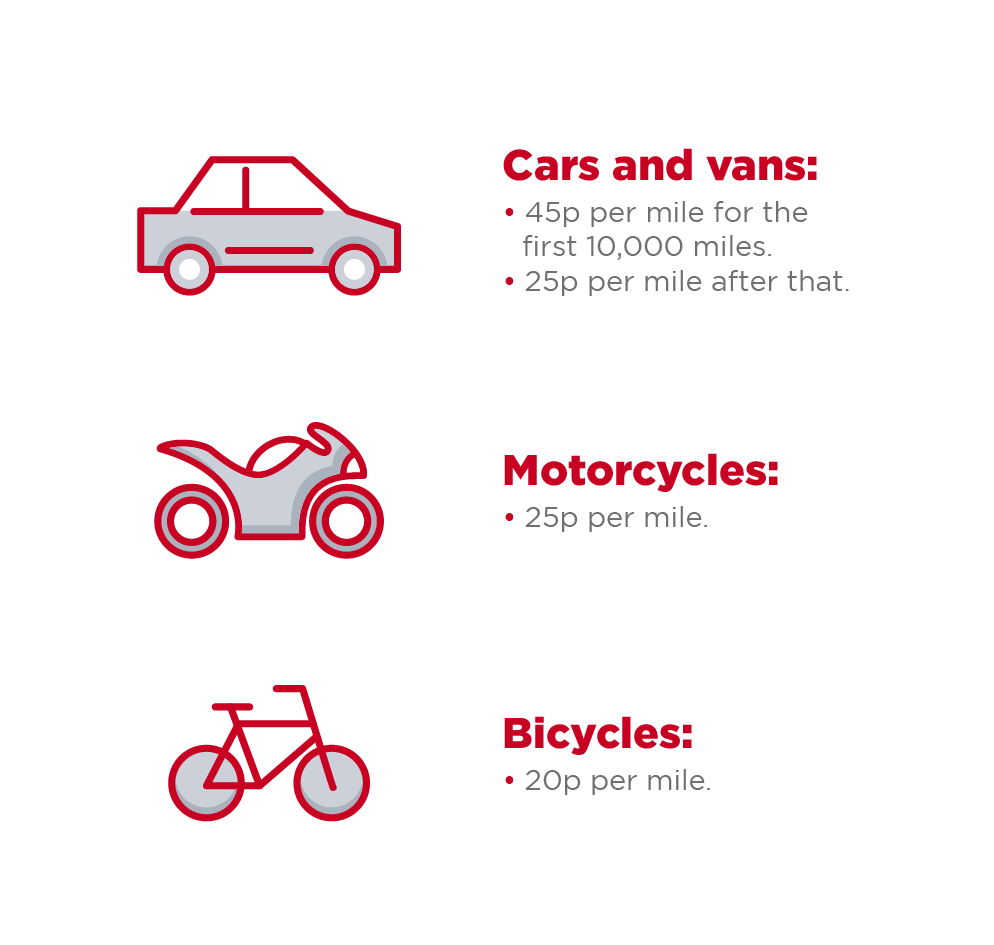
While many people go the DIY route when claiming their tax rebates each year, a range of professional services are available for those who want a more thorough job done by an expert, such as RIFT. A traditional accountant will usually be able to take care of the basics and keep you out of trouble, but there are also companies that specialise in handling every aspect of tax rebate claims, from calculating your work mileage and costs to taking care of the Self Assessment forms you need to file if your qualifying expenses top £2,500.
The basic form you use to claim back the tax you're owed for your work expenses is called a P87. This is where RIFT will tell HMRC about all the work travel and other essential costs you're paying out to do your job. These expenses are the core of your tax refund claim, which is why RIFT takes such great care with them.
This is the document that gives RIFT permission to talk to HMRC on your behalf. It's a lot less scary than it sounds, and means you never have to go toe-to-toe with the taxman yourself. You can take that permission away at any time, keeping you in control every step of the way.
When you're claiming for more than £2,500 of work expenses in a single tax year, HMRC says you need to file a Self Assessment tax return to claim your refund. It's the same form self-employed people use to pay their tax. RIFT handles your SA1 paperwork for you automatically when we prepare your tax refund claim, meaning no stress or hassle for you!
When you're paid through CIS, a 20% chunk of your cash is hacked off by your contractor and sent straight to HMRC. This leaves a lot of construction workers losing out to the taxman. When RIFT works our your tax refund claim, we make sure you get back any tax you've overpaid through CIS.
Read our guide to CIS and Self-Assessment
When you work in construction, many of your day-to-day expenses count toward the tax refund you're owed. Anything from upkeep and replacement of specialised clothing or tools through to your morning cuppa at the on-site cafeteria can earn you some tax back, and RIFT will sort your paperwork out to make sure you get it.
Travel to and from temporary workplaces (where you work for under 24 straight months) are the core of most tax refund claims. That's why it's so important to keep track of the mileage you're doing for work. RIFT will work out all the tricky details for you when we prepare your claim, and can even calculate your mileage to sites that no longer exist!
A P11D form is a document used by an employer to list any expenses or benefits given to directors or employees. It is submitted to HMRC yearly and includes items or services such as private healthcare, company cars or season ticket loans. The P11D form is designed to inform HMRC of any taxable benefits that must be included in your self assessment tax return. There may also be National Insurance contributions to me paid on them by your employer.
Tax rebates are for anyone who has to reach into their own pocket for the essential costs of doing their job. Depending on the work you do, that could mean business mileage, maintaining tools and work clothing or food and accommodation when you're travelling for work.
There are lots of reasons why you might be owed some tax back. If you've paying for work travel or other essential expenses, for instance, you're owed a tax refund. You could also be owed cash by HMRC if you've stopped work during part-way through a tax year, been given the wrong tax code or switched from full-time to part-time work. Whatever your situation, RIFT will always make sure you get back what you're due.
It usually takes 8-10 weeks for HMRC to process a tax refund claim. However, if your claim's more complicated or the taxman has questions about it, it can be longer. Getting your claim started as early as possible will help speed things along, as will having the UK's top tax experts at RIFT handle the process for you.
Find out more about how long it takes to get your tax refund payment.
The tax refund rules give you a hard limit of 4 years to claim back the tax you're owed. After that, it's gone for good. When RIFT works out your claim, we'll be able to claim back everything you're owed for the last 4 years.
Being stuck on an emergency tax code such as 500 0t or X can easily leave you being owed a tax refund. This can happen when you start a new job without a P45 form from your old one, for instance. How much tax you can reclaim will obviously depend on your situation, so talk to RIFT to find out exactly what you're owed.
Yes, if you’re confident you can get your head around the legislation on temporary workplaces and have the time to liaise directly with HMRC.
However, if you don’t apply the rules correctly and claim more than you’re allowed to, HMRC may ask you to pay back some or all of your refund.
It's like getting your car fixed. Some people can do it themselves already, lots of people could learn to do it but they prefer to have an expert do it because:
Visit our How to make a claim page for details of what's involved.
Have a look at our tax refund calculator and see if you're due anything back from HMRC.
You can make your tax refund claim any time after the end of the tax year it relates to. The sooner you get the process moving, the sooner you'll have your money back.
You can claim back any tax you're owed for the last 4 tax years. Once that 4-year limit is passed, though, your refund vanishes into the depths of HMRC forever.
On average, it can take HMRC up to 12 weeks to process a tax refund claim.
Find out more about how long it takes to get your tax refund payment.
If you're worried you might be paying emergency tax, the first thing to do is check the tax code for the job you're concerned about. Remember, every employment you have has its own tax code and your Personal Allowance is only applied to one of them. If you've got 2 PAYE jobs, for example, you'll have 2 different tax codes.
Check your payslips. If the tax code for your job ends in an "M1" or "W1", then you're paying emergency tax. If you've got an unusual pay period (meaning not weekly or monthly), you might have an "X" tax code instead. If you see an "OT" at the end of your code, it means HMRC doesn't have enough information about what you're earning to give you the right code.
It's always best to have your National Insurance number to hand when you're claiming a tax refund. Without a record of your NI number, it can be more difficult and time-consuming for HMRC to check all your important information. You may still be able to make your tax refund claim, but you'll have a bumpier ride getting it.
RIFT can help track down all the crucial details for your tax refund claim. Get in touch if you're worried you might be missing any details.
If you've overpaid your National Insurance Contributions (NICs) for any reason, you can claim back what you're owed as a National Insurance rebate. This can happen, for instance, if you've got more than one PAYE job, or have both employment and self-employment income.
If you're employed, you can often get your National Insurance refund by contacting your employer. If you're self-employed, though, you may need to write to HMRC directly or call the Deferment Services Helpline. The exact process depends on the type of NICs you're claiming a refund for, so check with RIFT if you're not sure of your footing.
A P60 End of Year Certificate is a form that details all your earnings from a given tax year, along with the NICs and Income Tax you've paid through the PAYE system. It will also show important information like any pension contributions or student loan repayments you've made.
A P45 is a form you get when you leave a job for any reason. It shows all your income so far in the current tax year, and all the PAYE tax you've paid on it. Unlike a P60, it usually won't include an entire tax year's worth of information. It's an important document to have when you're changing jobs, since it allows your new employer to work out the right tax code for you.
CIS refers to the Construction Industry Scheme, a system set up to tackle tax evasion in the building trade. What it basically means is that subcontractors have tax taken out of their pay directly by their contractors. If this means they end up overpaying, they can claim back what they're owed as part of their Self Assessment tax return paperwork.
Even if you're not classed as a UK resident for tax purposes, you still generally have to pay UK tax on your UK income. Of course, this means you can still claim any tax relief you're entitled to, such as your Personal Allowance and any tax refunds you're owed for your work expenses. Your tax situation can get complicated if you're earning money in the UK while living abroad. In some cases, it's actually possible to end up paying tax in two countries on the same income—although there are some "double taxation" agreements in place around the world to help balance things out.
If you're a UK resident, but your permanent home's abroad, you may not need to pay any tax on your overseas income. Always talk to RIFT if you're not sure you're paying the right tax in the UK.
No matter how many jobs you have, you can claim back any tax you're owed through the tax refund system. Any time you're shelling out your personal cash for the necessities of doing your job, you might be owed some tax back.
When you have more than one PAYE job, you'll have more than one tax code. Your Personal Allowance will only be applied to one of these, which generally needs to be your "main" job (meaning where most of your income comes from). If your Personal Allowance is attached to the wrong job, you might not be getting the full benefit if it. Talk to RIFT if you're not sure where you stand. If there's a problem with your tax codes, we'll get it fixed.
When you're claiming a tax refund from HMRC, they'll need to see some basic information about you, your work, and what it's costing you to do your job. Here's some of the main paperwork that can help build your tax refund claim:
Flat rate expenses are a simplified way of claiming back some of your overpaid tax for essential work expenses like maintaining your tools and equipment or washing your uniform. They're basically just set amounts that you can claim, meaning you don't have to go through the grind of calculating all your expenses by hand. The amounts themselves vary according to the kind of work you do, but even if your specific occupation isn't listed you might be able to claim the standard £60 in tax relief each year.
You probably won't ever get back everything you're owed using the flat rate expenses system, but it can be less hassle if you don't like keeping a lot of records.
There are lots of reasons why you might be owed a PAYE tax rebate from HMRC. You might have overpaid your Income tax because you stopped working part-way through a tax year, for instance, or because you're on the wrong tax code.
On of the biggest reasons why you might be owed a tax rebate is that you're paying from your own pocket for essential work mileage or other expenses. When you're meeting many of these unavoidable costs yourself, you can claim back the tax portion of their costs as a refund. Examples include:
Generally, the first time people realise they've paid too little tax is when they get a P800 Tax Calculation from HMRC. When that happens, HMRC will explain what they plan to do about it, which will usually mean a change to your PAYE tax code or a direct payment to settle up. If you think your P800 might be wrong, always check it against other tax paperwork like your P60 or P45 (and P11D if you're getting any work benefits from your employer). If it still looks wrong, talk to RIFT so we can get it fixed.
If you want to check whether or not you might be owed a tax refund for things like work mileage and other expenses, RIFT's free online tax refund calculator should be your first port of call. With a few clicks, we'll be able to let you know whether you have a claim to make, and what to expect from it.
On average, our clients get £600-£800 per year, and we can reclaim your expenses for the last four complete tax years. So your first claim could be worth around £2,500.
There are lots of ways to start your claim:
If it's hard for you to call us, don't worry, let us know what time is best for you and we can call you back. Any calls from us will come from 01233 628648 so you'll know it's us.
Once we have received all of your information and documents, our team of experts will put your claim together before sending it to HMRC to be processed. The sooner we receive your information and signed forms, the sooner you will receive your tax refund. Typically HMRC then take 6-8 weeks to process and pay out your refund.
Read more about how long a tax refund takes.
See our checklist of information that we'll need to make your claim.
It takes a few weeks to put together a really comprehensive tax refund claim. As soon as you're happy to go forward, we'll send your claim to HMRC for approval. It can take 8-10 weeks for the taxman to check your details and confirm your refund total, so the sooner you get us the information we need the sooner you'll have your money.
The best way to speed up your RIFT Tax Refund is to get your Authorising your agent (64-8) form back to us fast. This is the form that lets us tackle the taxman on your behalf. Without 2 physical copies of your 64-8 document, HMRC won't even speak to us about your claim. It's annoying, but it's all about protecting you.
As soon as your refund's paid out, we'll either send you a cheque or pay it into your bank account if you prefer. The choice is yours.
Have a look at our 'How Long Does A Tax Refund Take' page for more information about how long it takes to get your tax refund done and some pointers for how to make things happen as fast as possible.
Remember that you can claim for the last 4 tax years and you can make your claim at any time.
Our standard charges are:
When we receive your refund from HMRC we take out our fee and then pay it the refund to you. There are no up front charges to pay for anything. If you are not due a refund then there is no charge.
Before we send your claim to HMRC we sent a copy to you with a full breakdown of all the fees so you can clearly see:
You will need to sign and send this back to us to say you have read, understood and agreed with it, along with a declaration that all the information you have provided about your claim is true. This means you will never be charged any fees you have not agreed to.
There are no further fees to pay, and no hidden charges.
All aftercare is included (if you need us to call HMRC on your behalf, if you have a problem you would like us to resolve with them, if your tax code needs correcting etc).
Your refund is covered by the unique RIFT Guarantee which means that whatever happens, your refund stays in your own pocket and will never go back to HMRC. If we fight any HMRC enquiries for you (still included in the cost) and if anything did go wrong (which it never has in 15 years) we would pay back the refund to HMRC ourselves.
We will also send you a reminder when it's time to see if you have a claim next year.
Not at all. That's just what we're here for.
To make your tax refund claim we need to know where you worked, how you travelled there and how much it cost you. For the first claim you make we'll also need to set up your account so will need some ID. Have a look at our checklist.
If you haven't got copies of everything we can help you get hold of them, even getting in touch with your employers, ex-employers, job centre, DVLC and so on.
You can fill out your info on our easy to follow paper pack or online.
If you don't like doing paperwork yourself or don't have the time/opportunity to do it then you can give us your info:
Many of our customers have jobs that take them away from home for long periods, or work unusual hours, which can make paperwork difficult we know. Once we have your signed forms that say you want us to proceed with your claim you can give permission for a spouse, partner or relative to talk to us about the paperwork if that's easier.
Please do!
Not only will you be doing them a big favour if you can get some cash back in their pockets but we'll pay you a £50 referral reward for anyone who does go on to claim through us.
Until the 9th of October we'll also pay you an extra bonus of £150 if 5 people claim with us (T&Cs apply)
If you tell them to apply now they'll get their tax refund in time for Christmas and you'll get something extra to stuff in your stocking. That could be £400 in your pocket as well as the warm glow you get from helping out your mates.
To get started:
Not sure which friends could claim? Find out more about who can claim tax refunds.
There's no limit to the number of people you can refer and we pay out the rewards every week. It could be a nice little extra in your pocket, as well as the lovely warm feeling you get from knowing you helped out a mate.
Find out more about the referral scheme.
In HMRC's language, a tax rebate is "a refund on taxes when the tax liability is less than the taxes paid". What it's definitely not is a prize or a dodgy way of ''cheating the system''. When you're owed a HMRC tax refund, it's because you've already paid too much tax.
When you're paying your own way to temporary workplaces, the odds are good that you're owed some tax back for your expenses. ''Temporary'' here just means it's somewhere you're working for less than 24 months on the trot. It's worth making sure you get back what you're owed, too. You can claim a tax rebate for up to 4 years, with an average 4-year rebate with RIFT coming to £3,000. This is based on average total claims data for a 4-year period. Refunds are subject to fees of 36%. Exclusions apply.
A lot of the time, people don't even realise how many of their day-to-day expenses qualify for tax relief. Unless you prove to HMRC what you're owed, though, the taxman won't have the information he needs to settle up. The tax rebate system's a little clunky in places, but RIFT's on-demand, 1-on-1 service means you'll never get lost or lose out.
Just answer a few simple questions and we can tell you whether it looks like the expenses you've had to pay out in the course of your work meant that you may have paid more tax than you should.
You can also use our tax refund calculator to see an estimate of how much you could be due if you make a claim.
Claiming a tax refund should not change your tax code. If your tax code changes, just let us know and we’ll make sure it’s right - it’s all part of our aftercare service and included in the price.
Your tax code represents the amount of money you can earn tax-free so it’s important that it’s correct. Who wants to pay too much tax? Or worse still, get a bill from the tax man because you haven’t paid enough?
Your tax code is used by your employer or pension provider to work out how much Income Tax to take from your pay or pension. The code is worked out by HMRC, who sends it to your employer or pension provider.
A higher tax code means you can earn more money before you start paying tax, so you’ll pay less tax over the year. However, tax refunds are hardly ever the same two years running, so if your claim is smaller, you won’t have paid enough tax and you’ll owe money to HMRC.
Your payslip should have your tax code on it. HMRC may tell your employer to use a higher tax code after you’ve claimed your tax refund because they assume you will be eligible for this tax relief next year – but you may not be. It all depends on how much travel you do.
A 1263L tax code tells your employer that you’ve got a slightly higher Personal Allowance than most people. In real terms, it means you’re able to earn a little more in each tax year before you start to pay Income Tax.
Many people are worried about tax codes because they sound much more difficult than they actually are but once you know what all the letters and numbers mean it's as easy as reading any other code.
Find out more about your tax code and how to check if it's right.
Yes, if you’re confident you can get your head around the legislation on temporary workplaces and have the time to liaise directly with HMRC.
However, if you don’t apply the rules correctly and claim more than you’re allowed to, HMRC may ask you to pay back some or all of your refund.
It's like getting your car fixed. Some people can do it themselves already, lots of people could learn to do it but they prefer to have an expert do it because:
Visit our How to make a claim page for details of what's involved.
Have a look at our tax refund calculator and see if you're due anything back from HMRC.
No, we work direct with HMRC and reclaim the tax you have overpaid from them, not your employer.
Sometimes we need some information from your employer to support your claim. In these cases either you can ask your employer for it or we can contact them for you.
If your employers would like to know more about the process then you can send them to our information for employers page which explains everything, or you can look there and find the answers before speaking to them yourself.
If you claim too much tax back and HMRC pays out, they can later decide to demand the money back as it rightly should have been paid to them. If you’ve already spent your tax refund (and why wouldn’t you?) that means paying it back from your own pocket - UNLESS YOU ARE A RIFT CUSTOMER.
Our expertise means that we will never submit an incorrect claim, but HMRC do conduct random checks, there may be something unusual in your claim that they want more information on due to your personal circumstances (maybe you had a lot more expenses than usual this year because you got more work or had to replace more equipment) and sometimes do even make mistakes.
We’re proud to work to the highest standards. We make sure that we assess, calculate and validate each and every claim thoroughly against the latest legislation. RIFT claims for everything you’re due so you get the maximum refund. And we never claim for anything that you’re not entitled to or that we can't prove to HMRC.
When you claim your tax refund with RIFT, our unique RIFT Guarantee means that you don’t have to worry about the taxman reclaiming any of your money. So long as you give us full and accurate information, if HMRC disagrees with the amount that we’ve claimed and ask for the money back, we’ll pay it. It won’t cost you a penny.
If there is any sort of investigation we will handle the whole thing for you. It's all part of our aftercare service and there are no extra charges. It's not just about the money, either. Even if you know you're in the right the whole process can be incredibly stressful if you have to deal with it on top of your normal job but that's why we're here to help you.
We're the only Tax Refunds company that has been awarded the Institute of Customer Service Accreditation.
Have a look at our blog about what to do if you get an HMRC enquiry letter or what to do if you find you haven't paid enough tax.
Your wage slips can help us determine whether or not you’ve received expenses towards your travel.
If you have, we have to deduct this from your claim. If you haven’t, we need the wage slips to show that no deduction is required. We need all the wage slips for the period you’re claiming for.
We need to be able to provide HMRC with evidence that your claim is valid. If you have been told by anyone that this is not necessary then you may want to investigate their service guarantees further as you may end up losing any refund awarded back to HMRC if you cannot prove that you are entitled to it.
Often we find that people get a higher refund the second year that they claim as they know more about which paperwork to keep for proof of expenses.
See our checklist of documents for what you'll need and remember that we can help you get copies of many things you may have lost.
Get in touch with us and we can give you expert advice and if you need us to we can talk to HMRC on your behalf to try and get things straightened out.
There’s a chance we can reduce your debt and even get you a refund. Often people find that their refund will be big enough to clear the debt and still leave them with a little extra. While that's not such good news as getting to keep your whole refund it does give you peace of mind that the debt is gone and there are no fines or interest stacking up. With that cleared you'll be able to claim again next year and keep all of it.
If the debt is too large to be covered by any refund we can help arrange a payment plan for you or for you to pay it back through your tax code throughout the year.
Genuine mistakes do happen as well, so we can investigate and find out if that is the case.
There are lots of reasons that people might have unknowingly underpaid their tax. The important thing is to be able to show HMRC if it was an honest mistake as soon as you can. Showing willingness to get things sorted out will go a long way.
The one thing you shouldn't do if you think you owe HMRC money is ignore them. They will pursue it and the longer you leave it the worse it will be when they finally catch up with you.
Read more about what happens if you've underpaid tax.
Usually, yes. The only exception is when your employer has paid you the full 45p per mile, tax-free, for the first 10,000 miles in a year and 25p per mile for anything over that. If they've paid less than that, e.g. 10p per mile, then you can claim the difference.
Making a claim won't affect your employer at all, although sometimes they get worried when they hear the word "refund" or "claim". You're not claiming anything more from them, just making up the shortfall from HMRC, and they won't get in trouble because they haven't done anything wrong. If your employers has questions you can point them to our Information for Employers page.
Use our tax calculator to find out if you are due any money back.
Yes. The legislation is about travelling to temporary workplaces, it doens't matter what you used to travel there as long as you incurred a cost for doing so that was not refunded by your employer.
It helps if you've got the receipts but we may be able to claim public transport without receipts because the costs are quite standard for each journey.
See how much you could be owed with our tax calculator.
It makes no difference what your job is; if your employer doesn’t pay your travel expenses in full, you could get a tax rebate.
Whether you're looking for a tax refund for Armed Forces, PAYE Construction, CIS Construction , healthcare, offshore, security or any other industry sector, if you're paying out of your own income and work at different locations, you can get tax back for your costs.
The taxman's rules can be messy and complex. If you want to stay in his good books, you need to know exactly what you're entitled to but we can help you with your tax refund paper work.
With RIFT Refunds, finding out if you can get tax back is easy and it's free. You can talk to one of our friendly advisors right now or we can call you if that's easier. It won’t cost you anything to find out if you can get a tax rebate and you never know - you might get a nice lot of tax back from HMRC!
If your annual expenses are over £2,500 then it’s a bit more complicated. Instead of just submitting a tax refund claim you have to complete a self assessment tax return for HMRC. If you have to do that yourself it’s quite a lot of extra work and hassle. There’s no need to worry about that though; if we do it you won’t even notice the difference.
Find out if there's any money waiting for you at HMRC today with our tax calculator.
If your employer pays your travel expenses in full, or you only work in one location for an employer, you won't have overpaid the tax.
Although it may seem disappointing if you have nothing due back from HMRC all that really means is that you haven't been out of pocket for the last 1-4 years. You're not losing out now, if there is a claim to make it's because you've overpaid tax. It's not winning the lottery, it's putting things right.
Here's a list of the most common reasons that people can't a refund.
If you're self employed, the rules are different, and there are other expenses we may be able to claim for you. Find out more about self employed tax returns
Tell us a bit about your situation and we can quickly let you know if you should claim a tax rebate.
A Letter of Assignment (sometimes abbreviated to LOA) is the letter that you sign that legally allows HMRC to send your tax refund money to another person or organisation on your behalf. This will usually be your "agent" - which could be a tax refund specialist like RIFT or another accountant.
The work that RIFT does will usually mean that if we are claiming a refund for our you then we will do your paperwork and submit your claim and HMRC will then send the money to us on your behalf. At that point we deduct our fee and send the balance of the refund to you.
The letter must specifically mention to the tax years that to which it applies. It can be cancelled at any time with the agreement of both the person assigning the repayment and the person or organisation assigned to receive the repayment.
When we send you your letter of assignment it will look like this:
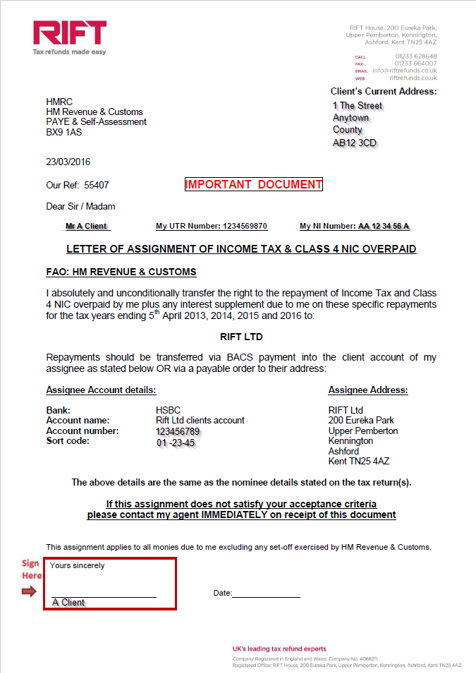
What should I do if I have assigned another company to receive my refund in the past but now want to switch to RIFT?
If you have signed a Letter of Assignment with another company then it is legally binding for the tax years listed on it unless both parties (you and the company you signed with) agree to "rescind" (remove their right to receive your tax refund from HMRC) that assignement.
This means that you need confirmation from the existing company that you used that says they have "rescinded their right" to receive the refund before either you or an alternative tax agent can receive any refunds due for those years.
Unfortunately we will not be able to offer our service until you have confirmation from them that the letter has been "rescinded".
How can I change the company I want to receive my refund for me?
You need to contact the company you used and ask them to confirm that they"rescind their right to receive any refunds of tax" on your behalf. As long as there are no outstanding fees to pay the company will usually agree right away.
However, we are aware that some people who want to use our services are finding it difficult to contact their previous supplier of tax services to do this and that in some instances there have even been outright refusals by those companies. In these situations we may be able to help you to contact the company and get it sorted out for you.
Is signing a letter of assignment the same as authorising an agent?
No, but you will need to do both for RIFT to claim your refund for you. You make a person or organisation your agent with HMRC by signing a form called Authorising Your Agent 64-8. Your agent is the person who deals with HMRC on your behalf and who prepares and submits your tax refund claim paperwork. For example if you are a RIFT customer then RIFT is your agent.
If you're waiting for your refund for longer than you expected then the usual cause is that we don't have one or both of these signed documents from you. Get in touch if you need to check and if you need new copies we can send them out to you.
Claiming a tax refund should not change your tax code. If your tax code changes, just let us know and we’ll make sure it’s right - it’s all part of our aftercare service and included in the price.
Your tax code represents the amount of money you can earn tax-free so it’s important that it’s correct. Who wants to pay too much tax? Or worse still, get a bill from the tax man because you haven’t paid enough?
Your tax code is used by your employer or pension provider to work out how much Income Tax to take from your pay or pension. The code is worked out by HMRC, who sends it to your employer or pension provider.
A higher tax code means you can earn more money before you start paying tax, so you’ll pay less tax over the year. However, tax refunds are hardly ever the same two years running, so if your claim is smaller, you won’t have paid enough tax and you’ll owe money to HMRC.
Your payslip should have your tax code on it. HMRC may tell your employer to use a higher tax code after you’ve claimed your tax refund because they assume you will be eligible for this tax relief next year – but you may not be. It all depends on how much travel you do.
A 1263L tax code tells your employer that you’ve got a slightly higher Personal Allowance than most people. In real terms, it means you’re able to earn a little more in each tax year before you start to pay Income Tax.
Many people are worried about tax codes because they sound much more difficult than they actually are but once you know what all the letters and numbers mean it's as easy as reading any other code.
Find out more about your tax code and how to check if it's right.
The simple answer is as soon as possible after the 5th April.
We complete your tax return online and this has to be submitted and paid before the 31st January the following year.
If you miss the deadline there are some pretty expensive penalties from HMRC, and they are very strict on what counts as a good reason for being late. Get your information into us as quickly as possible.
Another important deadline to note is that you should get yourself registered as self employed as soon as possible after you start trading. The deadline's the 5th of October in the year you started your self-employment. Miss that, and you're risking penalties based on the potential lost tax.
If you're self-employed, you'll need to file yearly Self Assessment tax returns to report your earnings and expenses to HMRC. However, there are several other reasons why you might need to file tax returns. For example:
The main thing to realise is that you can't afford to keep the taxman waiting if he's expecting a tax return from you. Even if you're sure it's a mistake, get in touch with RIFT. If there's a problem, we'll be able to help—even if you're already facing penalties for missing a deadline.
Having a plan is the best place to start your saving journey. The most popular first goal is to secure your living expenses in the short-term future. And many financial experts recommend that you have at least three months’ living expenses saved up.
If you don’t know how much money leaves your account in the average month, you won’t know how much you can afford to save.
Take a look at your last few bank statements. Break those expenses down into ‘necessities’, like grocery shops, energy bills and council tax, and ‘wants’, like nights out, takeaways and shopping. That way, you’ll know roughly how much you’ll need to save to hit that three-month target.
If three months’ money sounds like a lot to put away in the short term, don’t worry. Right now, nearly 41% of Brits don’t have enough savings to last more than a month, while a third have less than £600. So, having any money saved means you’re in relatively good shape.
You don’t need to start your savings fund with a chunk of money. The 1p challenge is a brilliant way to kickstart your savings. Start by saving 1p on day 1, 2p on day 2, 3p on day 3 and so on. By the end of the year, you’ll have over £660 saved up from something that started with loose change! You can start off the old-fashioned way with a coin jar and move the process over to a savings account when the savings grow
If that sounds like a bit of a chore to do every day for a year, there are plenty of banking apps out there that do something similar.
With apps like Monzo, Revolut and even NatWest, you can round up your purchases so that the remainder goes straight into a savings pot. That way, you’re saving money even as you spend.
This system is especially useful if you’re saving for something specific, like a holiday or a new TV, but still works even if you’re just putting that money aside for a rainy day. Set a target amount and you’re good to go. You’ll be saving without thinking about it.
For longer-term budgeting, one of the most well-known saving techniques is the 50/30/20 rule. That’s 50% of your income going on necessities like food, energy, and rent, 30% on wants, and the remaining 20% straight into savings. It’s not a hard and fast rule, but it reinforces good saving habits and means you’re never spending more than you can afford.
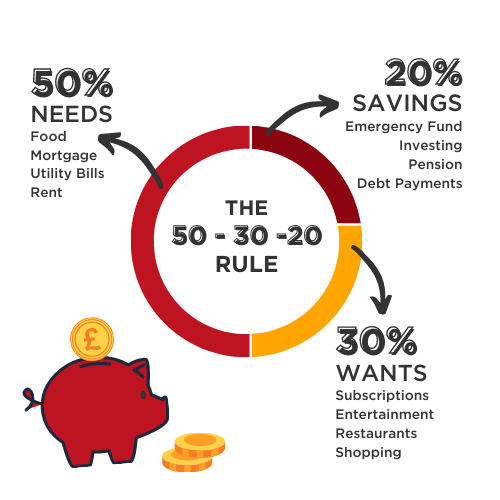
If you’re around 21 years old, have a job and live at home with family or guardians, you’re in a brilliant position to save! And since your ‘needs’ aren’t likely to use up 50% of your income, why not make it 40/30/30? That’s an extra 10% in your savings every month.
If you want to make money from home without any extra equipment, you’ll need to make use of what you already have. As most of the ideas we’ll talk about are digital - how else are you going to make money without leaving the house? - you’ll need:
Bear in mind, you’ll also need to have some level of digital ability - typing, writing emails et cetera - even for our beginner-level options. If that sounds like you, let’s get into some money-making ideas…
It takes a few weeks to put together a really comprehensive tax refund claim. As soon as you're happy to go forward, we'll send your claim to HMRC for approval. It can take 8-10 weeks for the taxman to check your details and confirm your refund total, so the sooner you get us the information we need the sooner you'll have your money.
The best way to speed up your RIFT Tax Refund is to get your Authorising your agent (64-8) form back to us fast. This is the form that lets us tackle the taxman on your behalf. Without 2 physical copies of your 64-8 document, HMRC won't even speak to us about your claim. It's annoying, but it's all about protecting you.
As soon as your refund's paid out, we'll either send you a cheque or pay it into your bank account if you prefer. The choice is yours.
Have a look at our 'How Long Does A Tax Refund Take' page for more information about how long it takes to get your tax refund done and some pointers for how to make things happen as fast as possible.
Remember that you can claim for the last 4 tax years and you can make your claim at any time.
In HMRC's language, a tax rebate is "a refund on taxes when the tax liability is less than the taxes paid". What it's definitely not is a prize or a dodgy way of ''cheating the system''. When you're owed a HMRC tax refund, it's because you've already paid too much tax.
When you're paying your own way to temporary workplaces, the odds are good that you're owed some tax back for your expenses. ''Temporary'' here just means it's somewhere you're working for less than 24 months on the trot. It's worth making sure you get back what you're owed, too. You can claim a tax rebate for up to 4 years, with an average 4-year rebate with RIFT coming to £3,000. This is based on average total claims data for a 4-year period. Refunds are subject to fees of 36%. Exclusions apply.
A lot of the time, people don't even realise how many of their day-to-day expenses qualify for tax relief. Unless you prove to HMRC what you're owed, though, the taxman won't have the information he needs to settle up. The tax rebate system's a little clunky in places, but RIFT's on-demand, 1-on-1 service means you'll never get lost or lose out.
Just answer a few simple questions and we can tell you whether it looks like the expenses you've had to pay out in the course of your work meant that you may have paid more tax than you should.
You can also use our tax refund calculator to see an estimate of how much you could be due if you make a claim.
Our standard charges are:
Don't worry if you had a mixture of self-employed and PAYE (employed by a company) work during the period you want to claim for. We can work out if you would be due a refund and let you know what the fee would be.
See our full list of services with prices and options.
When we receive your refund from HMRC we take out our fee and then pay you your refund. There are no up front charges to pay for anything. If you are not due a refund then there is no charge.
Before we send your claim to HMRC we send a copy to you with a full breakdown of all the fees so you can clearly see:
You will need to sign and send this back to us to say you have read, understood and agreed with it, along with a declaration that all the information you have provided about your claim is true. This means you will never be charged any fees you have not agreed to.
There are no further fees to pay, and no hidden charges.
All aftercare is included (if you need us to call HMRC on your behalf, if you have a problem you would like us to resolve with them, if your tax code needs correcting etc).
Your refund is covered by the unique RIFT Guarantee which means that whatever happens, your refund stays in your own pocket and will never go back to HMRC. If we fight any HMRC enquiries for you (which is included free of charge) and if they did demand any money back, we would pay back the refund to HMRC ourselves.
We will also send you a reminder when it's time to see if you have a claim next year.
You can reach us on the phone or Livechat
You can email us or send us a question or feedback through our contact page at any time and you can leave us a private message through our Facebook page.
If you qualify for one, a Lifetime ISA (LISA) is one of the best ways to save toward your deposit on a first home. You can only get one if you’re between the ages of 18 and 39, with a yearly pay-in limit of £4,000. Why are they so good? Well, how does an annual 25% cash boost to your pay-ins sound? That exactly what the government offers on these accounts - meaning that if you pay in the maximum of £4,000 in a year, you’ll get it topped up by an extra £1,000 for free.
Obviously, there’s a little more to it than that. For example, like other kinds of ISAs, you’ve got a choice about how your money is used. A stocks and shares LISA will invest your savings in businesses in hopes of faster growth, while a cash LISA will pay out an agreed rate of interest. Since you’ve got a specific goal in mind here, you might decide that a cash LISA is the less risky option.
You can read more about Lifetime ISAs in our other guide, “5 Alternatives to Savings Accounts”. One key point to understand now, though, is that you really have to commit to them to get the benefits. There are rules about how you access your cash that can completely wipe out most of the rewards of saving this way, with a 25% penalty to pay on any withdrawals you make before the age of 60 unless you’re using them to buy a house. That basically blows your whole bonus if you take it out early or use it for something else.
Train fares can vary massively, with a lot depending on when you buy your ticket and the specific route you pick. In general, the earlier you buy, the less you’ll pay to travel, so checking out the fares well in advance will usually get you the best deals. If you use trains regularly, then a railcard could be a smart option, too. You’ll get a discount of a third off your fare when you use it, assuming your journey qualifies, and it’ll all add up over time.
Another option to look into is “splitting”, which sites like trainsplit.com can help you do. Basically, instead to buying a ticket for your entire journey, you can often make impressive savings by splitting the journey into chunks. Your first ticket gets you from point A to point B, then your second one takes you from B to your final destination of C. The best thing is you don’t even have to change seats, let alone trains, to do it. Strangely, this “split” journey can end up being a lot cheaper overall.
The last thing to remember about trains is that you can get compensation if your journey’s delayed by over 15 minutes. A lot of people miss out on this, and the systems can vary depending on the company. Even so, it’s always worth checking what you’re entitled to when your train service lets you down.
When you’re paid via the Pay As You Earn (PAYE) system, you can claim back some of the tax you’ve paid on your earnings. How much you can claim depends on the money you’re splashing out on the essentials of doing your job. We’re talking about things like travel to temporary workplaces and repairing, cleaning or replacing the crucial tools of your trade. Depending on the work you do, the expenses you can claim for will vary. Electricians, for example, may have to fork out for replacing damaged electrical tools. Scaffolders, meanwhile, may find themselves out of pocket on maintaining safety gear and so on. The basic rule is that, if you need it to work and you’re paying for it yourself, it could count as part of your tax refund claim. That goes for any food and accommodation bills you rack up while on the road, for instance. Even fees and subscriptions to professional bodies and unions can qualify, along with certain types of training, as long as it’s all essential.
If you work for yourself you will need to submit a CIS Self-Assessment Tax Return
One regular cost that basically every construction worker has to contend with is work travel. In fact, for most people, that’s where the bulk of their yearly tax rebate comes from. If you travel for work, and not just to work, then you may have a refund claim. That means the taxman’s not just going to stuff your pockets full of cash every time you put your key in the ignition. There are specific rules on the kinds of work travel that count for tax rebates. For example, if you always work in the same place and drive there from home every day, that’s just a regular commute. You can’t claim anything for that. In the building trade, though, most of the real work gets done at “temporary workplaces”.
In HMRC’s eyes, a temporary workplace is a site you’re working at for under 24 months. As long as you remember that rule, you shouldn’t go too far wrong. As with everything else in the tax world, though, things are never quite as simple as that. For instance, if you spend less than 40% of your time at a workplace, it might count as temporary even if you’re there for more than 24 months. Knowing exactly where you stand is the key to getting the most out of your tax refunds, which is why so many people call in the professionals to handle their claims.
Here’s another example. If you end up working at the same workplace for longer than you were originally expected to, your situation can change. In that case, you can usually still claim for travel to and from your workplace for that original 24-month period.
This is another area where HMRC’s rules can get a little tangled. Sometimes, you change workplaces without making much difference to your travel time and costs. For the new workplace to count as separate from the old one, both the travel cost and physical journey made must be different. As you can imagine, there's quite a lot of wiggle room in the definitions here. Of the two factors, though, the cost is usually the main decider. If there’s not enough of a difference in the taxman’s eyes, then he’ll probably say you’ve accepted a permanent workplace when you move to the new site. Naturally, that also means your old worksite no longer counts as temporary either.
Just to show this working in practice, let’s assume Bob the joiner accepts a job on a site that’s set to last 18 months. After a while, though, things change:
Off course, that’s just one example of the weird little wrinkles in the taxman’s rules. Things get even stranger if your job takes you to a range of places over a region. In some cases, if your travel costs and times don’t vary much, it’s actually possible for the whole geographical area to be considered your permanent workplace! Again, knowing exactly what you can and can’t claim for is the only way to steer clear of trouble.
HMRC calls you a site-based worker if you work at a succession of sites. You'll usually only work at one site at a time, but there are exceptions to that. Either way, HMRC will look individually at each of the sites you visit to work out if they're temporary or permanent workplaces. For the most part, this will come down to whether or not you work there for longer than 24 months at a time. Again, though, there are some complex rules that can change things. For example, if you might reasonably expect to work at the same site for practically all of the time you're in a particular employment, then that will often be classed as your permanent workplace even if you end up being there for under 24 straight months. As always, RIFT will steer you right so you never end up missing out on the tax refunds you're owed.
When you're travelling to different sites as a core part of your work, some or all of your daily travel can qualify you for a tax rebate. What you're actually owed will depend on the kinds of work travel you're doing. For instance, if you drive to a main office in the morning, then spend your day shuttling between various other sites, then you've got a fairly complicated travel situation. Your journey from home to the office, for instance, would probably count as a normal commute, meaning you can't claim back any tax for it. All the other mileage you do during the day, though, could count as travel to temporary workplaces, allowing you to include it in your tax refund claim.
HMRC won't count any ordinary commuting costs when working out the mileage you can claim a tax rebate for. That's why it's important to understand which kinds of travel earn you tax relief. An "ordinary commute" means a journey to a regular, permanent workplace. More specifically, if you're working at the same site for more than 24 months on the trot, then HMRC will usually consider your travel to be a normal commute and won't pay out any tax refunds for it.
Things can get complicated if you work across multiple sites in the same area and your daily travel time and costs don't vary much between them. Sometimes, HMRC will call the whole region you're travelling around your "permanent workplace". This would mean you couldn't include those journeys in your tax refund claim. Talk to RIFT if you're not 100% sure where you stand.
If you're a self-employed subcontractor claiming for your mileage, you'll be claiming tax relief on your work travel expenses through your yearly Self Assessment tax return paperwork. Since you'll almost certainly be paying 20% tax at source on your payments through the Construction Industry Scheme, it's important to make sure you're getting the best out of the Self Assessment system. A key part of that is keeping good records of your essential work travel.
Okay, here’s where the rubber hits the road. The amount of tax you can claim back for your work travel depends on the rates and thresholds set out in the HMRC rulebook. They’re called Approved Mileage Allowance Payments (AMAP) and as of the 2019/20 tax year they look like this:
You won’t get taxed on your AMAP payments, so travelling 15,000 miles for work in a single tax year nets you a tax-free payment of up to £5,750. That breaks down as £4,500 for the first 10,000 miles you travelled (10,000 miles x 45p), plus £1,250 for the rest (5,000 miles x 25p). Obviously, this assumes you travelled in your own car or van. The AMAP rates for motorbikes and bicycles are lower, but they're still worth claiming.
Another point to keep in mind is that you have to be footing the bills yourself to claim - or part of them, at least. If you’re already getting at least as much as the AMAP rates say you should from your employer, you can’t claim tax back. However, if you’re getting less than that you can claim back the difference from HMRC. Also, if your employer's paying you a higher rate, then it'll be considered a "benefit". That means you'll owe some tax on the extra. It doesn’t matter how many vehicles you’re using for work. The AMAP rates don't exclusively apply to any one vehicle. The distance you travel in each of your vehicles is simply lumped in together to work out your payments.
On the other hand, if you're on the road for more than one job, then each is usually considered separately. That means you can claim the full AMAP rates for each. The jobs really do have to be separate, though. Working for associated companies or employers probably won't count, and you’ll get heat from the taxman if you try to bend the rules even slightly – so don’t do it!
If you’re taking other passengers to work with you in your car or van, you can claim an extra 5p a mile per passenger. The travel’s obviously got to be work-related for them as well, though, so don’t just load up the kids and family dog and expect a pay-out from the taxman.
The AMAP rates and thresholds are generally used when you’re doing your work travel under your own steam. However, that doesn’t mean you’re out of luck if you hop the bus to your temporary workplaces. Even coughing up for public transport can get you a tax refund from HMRC. Instead of keeping track of the miles you’ve travelled, though, you’ll need to keep records of the money you’ve spent on tickets and so on. The taxman will always expect you to back up your claims with evidence of what you’ve spent, so don’t lose your paperwork.
Once again, if your employer’s reimbursing you for your public transport costs, you can’t claim any tax back for them. If you’re not getting back as much as you’re spending, though, you might still have a tax rebate claim.
If your boss stumps up for a company car for you, you can often still claim a tax refund for your work travel. In some cases, though, your employer may also provide you with free fuel for private use. As always, you can’t claim a tax refund for any expenses you’re not paying yourself, or for anything that’s not necessary for work.
When you're using a company car, the mileage rates (in this case called Advisory Fuel Rates) are different. That's because you're only getting reimbursed for the fuel you're burning on your business travel. You aren't, for instance, getting anything toward maintenance costs, which are figured into the AMAP rates.
As of the 1st of September 2019, the company mileage rates for petrol and LPG vehicles are:
| Engine size | Petrol: amount per mile | LPG: amount per mile |
|---|---|---|
| 1,400cc or less | 12p | 8p |
| 1,401cc-2,000cc | 14p | 8p |
| Over 2,000cc | 21p | 14p |
For diesel vehicles, you're looking at:
| Engine size | Diesel: amount per mile |
|---|---|
| 1,600cc or less | 10p |
| 1,601cc-2,000cc | 11p |
| Over 2,000cc | 14p |
Hybrid cards count as either diesel or petrol, as appropriate and there's a separate Advisory Electricity rate of 4p er mile for electric vehicles.
When your job has you trekking overseas to temporary workplaces, your tax rebates can get complicated. You might be using a bunch of different types of transport (personal vehicles, trains - maybe even a helicopter or two) and stacking up a load of additional costs along the way. The best advice is always to keep hold of your records, from tickets bought and miles driven through to overnight hotel stays and food bills. These scraps of paper are your ammunition when you go up against the taxman to claim your refund.
Remember - HMRC will never try to cheat you. That’s not how this works. They will, however, insist that you prove every penny you’re owed. Get professional help if you’re having trouble, and never settle for less than you’re due.
With travel from home to work, everything depends on whether you're doing a normal commute or heading out to a temporary workplace. If your travel distance and costs stay basically the same for over 24 months, for example, HMRC might say you have a permanent workplace even if you actually travelled to more than one site over that time.
In general, though, you can claim for mileage from home to work any time the site you're travelling to is somewhere you work for under 24 straight months.
You don't necessarily need to keep all your fuel receipts to claim a tax refund for your work mileage. Since the tax relief rules for work mileage are supposed to consider general upkeep of your vehicle as well as your fuel costs, HMRC has set out specific rates you can claim per mile you travel in a tax year. If you're travelling in your own car, van, motorcycle or even pushbike, there are rules to let you claim back tax based on your mileage. The most important records you'll need to show HMRC for this are the places you've worked and when you were there.
When you claim travel expenses, the important thing to show HMRC is the total number of work miles you've travelled in a tax year. The Approved Mileage Allowance Payment rules have the following rates you can claim as a tax refund—and again, it's more important to record your actual mileage, rather than cling onto receipts from the petrol station:
Yes, when you're travelling to temporary workplaces, the total mileage you're claiming a tax refund for will include journeys to and from your sites.
Almost everyone in the UK gets a tax-free Personal Allowance, which is the amount you can earn in a year without paying any tax. If you earn less than your Standard Personal Allowance, you won’t pay any tax on it at all. If you earn more, only income above your Personal Allowance will be taxed.
Here are some other UK tax allowances you might not know about:
| Individuals (all) | £12,570 |
| Marriage allowance* | £1,260 |
| Minimum married couples allowance* | £3,530 |
| Maximum married couples allowance* | £9,125 |
| Income limit for married couple's allowances | £30,400 (allowances are abated if income limit exceeded) |
| Blind person's allowance | £2,600 |
| Dividend allowance | £2,000 |
| Property allowance | £1,000 |
| Trading allowance | £1,000 |
| Personal savings allowance (basic rate taxpayers) | £1,000 |
| Personal savings allowance (higher rate taxpayers) | £500 |
| Income limit for standard personal allowances | £100,000 (allowance completely lost once taxable income exceeds £125,140) |
**Transferable allowance available to married couples and civil partners who are not in receipt of married couple’s allowance. The recipient spouse cannot be liable to higher or additional rate tax.
** Tax relief given at 10% where one partner was born before 6/4/1935
When you claim a tax rebate from HMRC, you can choose how you want to get your money. The fastest way is usually to have your refund transferred directly into your bank account. If you prefer, though, you can ask HMRC to send you a cheque instead.
It usually takes HMRC about 8-10 weeks to process a typical tax refund claim. The wait can be longer at busier times of year, though, or if your claim’s complicated and they need to get more information from you.
It's possible to claim for the last four tax years. That could add up to a substantial refund value.
Read our complete guide to claiming uniform tax refunds.
No, you cannot claim for PPE (Personal Protective Equipment). If your job requires you to use PPE your employer should either:
If you want to claim the exact amount spent then yes you will need a copy of your receipts. If you don't have receipts you can claim via flat rate expenses which allow you to claim tax relief for a standard amount (a flat rate) each tax year.
It can take between 8-12 weeks for HMRC to process your tax refund claim, depending on your personal circumstances.
Find out more about how long it takes to get your tax refund payment.
If you find yourself making tough choices between heating your home and feeding your family, no amount of mental health support will solve your immediate crisis. That’s when you need to fall back on emergency resources like food banks and “Community Fridges”. A food bank will generally need you to have a voucher to use, but Community Fridges usually don’t. They’re also good resources for learning new skills and ways to reduce household food waste.
As for the benefits you should be claiming, you might be surprised by what you qualify for. Benefits like free social care and Disabled Facilities Grants can be a genuine lifeline for many. Your local council might also have a range of schemes and services available for people on lower incomes. If you’re suffering from mental health problems yourself, there may be extra benefits you should be claiming.
Energy bills are a massive worry all across the UK, and the industry regulator Ofgem can offer advice and information on how to get help with rising costs. If you’re struggling, it’s also worth getting in touch with your energy supplier directly. Many of them have options for people facing unmanageable bills.
f you’ve read any of our articles before, you’ve probably already got a decent grasp on the benefits of various types of savings account, along with their alternatives.
The way savings accounts are handled has seen some pretty serious shake-ups in recent years, meaning a lot of people actually end up paying no tax at all on their interest. Before April 2016, tax was taken from the interest on most savings accounts at the highest rate you paid, which is 20% for Basic Rate taxpayers. Now, instead, you can earn a chunk of untaxed interest that’s based on the tax bracket you’re in. Basic Rate payers can get £1,000 before paying tax, for instance. At the Higher Rate, the amount you can earn drops to £500 per year, though. Keep in mind that if you're getting interest from other tax-free sources like cash ISAs, it won’t count toward this “Personal Savings Allowance”. Any tax you do owe on your interest will come out through your PAYE tax code, or via Self Assessment if you're signed up for that.
Savings accounts are good for keeping your cash protected, since they’re covered for up to £85,000 of losses by the Financial Savings Compensation Scheme on the off-chance that the wheels ever fell off the banking system. While they’re not a super-efficient way to grow your savings, particularly when inflation’s high and interest rates are low, the important thing is that you’re setting your cash aside somewhere it won’t get eaten into by your day-to-day spending.
Setting up a budget can feel like a steep climb if you haven’t done it before. Again, you can look through our guide articles for the basics, but there are also a few really useful apps out there to help you get organised. Some of them make saving so easy it’s practically automatic! For example, there are “round-up saving” features in savings apps like Monzo, Natwest and Moneybox that actually save cash as you spend it. This basically rounds your spending up to the nearest pound, with the extra change socked away in a savings account. It might not sound like it’ll take you much of the way toward your used car on its own. However, as anyone who’s tried the 1p Money Saving Challenge will tell you, those pennies really mount up over time.
When you get right down to it, budgeting for a car (or anything else) just means taking a little more control over your money. It’s honestly something we should all be doing anyway, especially when the cost of living’s soaring.
Job done – you just made a budget! If you want to dig a little deeper into making the most of your money, learn about things like “zero-based budgeting” and the “50/30/20” rule.
Another critical thing to look at is the fuel consumption of any vehicle you’re seriously considering. It might be the car of your dreams at an absolute bargain price. However, if it’s a real gas guzzler you’ll be paying a painful charge any time you drive through an ultra-low emission zone. Worse still, you might find yourself banned from certain routes altogether.
It’s not just emissions charges you’ll want to look out for, of course. There’s also the basic, day-to-day cost of topping off your tank to consider. Before you slap down your hard-earned savings on a used car, make sure you know what kind of running costs you’ll be paying down the road.
One final tip, given that you could be coughing up anywhere from a few hundred to many thousands of pounds on your car: look into its background before you buy. Make, model, registration and general history on the road can make a big difference to the value of a vehicle. If the price looks too high – or especially if it’s suspiciously low – ask a few questions before parting with your cash. While you’re at it, be absolutely certain the car’s in roadworthy shape. Even if the asking price is amazing, you’ll still lose out in the longer run if you end up on a never-ending cycle of expensive repairs.
Keep checking back here for more money tips and updates. We’re experts at saving you cash and we’re always here to help. That’s the reason why you’re better off with RIFT.
Doing volunteer work while you’re studying can be a great way to get real-world experience and training. A lot of students decide to take a crack at this, to boost their chances of landing a related job after graduation. Typically, with volunteer work, you won’t be getting paid. That means no worries from the taxman, but also doesn’t help much with paying your bills. If you’re being paid at all, though, HMRC will want to know about it. If all you’re getting is your expenses reimbursed, then things are pretty simple. Otherwise, you’re looking at actual, taxable income (but remember your tax-free Personal Allowance).
Depending on how your work’s set up, you might be classed as employed, self-employed or purely a volunteer. It’s important to get this straight from the outset, as your employment status can make a real difference when you’re doing things like claiming benefits or tax credits. Voluntary work without pay won’t trip you up on these, but other circumstances can.
You may also find yourself on a training contract, or being “sponsored” by an employer. A training contract basically just means that an employer’s offering some kind of training as part of the work you’re doing. If this involves you getting any costs paid for courses, travel or other necessities, then those are tax-free. It makes no difference whether your employer stumps up for them directly or reimburses you.
While you’re on employer-sponsored training, your pay usually still counts as normal for tax and NICs. However, there’s a wrinkle in the rules for people whose employers let them take a break from work to study. It’s called Statement of Practice 4/86, and means that employers can sometimes pay to support you while you’re studying. In those cases, the payments you get won’t be taxed. You have to be studying full-time for at least a year to qualify, and to put in at least 20 weeks of study in the year. As of 2019/20, your employer can pay you up to £15,480 tax-free. Your tuition fees are handled separately from your day-today costs like accommodation and travel. They’re still exempt from tax, though, as long as the course you’re taking is related to your work.
There’s another side to this coin to think about, of course. If you’re a student on a work placement as part of your degree, you may or may not be getting paid. In fact, there’s no technical obligation for employers to fork over a penny. Even if you are getting some cash, you won’t be legally entitled to the National Minimum Wage. On the other hand, you’ll still be counted as a student for this time, so won’t be paying Council tax either. The bottom line is that, unless your income falls under one of HMRC’s exemptions or allowances, it’ll be taxed as normal.
The question of what counts as a uniform trips a lot of people up. You can't simply claim for whatever clothes you wear for work. Your clothing needs to be identifiably a necessity of your job to count. For instance, a normal suit won't usually qualify for tax relief, even if your employer insists you wear it. A jumper with a company logo, however, would entitle you to tax relief (unless it's a detachable badge or something similar).
You can't necessarily claim for cleaning your clothes just because they were given to you by your employer, either. If your "uniform" is something you could reasonably wear outside of work, you can't expect any cash back from HMRC.
There are obviously some difficult grey areas here - and we're not just talking about dirty collars. A lot of people either end up not claiming what they should, or getting stern looks from the taxman for claiming too much. If you're not sure whether your work clothes count as a uniform, get some professional advice to find out exactly where you stand.
If you make the same flat rate uniform claim every year HMRC will change your tax code to 1263L. This adds £60 to your tax-free Personal Allowance so you don't have to manually claim each year. If your costs are higher than this, or you have more expenses to claim, get in touch with RIFT.
Read our complete guide to claiming uniform tax refunds.
The form comes in 4 parts. Part 1 goes to HMRC, while part 1A is the one you keep for your own reference. Parts 2 and 3 are for your next employer, assuming you’re moving on to another job. You might also be asked to show your P45 paperwork if you find yourself at a Jobcentre Plus.
The bits that go to your new employer give them all the information they need to get you set up. That means your tax code, for one thing, but also your earnings and tax for the year.
The main thing people tend to need their P45s for is keeping their tax information straight when they’re switching jobs. Getting stuck on the wrong tax code can be seriously bad news, so this is something you really need to stay on top of.
The form does have some other uses, though. If you have to file a tax return, for instance, you’ll need the information from your P45 to get it done. Typically, people on PAYE don’t have to worry much about tax returns. However, there are several reasons why you might still have to use the Self Assessment system while you’re on PAYE. If you’re claiming a tax rebate or getting extra income outside your normal job, for example, you might well find yourself using Self Assessment. You’ll be glad of your P45 then.
P45s can also be worth their weight in gold (figuratively, at least. They’re pretty light) when you’re claiming any social welfare benefits. Basically, if you get one, don’t throw it away. Remember, you can’t get a replacement P45 if you lose it.
The first thing to look at is how much cash you’re bringing in each year. Once you’ve got a clear picture of your income, you can start to decide how much of it should be saving. So, for instance, if you’re following the usual kinds of advice floating around, you’re probably trying to stick to the “50/30/20 rule”. If you don’t know about this, it basically just means you’re trying to handle your spending so that:
The thing is, that rule really only works when you can afford to stick to it. Not everyone can balance their books so their essentials get covered that easily, for instance. Even so, there’s an important lesson to learn here. All these kinds of “rules” are really trying to do is help you get your priorities straight. For instance, it won’t do you any good to stock up your savings if you’re digging yourself into debt to do it. Interest on things like loans and credit cards will almost always pile up faster than it does on savings. In the long run, you’re just digging a deeper hole for yourself by ignoring your debts.
As for your actual savings, a basic target to aim for is having an “emergency fund” that could cover your essential costs for 6-12 months. With a bit of luck, you’ll never need to rely on it for that long – but even so, it’s worth having so you can handle unexpected stuff like a job loss or some sudden repairs. Don’t fall into the trap of sticking your emergency fund where it’s hard to get at, either. Basically, keep it in something like a normal savings account where you’ve got good access to it in a pinch.
So much for the basics. Now let’s look at how much of your salary you should be saving at a few rough income levels:
So, at around £20,000 a year, keeping a tight grip on your most expensive debts is a smart move. This is where focusing on paying those down before worrying about saving money really pays off. Depending on where you’re borrowing your cash from, you might be looking at interest rates of anywhere between 9% and 20%. Those will creep up on you fast if you leave them sitting there. Once your essential costs are dealt with, bump paying off these debts to the top of your priority list. When you’re in the hole, the first thing to do is stop digging.
Of course, that doesn’t let you off the savings hook altogether. Saving money where you can, and as regularly as you can, is always a good habit to get into. In fact, you could well end up better off by saving small amounts more often than by dumping the occasional lump of cash into your emergency fund. It’s about getting used to saving whenever possible, without straining your wallet too hard.
Even just tucking away £50 a month can be a really healthy habit. That’s £600 per year saved with surprisingly little effort. At the same time, you’re building momentum in your saving routine and confidence in how you handle your cash. This is how serious emergency funds get built – one brick at a time.
However much you’re earning, the chunk of it you set aside for investments each year needs to be based on realistic expectations and goals. Having a savings target to aim for is great for motivation, but you’ll need to make a plan and stick to it to get there.
Okay, at £50,000 a year, you’re probably a little less handcuffed by your basic living expenses than you used to be. If your costs aren’t keeping up with your income, you’re going to have more savings cash to play with.
Your take-home at this point comes to £37,662 once you’ve paid out your Income Tax and National Insurance Contributions. That works out to about £3,139 each month. Using our 50/30/20 rule, this gives you £627.80 a month for savings and investments.
So, you’ve got your emergency fund nicely padded out with 6-12 months’ worth of spending cash. Now it’s time to take stock of your opportunities. You want to make the most of your money, obviously, but you’ve got to go into it with your eyes wide open. We’ve already talked a bit about risk, so now you’ve got to decide where the lines are drawn for you.
If you like to play things nice and safe, you’re probably going to have to make do with a lower “rate of return” on your invested money. That, in turn, will probably mean you end up pouring more money into the investments you choose. Stocks can be notoriously risky, but they aren’t your only option here. You might decide to vary things up a bit by throwing a few less volatile investments into the mix. Strap in here, because this is where things get a bit technical:
Once you get the idea of “diversifying” the investments you’re putting your savings into (basically, not dumping all your nest-eggs in one basket), you can go even further. You can diversify into different countries, for instance. You could also look into “emerging market index funds”, which are often seen a more dangerous investment since the economies they’re grounded in can be more volatile. As always, you decide up-front how much risk you want to take, and how much cash you want to risk. There are no guarantees, which is why you’re only using money specifically drawn from that 20% “savings” chunk of your income.
So that’s the high-risk, high-reward world of stocks in a nutshell. Honestly, this kind of thing is sort of a young saver’s game. As you get closer to your Golden Years, you’re probably going to want to play a little safer. In generally, that’s probably going to mean pulling your cash out of stocks and loading it into something like bonds instead.
A bond is a kind of “fixed term” investment. They’re like loans you make to a business, or even a government. You lend your money out in return for regular payments, at a pre-agreed interest rate. This means they’re generally safer than stocks, even if they don’t necessarily have the same pay-out potential. Once the fixed term of your bond expires (or “matures”) it’s paid back to you. Obviously, this isn’t a game to play with money you need at short notice. The smarter move is to work out when you’re likely to need the cash (at retirement, for instance), and work out your fixed terms from there.
A word to the wise here: “safer” isn’t the same as “safe”. Always remember that you’re still taking a risk when you invest in a bond. If the business you invest in goes bankrupt, for instance, you might have to wait a while until you get your money back. Depending on the situation, you might not even get back everything you’re owed.
Form P46 is an older form that was replaced by the starter checklist. If you don't have a P45 to show your new employer when you start a job, you'll get a starter checklist to fill out so you end up on the right tax code. Some people still refer to the starter checklist as a P46.
If you're paid through the PAYE system, your employer handles your tax deductions and National Insurance Contributions (NICs) automatically. For self-employed individuals or those with additional untaxed income, the Self Assessment tax return system is used. Key deadlines for Self Assessment include January 31st for filing your tax return and paying any tax owed, July 31st for the second payment on account (if applicable), and October 31st for paper tax returns.
You’ll normally make your tax refund claim after the end of the tax year. Tax years run from the 6th of April in one calendar year to the 5th of April in the next. By the end of the tax year, you should have enough all the information you need to make a full tax refund claim.
Don’t worry too much if you’ve missed out on your uniform tax rebates from previous years. You can claim back the overpaid tax you’re owed from up to 4 years back.
An ISA is a savings or investment account that you don’t pay tax on. Each tax year, the government allows you to save a certain amount of money without paying tax.
That maximum amount often changes when new government budgets are announced. If you’re new to saving though, ISAs are a popular choice. But remember, you must invest your money by April 5th for it to count towards this tax year’s allowance. Otherwise, it’ll count towards the following year’s allowance.
Depending on what you’re looking for in a savings account, there are all kinds of ISA out there to choose from. Here’s a quick breakdown:
Easy Access ISAs let you access your savings whenever you need without paying a penalty on the interest. This kind of account usually pays a smaller interest rate than other types of ISA, but if you need immediate access to your rainy-day fund, it can prove very useful.
Notice cash ISAs also let you withdraw cash from your account, but you’ll need to give a certain amount of notice in advance - it’s usually between 30 and 120 days. These will typically pay a slightly higher interest than easy access ISAs, so they’re good if you can wait to withdraw your money.
Fixed rate ISAs offer a higher interest rate than both easy access and notice ISAs. However, if you find yourself in a situation where you need to access your savings, you may pay a penalty on that interest.
Lifetime ISAs are popular if you’re thinking about saving for your first step on the property ladder. Made for those under 40, they’re a bit different to your usual ISA. You can only save £4,000 each tax year. However, the government will contribute 25% each month you save money into this account. That means if you save the full £4,000 over the course of the year, the bonus will take your total up to £5,000. And that’s before interest!
Be aware though: You can only really withdraw cash to buy your first home or if you’re aged 60 or over. If you withdraw at any other time, you’ll pay a penalty of 20%, which means a huge chunk of that bonus is gone.
If you’re planning on following the 50/30/20 method and putting away a steady amount of money each month, a regular savings account is worth considering. These tend to offer higher interest rates than easy access or fixed rate ISAs. And that’s because they have stricter Ts&Cs.
Some will limit the number of withdrawals you can make or the amount you can withdraw, while others require you to make a deposit each month. You’ll also find both fixed and variable interest rate options available, and you’ll get the advertised rate provided that you keep up with regular deposits.
After the term ends, you can withdraw your money without paying any penalties. So if you’re saving for something like a big holiday, wedding, or even a new sofa, check out the regular savings options out there.
Remember, this is not an exhaustive list. There may be other options on the market that we haven’t covered here. So as always, do your own research. Make sure you consider your full personal and financial circumstances and if you’re ever in doubt, speak to a financial advisor.
If you work in a kitchen, you're entitled to a range of tax reliefs on your unavoidable expenses. The things you can claim for depend on your circumstances. Your work clothes are a great example. If you're paying to clean, repair or replace your work clothing, you're entitled to a uniform tax rebate. This counts for your whites, your apron and anything else you're required to wear for work.
If you're responsible for supplying your own kitchen equipment, this can also qualify you for tax relief. Safety gear like non-slip shoes is a good example of an expense you can claim for. Essential utensils from knives to saucepans can also count if you're paying for them yourself.
Working in hairdressing takes a lot of specialised equipment. If you're paying for cleaning, repairing or replacing things like a uniform or tunic, you could qualify for tax relief. The key things to remember are that you have to be paying for the items yourself, and they must be essential to your work.
It doesn't stop with aprons and tunics, either. If you have to provide your own scissors, combs, hairdryers or clippers, you could have a claim. Whatever essentials of the trade you've shelled out for personally could go toward clawing back your tax refund from HMRC. Even if the individual costs are small, they still add up over time.
Mechanics face a lot of unavoidable expenses just to do their job. You've almost certainly got specialised clothing, and maybe even a uniform to take care of. If you're paying for laundry and upkeep of your work clothes, you could well be in line for a tax refund.
It doesn't stop there. Are you buying, repairing or replacing your tools out of your own pocket? What about your safety gear? Expenses like these are essential to your work, so HMRC says you can claim tax relief on them. Everything from a spark plug to a socket set could go toward your tax refund, so don't miss out!
Uniformed police officers know how tough the job can be on their work clothing. Luckily, the taxman knows it too and is willing to help out. If you're paying for the laundry and upkeep of your police uniform, you're entitled to a tax refund on your costs. In fact, the flat rate allowance for police is one of the more generous ones. Even if you don't typically wear a uniform on duty, you may still be entitled to claim the allowance.
Your tax refund isn't limited to just your essential work clothes, either. You could also qualify for tax relief on things like your Police Federation subscriptions. One quick note of caution is that some police forces have their own arrangements about claiming tax rebates for you. Check what your situation is before making a claim on your own.
A job in security can mean a lot of out-of-pocket expenses. HMRC rules mean you can claim tax relief for some of your unavoidable work costs. For example, if you're responsible for the cleaning and upkeep of your uniform, you can claim cash back from the taxman. This also counts for any protective clothing or equipment you're required to wear or use.
If you're shelling out for your own Security Industry Authority licences, you can claw even more cash back from HMRC. Depending on your duties, you may have paid for several SIA licences. It all counts toward your tax refund, so make sure you keep track of what you've spent on licences for:
Working aboard a commercial aircraft doesn't have to leave your taxes up in the air. Both pilots and air cabin crew can claim a range of tax reliefs on the necessary costs of the job. For a lot of people, that's going to start with their uniforms. Paying from your own pocket for laundry, repair or replacement of your work clothes qualifies you for a tax refund.
That's not the end of it, though. The rules agreed with the British Airline Pilots Association (BALPA) also cover a few essential pieces of kit. Sunglasses are included, as are things like flight cases, passports and even some training costs. Beyond the flat rate allowance, you may also be able to include other necessary expenses in your tax refund claim. For example, your BALPA subscriptions qualify, so always keep track of what you're spending just to do your job.
You don't have to be a pilot to claim a tax refund. Air cabin and flight deck crew can also get tax relief on a range of work expenses. Again, uniform laundry and upkeep is an obvious example, but there are plenty more. Visas and vaccination costs are covered by the system, and even small costs can add up over time to a surprisingly large tax refund.
Keep in mind that some airlines have their own arrangements for uniform and equipment allowances. These may differ from the HMRC amounts, so make sure you know what allowances apply to you.
Healthcare workers paying for laundry and upkeep of their work uniforms can get tax relief on their costs. HMRC has a flat rate allowance designed to make those expenses a little less painful to swallow, but that's really just the start. There's a whole range of unavoidable costs in healthcare work, many of which can be used to bring down your yearly tax bill.
One of the major costs for healthcare workers, from midwives to surgeons, is professional subscription fees. Depending on your actual job, you may need to be registered with a number of professional bodies. Those costs mount up, but so do the refund claims based on them. Examples of qualifying fees include:
That's really just the start of a very long list. If you're paying for insurance and you need to do your job, those costs count towards your tax refund, too. While it's great that so many expenses are included, it does mean that a lot of people in healthcare aren't getting all they're entitled to.
If you're a teacher, there are a few easily missed work expenses that could earn you a tax refund from HMRC. In general, these are for unavoidable costs that allow you to do your job. For example, if your work requires you to wear specific clothing, you can claim back tax on its laundry and upkeep. Sports clothing for P.E. teachers might be an obvious example, or any protective gear needed in a science or metalworking class. The basic rule is that, if it's necessary and you're paying for it yourself, it could qualify for tax relief.
Another area where teachers tend to miss out is subscription fees for professional bodies. Union subscriptions to organisations like the National Union of Teachers or for Institute for Learning fees all count.
As a lorry driver, you might be surprised at the out-of-pocket costs that count toward your tax refund claim. You might not think of the jumper you wear for work as a "uniform", but if it carries a company logo you might be owed some tax back. The same is true for any protective clothing or safety gear you need for your work. A high-vis jacket, for example, will often qualify as a work expense.
It goes way beyond just the clothes on your back, too. HMRC's tax rebate system is about making sure you don't suffer because of unavoidable work costs. It's still pretty easy to lose out, though. Some expense claims, like food and accommodation bills, might require some paperwork to back them up. You probably won't need to keep obsessive records, but any receipts you hang onto will help to put money back in your pocket.
Other easily missed refunds for lorry drivers include any medical examinations you have to take for your licence. Remember that the licences themselves entitle you to tax relief, whether for their issue or renewal fees. If you're paying for your digital tachograph smartcards yourself, make a note of what you're spending. It all counts toward your yearly tax refund from HMRC.
Like many other professions, workers in the gambling industry can claim a tax refund for some of their unavoidable costs. One major area that many miss out on is the uniform tax rebate. If you're required to wear a uniform for work and are paying for its laundry or upkeep yourself, you can make a claim.
Beyond your clothes, working in the gambling industry does come with few necessary expenses. Depending on your job, you might need to pay for a Personal Functional licence. This is particularly true if you have to handle cash in your work. If you pay for the licence yourself, then the fees can form part of your yearly tax refund claim.
Security staff are hugely important to the industry, and have a range of specific licences that apply to them. Security Industry Authority licences range from door supervision to the protection of cash and valuables in transit. However, the one thing they have in common is that they all qualify for tax relief.
When you set up a Limited Company, you have to submit annual accounts to Companies House and a company tax return to HMRC using a CT600 form to calculate your corporation tax. The period covered by your tax return can’t be longer than 12 months, so if you’ve been trading for longer than that you may have to file two tax returns to cover the period of your first accounts. If you do, you’ll also have two payment deadlines. In the following years, you’ll usually only file one tax return.
There's a lot of paperwork involved in being a company director. You should obviously keep all your P45, P60 and P11D documents, but that's not all. Taxed award schemes, redundancy payments and a whole range of benefits all come with records to hold onto. You should also remember to keep track of any essential expenses you've had. You might be able to use them to bring down the tax you owe.
HMRC will expect you to tell them about any benefits you've received, whether that's Jobseeker's Allowance, Sick Pay or Statutory Maternity Pay. You should also record any income or other benefits you've had from things like employee share schemes. It's all part of the big-picture overview of your finances that the taxman wants to see.
A Limited Company has to file a few different kinds of paperwork to stay in business. One of the most obvious is your Company Tax Return. This is how your Corporation Tax is worked out, and mostly has to do with the profits or losses you made. One thing to keep in mind is that this is separate from your annual return or "confirmation statement". An annual statement is a yearly check that all the conformation Companies House holds about your company is correct.
Finally, you'll need to file your personal Self Assessment tax return as a director of the company. Self Assessment returns work out how much tax you owe personally, and again are separate from your company's return.
If you decide to sell your business, some of its assets, or your share in it then make sure you claim your Business Asset Disposal Relief (previously known as Entrepreneurs’ Relief) which allows you to pay a reduced Capital Gains Tax rate and maximise your profits when you sell up
When you're in a partnership, you've got two Self Assessment registrations to make – one for you and one for the business itself. One of the partners has to be in charge of the business' tax records (the “nominated partner”). If that's you, it means you have to register the partnership for Self Assessment and deal with all its tax paperwork. Like a person, the partnership will get a Unique Taxpayer Reference number to use when filing its tax returns.
As a partner, you'll also have to register for the system yourself. Again, though, the basic rules and deadlines are the same. If your business is a Limited Liability Partnership, of if the “partner” you're registering is itself a company, then special rules apply.
If you decide to sell your business, your share in it, or some of its assets, then you may need to declare any capital gains from the sale to HMRC and claim Business Asset Disposal Relief (previously known as Entrepreneurs’ Relief) on the tax due.
When you let out a property, HMRC wants to hear about the money you're making. To declare what you've got coming in, you need to register for Self Assessment Tax Returns. Even if you don't think of yourself as being a self-employed landlord, the taxman will still come sniffing around your rental income.
Under the Self Assessment system, you fill in a form (usually online) to tell HMRC what money you've made. However, the taxman's only really interested in your profits. Because of that, you also show him what you've spent on renting the property out. These necessary costs bring down the amount of profit you're paying tax on.
Getting set up for Self Assessment can take a while, so it's best to do it early. You'll have to give some basic information, and hit strict deadlines for submitting returns and paying what you owe. It can be hectic, if you're not used to the system, but keeping good records and getting professional help make all the difference.
The way you pay tax on your rental income depends on how much you've got coming in. If it's between £2,500 and £9,999 a year after expenses, you'll need to file a Self Assessment tax return. You'll also need to file a return if you're making over £10,000 before expenses.
If you're below these limits, you probably won't need to register for Self Assessment, meaning you'll be taxed via PAYE instead. You'll need a P810 form from HMRC to declare the money you're making.
All your income is taxed at your normal rate, regardless of where it comes from. However, there are ways to bring down the amount of tax you owe. The government's Rent a Room scheme is a good example. Under this scheme, landlords letting out a furnished room in their own home can earn up to £7,500 per year tax-free. You don't need to do anything to claim this tax relief, other than opt into the scheme. However, you'll still need to file a Self Assessment return to pay tax on anything you make over the £7,500 threshold.
If your come to sell your rental property you will need to pay Capital Gains tax on the profits from the sale.
HMRC can sometimes collect your tax through your tax code if you're employed as well as self-employed. It depends on how much you owe and how much you earn through employment. If you want to do it this way, you'll need to get your paper tax return filed by the 31st of October. If you're filing online instead, you'll have until the end of December. Either way, you'll have to specifically tell HMRC that you want to do it.
As for what counts as “additional income”, it all depends on what you’re doing, how often you’re doing it and how much you’re making from it. Let's say you started out with a hobby - something in the arts-and-crafts field, for instance. You post pictures of a few of your creations on social media, and get a surprising number of positive comments. A couple of people ask if you'd consider making something for them (paying your costs, of course), and are delighted when you do.
They're so delighted, in fact, that they post pictures of your stuff on their own pages. Soon enough, people you don't even know are asking you to make things. By now, they're actually offering you some pretty decent cash for your work. Before you know it, you've got an Etsy shop and with regular orders. You're buying materials to pursue your hobby, and you're getting more than your costs back. The thing is, the taxman has a word for this kind of hobby. He calls it “running a business” - and he wants his cut of your profits.
HMRC don't care if you sell a few possessions online or make a few quid out of your hobby on Etsy. You can make up to £1,000 a year this way and he'll usually give you no grief over it. However, if you sell things regularly, or make enough doing it, he'll want you to do some paperwork. This is where the Self Assessment tax return system comes in.
So, is your hobby a “business”? This isn't as simple a question as it might seem. Here are a few things to consider:
If you're answering yes to any of these, then HMRC might decide that what you do counts as a business. It's not always so cut-and-dried, though.
As mentioned above, there's a particular wrinkle in the rules for people who sell stuff casually online. If your income from things like online sales comes to under £1,000, you can use the new “trading allowance” system. Basically, this just means that you don't need to declare the income. However, there are a couple of twists and turns to be aware of here:
Just as there's a difference between selling the occasional unwanted possession on eBay and running a retail business through it, there's a difference between running a blog or podcast and being a professional journalist. You may not know exactly when you've crossed that very blurred line, but you can be sure HMRC's going to have an opinion on the matter.
Success stories about people making money from sites like YouTube and Patreon are encouraging more and more people to dive into some of the murkiest waters in the UK tax law swamp. There are worse things than alligators down there. If you're careless with the rules, you could find yourself dragged down to the bottom by an investigation from the taxman.
Some internet sites allow you to post videos or other original content on them. That's fair enough. In some cases, you can let those sites slap some paid advertising around your videos and split the money with them. That's still great - but you have to understand how HMRC thinks. You may very well consider that advertising revenue to be a little extra pocket money, but the taxman will quickly start to call it taxable income - and that means he'll be expecting it to show up on a Self Assessment tax return.
If you're using something like Patreon, you're actually taking money directly from people, not just getting your cut from an advertising network, to supply them with whatever your content or product is. They might be paying monthly or only whenever you put something out, but you're still making an income from it. It doesn't matter if you don't think of it as your "job". The point is there's money coming in and that means you have to declare it to HMRC. If your income is already over the personal allowance threshold then they're going to want a bite of it.
A lot of people simply assume that no one's ever going to catch them, or bother chasing them. They may even be right, but "I didn't think I'd get caught" is a weak defence against an HMRC tax-dodging accusation and it won't get you out of any of the nasty penalties that will be stacking up if you miss the deadlines for not filing your Self Assessment.
If you've been paid in Cryptocurrencies, such as Bitcoin, Ethereum and NFTs, that income is subject to cryptocurrency tax in the UK and must be declared via self assessment
Of course, if you've got income you've probably got expenses, too. Again, there are rules you've got to get to grips with. If you're a photographer, buying a camera might count as a business expense now, rather than just something you bought for yourself. Taking a photo of your house and then claiming for the bricks would be a bad move, though.
The bottom line is you have to think about what you're doing. More specifically, think about how it looks to HMRC. When in doubt, get professional advice. Technology is moving faster than the law in many online areas and you don't want to end up on the wrong side of it as a test case.
If you've received additional income from dividends or property rentals you will also need to declare that, along with any profit you made from selling things like things like jewellery, antiques, valuable artworks for £6,000 or over, which will be due for Capital Gains tax.
If you decide to sell your business, or some of its assets, then make sure you claim your Business Asset Disposal Relief (previously known as Entrepreneurs’ Relief) which allows you to pay a reduced Capital Gains Tax rate and maximise your profits when you sell up
Depending on who you listen to, the new “gig economy” is either the pinnacle of self-employment freedom or a massive scam at the expense of workers and HMRC. Employment law and tax regulations have been tying themselves up in knots trying to keep pace with it. With potentially billions of pounds in the balance, it's not hard to see why. The way the UK works is changing rapidly, and the taxman's old tools are looking blunter every day.
In the gig economy, companies hire staff as independent contractors for what are usually short-term jobs. Those workers are paid by the “gig”, rather than on a regular schedule. On the one hand, it's a flexible way to work that suits a lot of people. On the other, you really don't have any guarantees to fall back on. Many gig economy workers end up putting in the equivalent of full-time hours. However, since they aren't employees, they get no job security and miss out on some important rights.
In the UK, employees of a business can generally expect sick pay, parental leave and a guaranteed minimum wage. These are all basic cornerstones of employment law. By treating everyone as an independent contractor, gig economy jobs tend to dodge all those fundamental rights. Given that we're talking about somewhere approaching 16% of the total UK workforce, that's a lot of people working without the security and safeguards that protect more traditional workers.
When you work from gig to gig, you're responsible for paying your own tax and National Insurance. That means registering for HMRC's Self Assessment system and filing yearly tax returns. There's been a lot of fuss kicked up by the taxman over the gig economy in recent years. Basically, HMRC believes that there's significant “bogus self-employment” going on in the UK. Billions of pounds' worth, in fact - and they're cracking down hard to put a stop to it. False self employment essentially means that a company is avoiding its responsibilities to its workforce and HMRC by declaring employees to be contractors. This can be a pretty complicated legal knot to untangle, particularly with agencies, umbrella companies and Personal Service Companies to consider.
The legislation is badly out of date when it comes to dealing with the gig economy, and HMRC employment status challenges can be a nightmare for everyone. There are new rules apparently on the way to shift the balance more in favour of workers and generally tidy up the system. For now, though, the taxman's definitely paying attention.
If you’re making over £100,000 a year, you have to file an annual Self Assessment tax return with HMRC. If you don’t usually send a tax return, you need to register by 5th October following the tax year you had the income. We can help you avoid any tax return penalties and handle everything for you.
Basically, when you're a "high earner", HMRC wants to take a closer look at your money. You may well be in a more complex position than most, with more than one source of income to consider. Getting it all properly accounted for means filing a yearly Self Assessment tax return.
Another reason the taxman will ask high earners for a tax return is because it can affect your tax-free Personal Allowance. It comes down what HMRC calls to your "adjusted net income". This figure doesn't take your Personal Allowance into account, but does include a few kinds of tax relief. The basic idea is that you lose £1 of your tax-free Personal Allowance for every £2 over £100,000 your adjusted net income goes. This can get complicated quickly, of course - which is why HMRC needs a tax return to sort it all out.
If you've got money coming in from abroad, you'll usually have to pay UK tax on it. You'll generally do this by filing a Self Assessment tax return. There are rules on the types of income that count, and a lot depends on your status as a UK resident.
Your foreign income might include wages from working abroad, or things like overseas rental money or foreign investments and savings. In most cases, your foreign income will be taxed in the same way as your UK money. However, there are special rules for pensions, property rental and jobs like working on a ship or for the government.
Income from dividends is taxed at different rates per bracket so check out our guide to that.
Being paid in Cryptocurrency, wherever in the world your client or employer is based, and needs to be declared for taxation via self assessment.
You generally only pay UK tax on foreign income if HMRC considers you a UK resident. That basically means you either:
If your residence status changes during the tax year, you might be able to get "split-year treatment". This means you'll only pay tax on the money you made as a UK resident. There are a few conditions to meet, though. If you come back after living abroad for under a tax year, you won't get split-year treatment.
Confusing as it sounds, it's possible to be a UK resident whose permanent home is abroad. This is called being "non-domiciled." Non-domiciled UK residents with under £2,000 of foreign income won't pay UK tax on it if they keep it abroad.
If you're living or working abroad, you may still have to pay UK tax on some or all of your income. It all depends on where the money's coming from and what your tax residence status is. This can be a tricky issue, so it's definitely worth getting professional advice about it.
Even expats living permanently overseas sometimes find themselves in HMRC's sights. For example, you might have to pay UK tax if:
What most people never realise is that, when you’re paid through PAYE, there are loads of everyday expenses that can earn you a tax rebate each year. With detailed records of your out-of-pocket costs for things like essential travel to temporary workplaces and upkeep of tools or equipment, you could claw back thousands of pounds from HMRC. You can make a claim online or on paper, but you’ll be expected to back up everything you’re claiming for with solid evidence. Again, talking to a tax professional can be a lot safer and more effective than going it alone.
That’s about it for our quick wrap-up of HMRC’s various refund systems. The key thing to remember is that HMRC really isn’t out to get you. All the taxman actually wants is the tax he’s owed and not one penny more. He’ll never try to cheat you - but he expects the same from you in return. As long as your claim has a solid leg to stand on, you’ll get back what you’re owed. There really is no reason to leave your refund cash in the taxman’s pocket, so do your homework, get your records organised and don’t be afraid to call in the pros for help.
Your uniform tax rebate depends on the work you do and the tax band you're in. As a basic rule, HMRC estimates that it costs most people £60 per year to maintain their work clothes. At the basic rate of tax, that means you're entitled to £12 (20% of £60) back from HMRC.
That's not where the story ends, though. Higher rate taxpayers get their 40% tax back (£24), while different industries sometimes have different allowances. The list of jobs with their own rules is pretty huge, but tends to focus on industries with particular clothing requirements. Fire services, the NHS, certain engineering and construction jobs and many others have allowances higher than £60. You can find the full, up-to-date list here.
An important thing to keep in mind is that the government’s figures won’t necessarily match what you’re actually spending each year. If your costs are higher than their estimates, then you’ll need to show some proof (receipts, etc.) to get back the full amount you’re owed.
Read our complete guide to claiming uniform tax refunds.
While these kind of websites can be helpful for tracking down the right deal for you, it pays to be a little bit wary before taking them at face value. Price comparison sites don’t charge you for using them, meaning they get the money they need to keep running from somewhere else. When a supplier signs up to a comparison site, they offer a commission to the site when they “generate leads” for the business – basically, when they attract customers for them. As a result, the sites really want you to keep coming back to them, meaning they have to keep finding you better and better deals.
Every time you visit a comparison site, the odds are you’ll find a better deal than the one you're on, whether you’re after a cheaper insurance quote or a less steep interest rate on a credit card. In fact, they’re so good at saving us money that we don’t ask nearly as many questions as we ought to. We just tend to assume that the sites are acting in an “unbiased” way, always keeping our best interests at heart. But, that’s really not quite true. Just like any other business, a price comparison site’s in it for the cash it can make, building up its profits and keeping its shareholders happy. Does that necessarily make them bad? Not at all! In fact, Moneysupermarket and GoCompare alone saved their users well over £3 billion last year. At the same time, though, they scored about £127 million in profits before tax, pouring £100 million of that directly into their shareholders’ pockets.
Watch our video: 8 ways to save cash
But they’re still “impartial”, right? Well, maybe – but it’s worth remembering that they’ve got more interests to consider than just yours. Admiral, for example, is a co-owner of Confused.com – meaning they’re selling their own insurance through a comparison site they’re partly running. None of that automatically means they’re giving bad advice, of course, but you wouldn’t necessarily know there was a link when you were mulling over your options.
The big change that price comparison sites have made to the way we buy things like insurance and energy is in the holes they poke in the idea of “consumer loyalty”. The way things used to be, an insurer or energy supplier could more or less assume that its customers would stick with them year after year, even if they kept pumping up their prices. Now, though, the news of a good deal elsewhere travels fast, and customers will jump ship a lot more readily than they used to. The same goes for things like banks – and honestly, it’s not a bad thing. Easier access to information about other suppliers makes competition a lot more effective, and can easily lead to real benefits for buyers. The problem is, those benefits really only ever materialise if you keep checking out the alternatives year on year. That deal you were so excited about 5 years back might have lost a lot of its shine by now, lagging behind today’s competition and ramping up the costs over time.
Suppliers, meanwhile, are falling over themselves to bring their prices down so they look good on comparison sites – even offering deals at a loss to make sure they stand out from the crowd. Once you’re sucked in by that great initial offer, though, there’s every chance you’ll get “price-walked” into a much more expensive rate over a few years. There are some rules designed to prevent price-walking for vehicle and home insurers by making sure existing customers can’t be charged more than new ones. Of course, the knock-on effect of that is that insurers are becoming much less excited about offering cheaper “first-timer” deals.
Like a strange rattle in your engine or an unexpected skin rash, if something looks iffy in your P45 it's always best to get it checked out. In most cases, a quick call to whoever deals with GR at work will clear things up. If that doesn't get you anywhere, you can talk to HMRC directly or have a tax expert look it over for you.
To put the cost of Christmas lights into perspective, it would cost you £2.03 in electricity for the month of December if you were to leave your TV on standby, while leaving a games console on standby will also cost you the same on your energy bill.
The law says your employer must give you a P45 once you leave your job, no matter why you're leaving it. Contact them (or their Human Resources department if they have one) if they don't send you your form. In the last resort, you can get in touch with HMRC to chase them up for you.
If there's a delay and you need to start a new job before your P45 arrives from your old one, you could use a starter checklist instead. At least that way, you shouldn't run into too many problems with your tax code.
Every penny of your income has to go somewhere, right? So let’s work out where. We’ll start with calculating exactly how much money we’re playing with. If you’re used to claiming tax refunds (and you really should be), this is basic stuff for you. If not, it’s easy to pick up. Simply add up all the cash you’ve got coming in, wherever it’s coming from. That’s step 1 done already!
Again, if you’re an old hand with tax refunds you’re on solid ground here. Start with the stuff you really can’t change, like your rent or mortgage payments. Once those are accounted for, look at the expenses you can control more easily. You don’t have to make any major life decisions just yet. Just track what you’re spending for now and we’ll worry about tweaking it later.
Here’s the real trick to zero-based budgeting. With any luck, there’s still some cash unaccounted for in your calculations. We’re talking about the money you’re saving, investing – or even just giving away. Every penny goes somewhere, even if you’re keeping it. List all that stuff here for a full picture of your finances.

01st April 2026
How far back can I claim a tax refund in the UK?
In the UK, you can usually claim a tax refund for up to four tax years after the end of the tax year in which the ove...
Read More
Wondering if you can claim a tax refund or need to submit a tax return? Use our online tools to find out if you're owed money by HMRC.
Do I Qualify?
Speak to us 6 days a week.
Mon-Thurs 08:30 - 20:00
Fri 08:30 - 18:00 and Sat 09:00 - 13:00.
RIFT Refunds, The Cobalt Building, 1600 Eureka Park, Lower Pemberton, Ashford, Kent, TN25 4BF

Want to chat to a member of our team? Why not use our live chat to speak to an online advisor now?
Open live chatRIFTPROD2 - Subscriber